

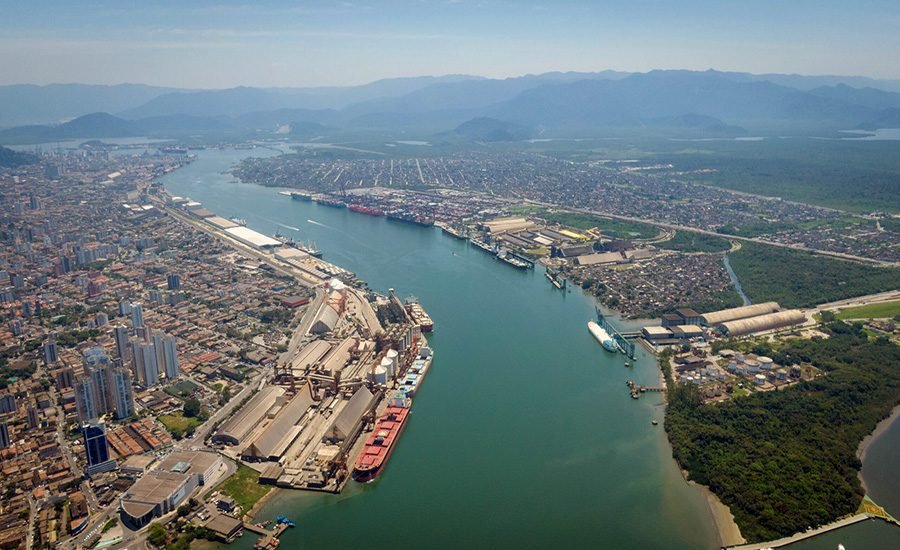
The state of São Paulo announced a public-private partnership with Portugal-based Mota-Engil to build Brazil’s first submerged tunnel, launching construction of a fixed link between the coastal cities of Santos and Guarujá and moving an approximately $1.2 billion transportation megaproject into execution.
The Santos-Guarujá Tunnel, an 870m undersea passage under the harbor channel serving the port of Santos, will be delivered under a 30-year P3 covering design, construction, operation and maintenance.
RELATED
Experts share progress, obstacles in New York region’s multibillion-dollar infrastructure spending
“What was impossible and expected for 100 years, we will make possible,” Rafael Benini, secretary of investment associations of São Paulo, said in a statement after the signing. Benini said the project is now moving into design, with construction slated to begin next year.
According to the contract, the tunnel will have three traffic lanes in each direction, with a dedicated walkway for pedestrians and cyclists, as well as a service gallery for services and systems. State officials estimate the crossing will cut travel time between Santos and Guarujá to less than five minutes, compared to journeys of up to an hour by road or ferry, which are often affected by port traffic and weather conditions.
The submerged tunnel method concentrates the risk of marine construction
Although submerged tunnels are common in Europe and Asia, they are relatively rare in the rest of the world compared to bored tunnels or bridges. This is mainly due to the complexity of marine construction, with risks related to dredging accuracy, control of buoyancy during immersion and the tolerances required to ensure watertight joints.

A project map shows the planned alignment of the submerged Santos–Guarujá tunnel and the approach roads under the port channel connecting the cities of Santos and Guarujá, including connections to the surrounding urban and port infrastructure.
Map courtesy of the Government of São Paulo
State planners have said the submerged tunnel approach was selected to avoid navigational conflicts, height restrictions and surface disruptions that a bridge or bored tunnel would have created within the Port of Santos corridor.
The Santos–Guarujá project will require extensive dredging under an active navigation channel, the construction of a dry dock for the prefabrication of massive concrete elements, and highly sequenced immersion and assembly operations coordinated with port activity. The works will be carried out under the access channel to the Port of Santos, and require coordination with vessel traffic and ongoing port operations during construction.
According to the delivery plan outlined by the state, the tunnel will be built from a series of large reinforced concrete elements fabricated in a purpose-built dry dock, sealed and rigged before being floated into position, sunk into a prepared trench and connected underwater.
Once aligned, the elements will be joined by watertight seals, after which the structure will be filled and protected, locking in the final geometry before installation of the internal systems begins.
Unlike bored tunnels, where alignment corrections can be made incrementally, submerged tunnel installation allows for limited opportunities for adjustment once submersion begins, placing a premium on initial engineering, marine surveying and construction sequencing.
P3 extends the engineering focus to operations
Beyond the structural works, the engineering scope of the project extends to the long-term operational systems integrated within the service gallery, including ventilation, drainage, fire and safety systems, energy and communications infrastructure, and continuous structural and environmental monitoring.
As the PPP includes construction with three decades of operation and maintenance, officials said the systems will be designed for durability, access and maintenance over the term of the concession.
Mota-Engil won the concession in a September 2025 auction, offering a 0.5% discount on the maximum annual public payment. The project includes approximately $971 million in public contributions, split equally between the São Paulo state government and the federal government, according to project documents.
São Paulo Governor Tarcísio de Freitas said the signing marks a turning point for a project that has stalled repeatedly over the past century.
“The land connection between Santos and Guarujá is a dream that has been going on for a hundred years and is finally becoming a reality,” he said in statements released by the state. He added that the tunnel is expected to be completed and open to traffic in 2031.
RELATED
Acquisition begins in 2026 for the $12.6 million Dublin MetroLink rail line
The project has already obtained a preliminary environmental license from the environmental agency of the state of São Paulo, Cetesb, and is entering detailed design and preparatory work. The review assessed impacts on mangroves, flora and fauna, noise and required expropriations, and sets out conditions to be addressed during post-licensing.
The execution schedule released by the state shows that 2026 will focus on design and related studies, with construction expected to begin in 2027 with site mobilization, dry dock construction and initial dredging.
Precast concrete elements of the tunnel are planned for 2028, followed by immersion and assembly in 2029. Installation, testing and commissioning of the systems is planned for 2030 before commercial operation the following year.
The concession also includes road works in both Santos and Guarujá to integrate the new crossing into dense urban traffic networks on both sides of the canal, with the supervision of São Paulo’s transport regulatory agency, Artesp.
State officials estimate the project will generate about 9,000 direct and indirect jobs while easing congestion in the Baixada Santista region and improving access to port-related employment and logistics corridors.
Benini said the immediate next step is to define the manufacturing site for the concrete tunnel module. “The signing of the contract is a decisive step to make this project a reality, with direct gains for mobility, logistics and the population’s quality of life,” he said.
