

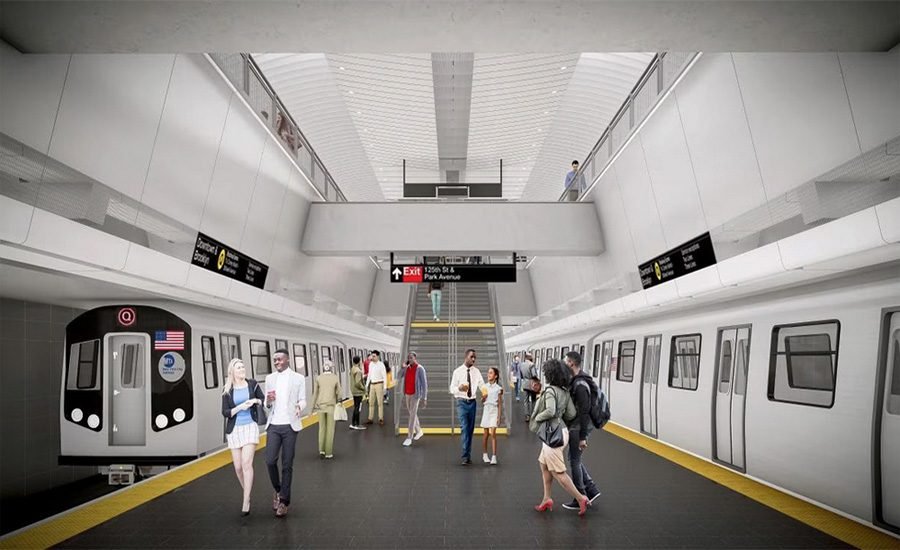
As the Metropolitan Transportation Authority finalizes the first construction plans for Phase 2 of the Second Avenue subway, decisions being made now could determine whether a future westward extension is built under 125th Street.
That question has taken on new weight after Gov. Kathy Hochul’s State of the State address on Jan. 13, delivered as the administration began putting together its next multiyear budget and capital priorities.
RELATED
COWI to Lead Design on MTA’s $1.97 Million Second Avenue Subway Extension
The governor proposed funding in the 2026 executive budget to advance design and preliminary engineering to extend the Second Avenue line west across 125th Street to Broadway, a policy direction that coincides with a reduced decision window in Phase 2.
Timing Matters: Although Phase 2 has not yet entered the tunnel, it has gone ahead of schedule. Utilities relocation is underway, the main tunnel contract has been awarded, and terminal configuration and construction sequencing are being finalized ahead of heavy civil works expected to extend in 2026. Tunnel boring is not expected to begin until 2027, leaving a limited window to preserve future optionality.
Phase 2 will extend Q train service north from 96th Street to 125th Street and Lexington Avenue, adding stations at 106th, 116th and 125th streets. The project is scheduled to enter revenue service in September 2032, according to MTA project documents.
Hochul said New Yorkers “deserve a world-class transit system,” framing the proposed design funding for a 125th Street extension as a way to build on existing investments while planning for construction of Phase 2 is underway. The administration has not committed to capital funding for construction, but the proposal moves the corridor from long-term planning to short-term design consideration.
Where phase 2 decisions become irreversible
Any westward extension along 125th Street would have to connect directly to the Phase 2 terminal while keeping the subway’s operating grades within tight tolerances.
The feasibility study identifies several high-risk interfaces, including the configuration of the tailway and crossing at the 125th Street terminus, the preservation of structural provisions for future westbound engagement, and the retention of ancillary and assembly parcels that could support the launch, recovery, or construction of the tunnel station west of Lexington Avenue.

A map from the Metropolitan Transportation Authority’s December 2025 125th Street Subway Feasibility Study outlines the study area for a proposed westward extension from the Second Avenue Subway Phase 2 Terminal, highlighting potential stations, major institutions, and key Harlem destinations along 125th Street.
Map courtesy of the Metropolitan Transport Authority
These limitations are compounded by subsurface conditions. Geotechnical investigations found that much of 125th Street consists of mixed terrain, with loose sand and gravel layered with clay and silt, while groundwater is typically 10 feet to 20 feet below grade.
The depth of the bedrock varies sharply, descending from less than 100 feet below the surface east of St. Nicholas to over 200 feet west near Broadway.
According to the MTA’s 125th Street Subway Feasibility Study, these mixed-face conditions, combined with shallow groundwater and extremely tight settlement tolerances under a dense urban corridor, make conventional drill-and-blast tunnels impractical for most of the alignment. Instead, the study advances mixed-face and pressure tunnel boring machines as the benchmark approach, citing their ability to maintain face pressure, control groundwater intrusion, and limit surface settlement above utilities, existing subway infrastructure, and building foundations.
For the construction of the station, the study foresees that the large underground caverns of Lenox Avenue, St. Nicholas and Broadway would be dug into unstable, water-logged soils, often over deep bedrock. It identifies the extensive use of soil freezing, grouting, and localized dewatering to stabilize soils, control inflows, and manage settlement during excavation and lining.
To manage construction risk throughout the corridor, the MTA evaluated multiple tunneling scenarios, including one- and two-TBM approaches launched from the east near Second Avenue or from new staging sites west of Broadway.
RELATED
AECOM-HNTB Team Wins $186 Million Contract to Manage New York’s Second Avenue Subway Extension
Several options would reuse deployed TBMs for Phase 2, potentially reducing capital costs but increasing schedule interdependence, while others would operate independently at the expense of additional staging, relocation of utilities, and traffic management complexity.
At the planning level, the feasibility study puts a full three-station extension of the city under 125th Street in the range of roughly $5 billion to $7 billion, depending on alignment length, station configuration and construction approach.
The agency cautions that the estimate is intended for comparative analysis rather than budgeting and would be substantially refined during environmental review and preliminary engineering.

A longitudinal profile from the MTA’s December 2025 125th Street Subway Feasibility Study shows the alignment of the proposed westbound tunnel under 125th Street and its required geometric linkage to the Second Avenue Subway Phase 2 terminus, illustrating how grades, station depths, and bedrock conditions limit future extension options.
Section profile courtesy of the Metropolitan Transport Authority
The planning-level analysis also found that the Broadway terminal option offered the best cost-benefit performance due to higher ridership, greater travel time savings and the greatest reduction in vehicle miles traveled.
The user model projects approximately 163,900 average weekday trips by 2045 in the three-station scenario, substantially outperforming the one- and two-station alternatives and maximizing connections with existing north-south metro lines.
MTA President and CEO Janno Lieber said Hochul “continues to step up to make sure the MTA can continue to fix, improve and expand our incredible transit system,” noting the agency’s alignment with advanced design work as construction planning for Phase 2 is underway.
The feasibility study does not recommend expansion. No environmental review has been initiated, no funding has been identified and no delivery schedule has been established. Moving the project forward would require formal environmental scoping, inclusion in a future MTA capital program, and identification of dedicated funding sources.
Instead, the study’s central conclusion is conditional: that Phase 2 decisions being finalized now, well before tunnel boring begins, will materially influence whether a 125th Street subway remains viable in the future.
The next turning points won’t come with an innovation, but with how Phase 2 progresses. Signs to watch for include whether the terminal geometry retains a westbound connection, whether auxiliary and staging sites remain available, whether TBM demobilization plans allow reuse, and whether the MTA initiates formal environmental scoping for a 125th Street alignment.
Absent those steps, the study suggests the window to integrate a future expansion could shrink rapidly as Phase 2 construction progresses.
