

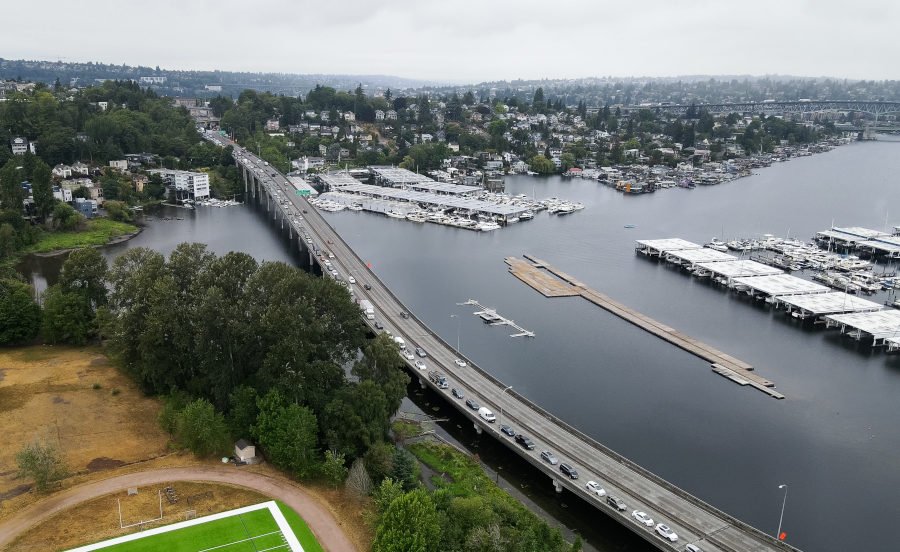
Last month, the Washington State Department of Transportation (WSDOT) awarded Skanska the $1.4 billion reconstruction of Seattle’s Portage Bay Bridge to meet current earthquake resilience standards.
Skanska’s design-build agreement with WSDOT includes replacing the aging Portage Bay Bridge and building a landscaped cap over the freeway that will connect the Roanoke Park and North Capitol Hill neighborhoods. The agency expects construction to begin later this year and be completed by 2030.
“Skanska is excited to deliver this critical piece of infrastructure,” said James Bailey, executive vice president of West Coast operations for Skanska USA Civil, noting that the bridge replacement is “an important piece of broader improvements on the SR 520 corridor, one of the busiest in the Puget Sound region.”
The project is part of WSDOT’s $5.69 billion SR 520 HOV and Replacement Program that will rebuild the entire corridor from Interstate 405 in Bellevue to I-5 in Seattle when completed in 2032. The of the Portage Bay Bridge will complete the program’s transit and HOV improvements. between Redmond and Seattle.
The four-lane bridge over Portage Bay, which was built in the 1960s, is supported only by hollow concrete columns, making it vulnerable to collapse in a major earthquake. It will be replaced by two parallel bridges, seismically stronger. The bridge’s eastbound span will extend the SR 520 regional bike and pedestrian route across the bay, connecting to Seattle’s non-motorized trail network.
Two bids were received for the project last summer, with Skanska’s $1.73 billion bid determined to be the best value in September. The company’s bid was about 72 percent higher than the state engineer’s estimate and $300 million lower than that of rival Kiewit/Stacy and Witbeck.
Because of the funding gap, the state was initially unable to award the contract. But Skanska agreed to extend the expiry date and was awarded the contract on 11 March.
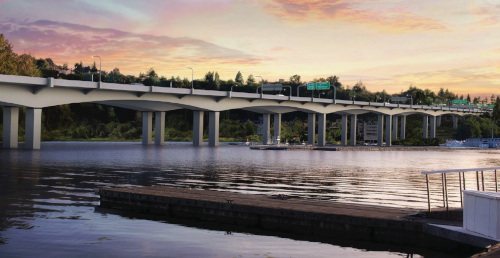
The reconstruction of the Portage Bay Bridge is scheduled for completion in 2030.
Rendering courtesy of WSDOT
Amid a state budget crisis, that shortfall prompted lawmakers to direct WSDOT to “pursue opportunities for consequential cost reductions through value engineering and prioritizing the functionality and usability of the Portage Bay Bridge and Roanoke Cap.” , with a report on closing the funding gap due to the legislature. in mid-December.
“This process will allow us to reduce some costs and mitigate potential future cost risks (e.g., escalation and inflation),” said Shoshana Wineburg, WSDOT spokeswoman.
He added that the value engineering process “will evaluate all elements of the project, including the bicycle and pedestrian elements, and determine where we can maintain function and also reduce cost, time and risk.”
WSDOT has reportedly looked at several cost-cutting options, including only building the twin Portage Bay bridges and leaving the Roanoke cap until later, building just the north bridge, and building the south bridge and cap later , and just replace the north bridge. and then pausing the entire project.
However, Wineburg said any improvements “will not eliminate key parts of the project’s goal: to replace vulnerable bridges, improve safety, improve regional mobility and provide new and better options for non-motorized travel.”
“The cap is an important element of the scope and purpose of the project and will not be removed from the project,” he added.
