


Office of architecture and engineering Skidmore, Owings & Merrill (SOM) and energy storage technology firm Energy Vault have announced a partnership to further develop gravity-based energy storage.
As the lead designer of numerous supertall towers around the world, SOM sees a natural fit with Energy Vault’s vertically oriented energy storage solutions, which use the inverters and turbine-spinning principles of the ‘hydroelectric energy pumped and the energy recovered from the rapid lowering of weights. Excess potential energy comes from the basic equation of potential energy equal to gravity times mass times height.
Current Energy Vault demonstration projects in Italy and China can lift and hold 30-ton masses that, when quickly lowered, convert that potential energy into kinetic energy. Today’s Energy Vault G-VAULT gravity-based energy storage systems take advantage of renewable energy generation, including wind and solar, to power the lifting of heavy composite blocks to store energy. The lowering of the blocks turns the turbines to generate electricity, which can be produced when needed.
Systems being developed with SOM will use the same approach, but involve the rapid transfer of water to turn turbines for finer control.
SOM will be the exclusive architect and structural engineer for the next generation of fixed frames and deployable structures for all new Energy Vault Gravity Energy Storage Systems (GESS). SOM will work on a new family of GESS for Energy Vault that includes:
-
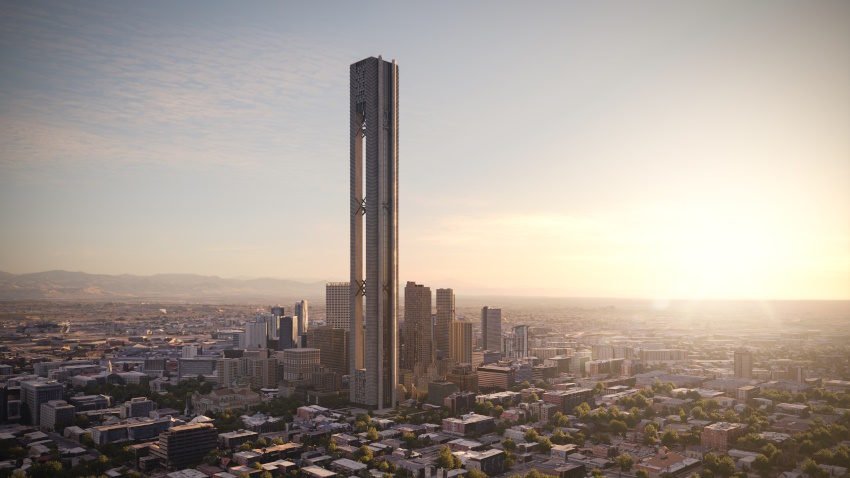
EVu: A technology for the design of superstructure towers that integrates a GESS in void spaces within tall buildings from more than 300 m up to 1,000 m. These GESS structures will have the ability to achieve several GWh of gravity-based energy storage to power not only the building itself, but also adjacent buildings. The companies say that carbon recovery from this type of structure could be achieved within a time frame of three to four years.
-
EVc: Large-scale pumped hydro energy storage systems to be integrated within tall buildings using a modular water-based system. Primarily a stand-alone GESS, EVc designs could also be integrated into tall buildings that form the basis of the EVu design. SOM says a cylindrical shape would be an optimized design for the structure, to better withstand wind and seismic events.
-
EVy: Uses Energy Vault’s gravity-based energy storage technology on pre-existing natural slopes and topography to store energy with minimal environmental impact and capital expenditure for reduce or eliminate the need for more complex artificial structures.
-
EV0: A pumped hydraulic energy storage system without problems related to concrete production or additional disruption to existing ecosystems. These modular systems will leverage a fabric vessel (a “water tree”) to store water in manufactured modules that can be deployed while leveraging pump-turbine and bore-tube designs for existing pumped hydro systems, such as the sites of existing hydroelectric dams or similar locations. .
“The partnership we’ve agreed to is one where we would be their architect and engineer for these new structures,” says Adam Semel, managing partner of SOM in Chicago. He adds that SOM is also willing to partner with other companies it identifies in parts of the world where it does not have an office on energy storage projects as it does on its building and infrastructure projects.
For gravity-based systems of composite blocks, Energy Vault says it plans to use only wind and solar to lift the blocks and claims it will have more than 80% round-trip efficiency. Energy Vault software will monitor, manage and optimize assets such as blocks and the motors and pulleys that lift them.
William Baker, SOM consulting partner and structural engineering pioneer whose innovations include the bundled tubes of the Willis Tower, says the availability of renewable energy, particularly solar but also wind, makes such systems viable as network storage.
“You have a storage facility up in the sky and another storage facility at the base, and you’re moving weights when the sun is shining and you have more solar power than you need.”
Delivering power when it’s not available from solar or wind generation will help fill off-peak gaps to run generators and power microgrids, Baker says.
Many of Evu’s structures would need to be dedicated structures, designed solely to provide power to microgrids and other nearby buildings as needed, Baker notes. But the technology could also be integrated into a building such as an office or residential tower.
Semel says SOM sees promise in the development of the Energy Vault technology.
“I think they will continue to evolve the technology to become more and more efficient. The commitment … is to unlock the potential of gravity, to store energy, renewable energy, at scale.” he said
He adds that SOM is considering using the systems in its own high-rise projects.
“We’re having some of those conversations now, it just has to be the right context, the right place and the right customer. We’re talking to some of them now about those ideas,” he said.
