

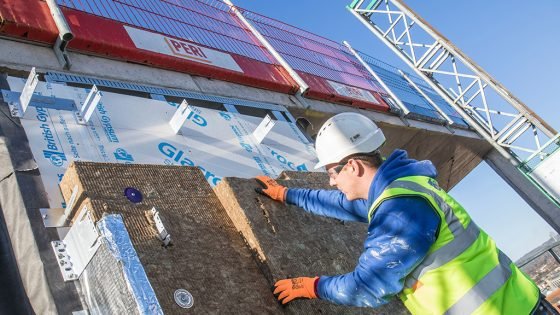
By Kelly Westwood, Head of Construction Projects at Knauf Insulation
Rainscreen facade systems are a popular choice for mid-rise and high-rise developments. But specifying insulation for these systems can be complex, especially when you factor in changing legislation and greater scrutiny of product choice.
Regulation change
The Building Safety Act applies to all residential buildings, although it is focusing on higher-risk buildings that have two residential units and are more than seven stories or 18 meters tall. It introduces three new gateways which act as ‘checkpoints’ to assess compliance with building regulations and requires the creation of the ‘golden thread of information’ to show how the highest risk residential buildings were designed and built elevated
Parts B and L in England and Wales have also been updated, with much stricter fire safety and thermal performance requirements. As well as an energy efficiency improvement, every new home must also have a Building Regulations England Part L (BREL) report which records the original plans, specification changes and photographs of insulation after installation.
The most important takeaway from these legislative updates is that the construction and performance of the finished building must not only comply with building regulations, but must also reflect its design.
Focused on fire safety
When specifying insulation for rain screen facade systems, always start with fire safety. This is because the materials you use must meet the strict non-combustibility requirements of Part B in England and Wales.
This was updated in December 2022 when the definition of relevant residential buildings was expanded. The ban on using combustible materials on exterior walls has also been extended to include certain constructions, such as rain-proof facade systems, of residential buildings between 11 and 18 metres. This means that materials with fire reaction classification Euroclass A1 or A2,s1-d0 must be used. The only exception is where a full-scale fire test has been carried out to BS 8414-1 and -2.
Therefore, to minimize the risk, the simplest solution is to choose a non-combustible mineral wool lining and SFS insulation, such as our Rocksilk.® RainScreen Slab and OmniFit® Slab, for every project, regardless of the height or use of the building.
Request U-value calculations in 3D
The next consideration is the thermal performance of the stack. Updates to Part L in England mean that new residential buildings must produce 31% less carbon emissions compared to 2013 standards.
But meeting the U-value on paper is not the only consideration. They must also deliver it in practice, which can be affected by the type of calculation used.
The most common method, simplified or 2D calculations, is best suited for simple accumulations with few variables. They are not recommended for rain screen facade systems because they apply a blanket correction factor that does not accurately account for metal supports.
Instead, contractors should insist on numerical modeling or 3D U-value calculations. These calculations provide the most accurate representation of the thermal performance of the finished building because the methodology considers the complex interaction between the insulation, the facade and the rail and support system.
Specifiers should also request an in-depth report so that the entire supply chain can see which components have been included in the calculation. This means they will understand how changes to the specification can affect it, helping to safeguard the design and giving specifiers confidence that the finished building will deliver the required performance.
The move to real performance is driven by legislation and brings greater control over the specification and use of building products. By focusing on fire safety and insisting on 3D U-value calculations, specifiers can help ensure that their choice of insulation meets and that the performance of the finished building matches their design.

For more information, visit our website
