

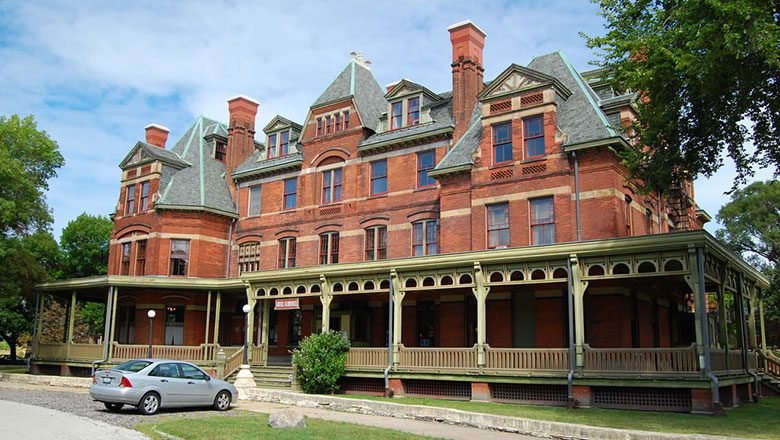

A team has been selected for a $104 million project to renovate the historic 1881-era Hotel Florence on Chicago’s Southside, along with its annex, portions of the Pullman Car Works building and surrounding grounds.
The project is slated to convert the long-vacant landmark, described by Preservation Chicago as a “red brick colossus,” into a boutique hotel, dining destination and cultural and performing arts center.
The team includes contractor Skender Construction, architect Farr Associates, historic preservation consultant Ramsey Historic Consultants, landscape architect Site Design Group, civil engineer TERRA Engineering and Wiss, Janey, Elster Associates, which will handle the engineering and building envelope.
The private investment led by Chicago-based developer Celadon Construction Corp. is providing $83.6 million in initial investment, and the state, which owns the property, is investing $21 million. Additional private capital commitments are expected over the life of a 75-year agreement to ensure long-term preservation and operations, the state says.
The brick and limestone Queen Anne-style Hotel Florence is located in a larger area of Chicago’s South Side, which is experiencing an investment boom. As part of the Pullman neighborhood, it would be served by the extension of the Red Line planned by the Chicago Transit Authority (CTA). The hotel is also about five miles south of the new 440-acre Illinois Quantum and Microelectronics Park (IQMP), which is currently under development.
According to the state, the partnership between Celadon and the Illinois Department of Natural Resources (IDNR) is the first major public-private partnership undertaken by the department. Additional private capital commitments are expected over the life of a 75-year agreement to ensure long-term preservation and operations, the state says.
With a combination of public and private resources, “We are preserving an irreplaceable historic site while driving economic growth,” IDNR Director Natalie Phelps Finnie said in a news release.
Looking for quick answers on construction and engineering topics?
Try Ask ENR, our new intelligent AI search tool.
Ask ENR →
The hotel was built by railroad manufacturer George Pullman and named after his daughter. It was designed by architect Solon S. Beman. The Pullman district is notable for its influence on urban planning and design, as well as its role in American labor history, including the Pullman strike and boycott of 1894. Pullman was also home to the Brotherhood of Sleeping Car Porters, the first black union recognized by a major American corporation, and played a defining role in shaping worker protections across the country, according to the state.
Farr Associates president Mercedes Miley says the project will present several challenges, including mismatched floor levels and building circulation, accessibility issues and the large amount of historic elements to document.
He says these challenges will be addressed early in the design process with an integrated design workshop that will bring together all parties, including financing, design, construction, use and maintenance of the buildings.
“This hands-on workshop provides an opportunity for the team’s knowledge and prior experience to shape the project during its formative stage, stimulating innovation and a building uniquely suited to the client and the context,” he says.
He adds that his company has previously worked Wiss, Janney, Elstner Associates and Site Design Group, and each has also worked on other Pullman building and grounds projects that will allow them to “bring their banking knowledge to this project.”
“We thrive on oddball questions like where to fit an 82-tonne train car or replicate historic cabinet details,” he says.
Celadon CEO Scott Henry is committed to incorporating local community input into the project.
“Public engagement is part of our DNA. Pullman residents and stakeholders will be central to this project from design to operation. It’s about building with the community, not just in it,” he said in a news release.
According to the state, the restored Hotel Florence will help fill a significant hospitality gap, attract new visitors and support local restaurants, businesses and cultural institutions and strengthen economic opportunity in an underserved community.
