

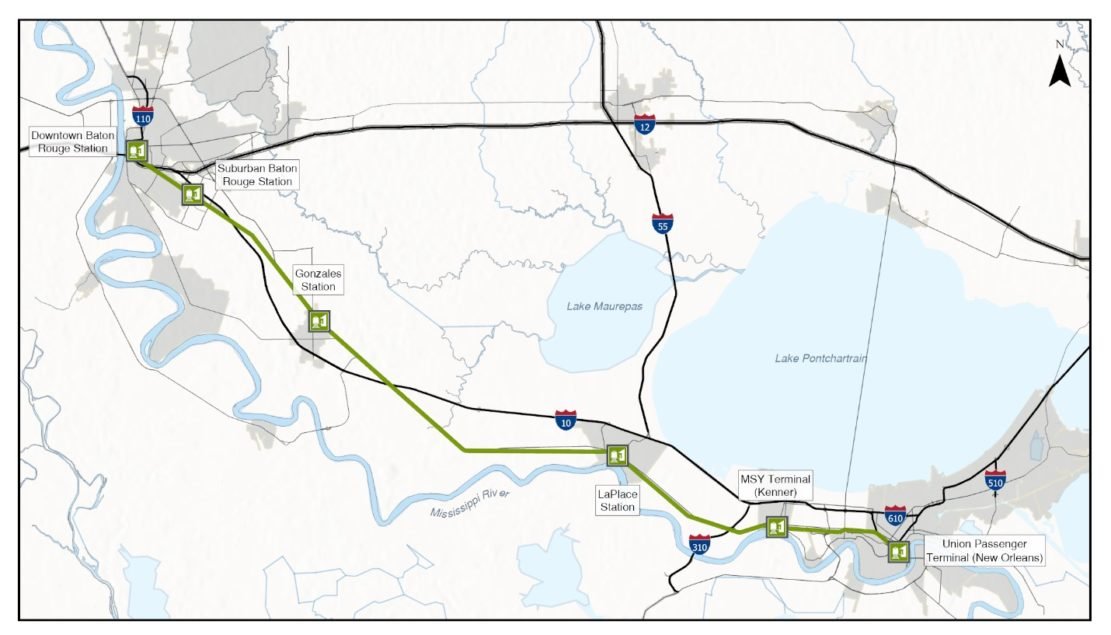
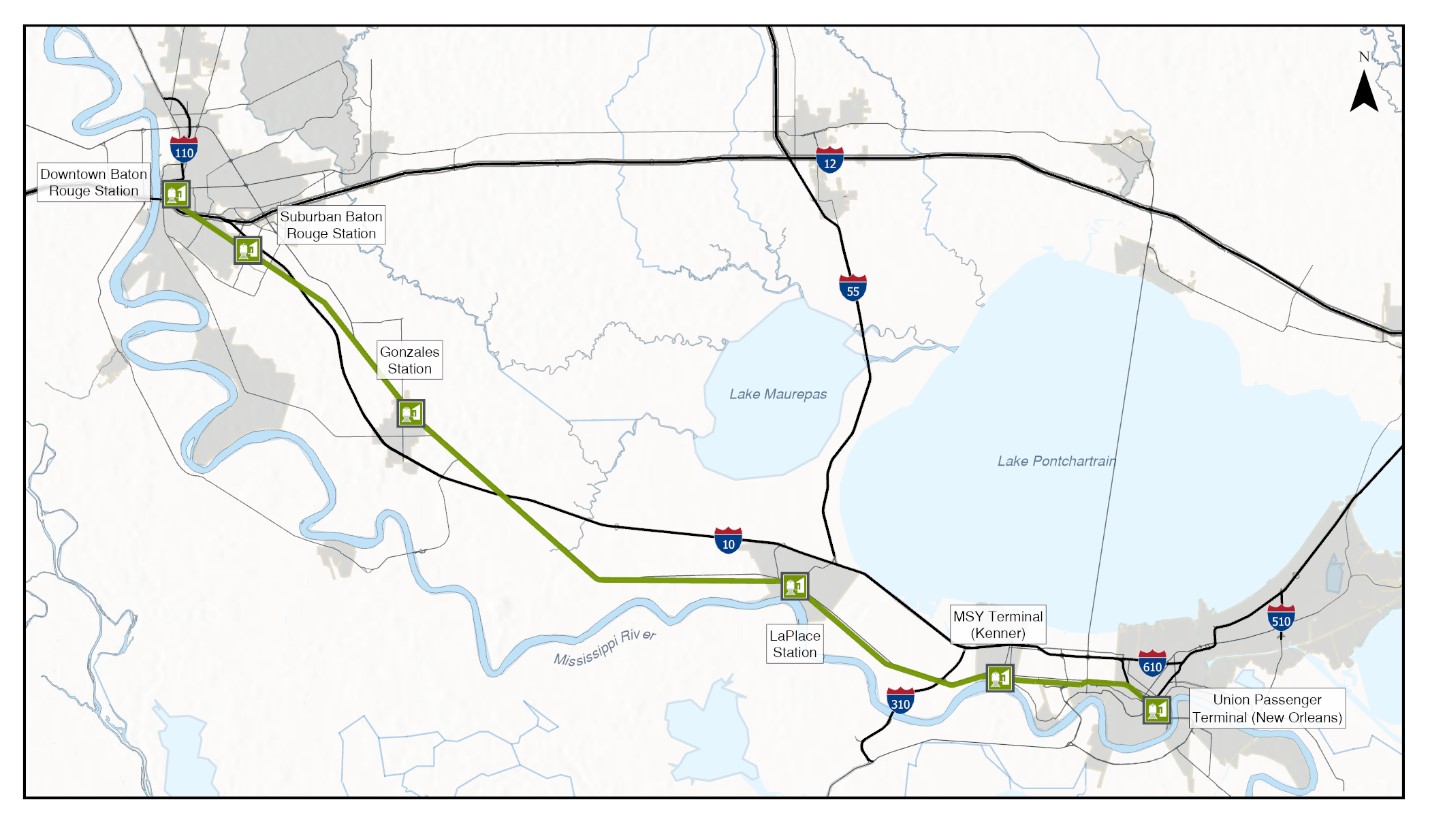
Rail service connecting Baton Rouge and New Orleans, La., has been talked about for decades. But now, after lobbying from the Southern Rail Commission (SRC) for regional rail coverage of the Gulf Coast, that talk has begun to shift toward real commitments.
Before leaving office, former Louisiana Gov. John Bel Edwards (D) signed into law Act 764, which allowed the state’s Department of Transportation and Development to outline the scope, time and budget to obtain approval and secure permits to implement rail service between Baton Rouge and New. Orleans. Now the State is moving forward with this exploratory work. With a focus on applying for grants and other funding sources, the Baton Rouge-New Orleans (BR-NOLA) Interurban Passenger Rail Feasibility Study was conducted to identify a path forward in implementing the project
Before the service can be implemented, the improvements must be completed. The track and the structures that make up the entire route must be improved to prepare for tourism use. Level crossings and signaling will also require improvements. Bridges and culverts along the route should be assessed to measure integrity and initiate improvements. In addition to reworking the existing infrastructure, new stations and platforms will need to be built.
The total cost of the project has yet to be determined. Additional elements will include planning and environmental mitigation, and the operational costs of the rail service have yet to be identified.
According to the study, a 2010 assessment indicated that nearly $20 million in funding would be needed for mainline subsurface stabilization, embankment and subsurface stabilization of the liner extensions. Rehabilitation of the main bridge would monopolize most of the expenses at approximately $120 million and an additional $1.3 million to replace other structures.
Envisioning multiple improvement projects to prepare the existing railroad, the recently completed study identified tracks, structures and grade crossings as the primary infrastructure components in need of attention. The current track structure includes mainline wooden ties 7 inches by 9 inches by 8.5 inches and spaced 19.5 inches on center. The corridor between Baton Rouge and New Orleans includes approximately 53 bridge structures, most of which consist of an open deck design over timbers, chords, curves, and piers.
The route connecting Baton Rouge and New Orleans includes a rail section that crosses the Bonnet Carre Spillway, and preparing that section would be a major part of the project. Its existing 1.8 miles of 20-foot open deck steel is not designed to support passenger rail.
According to the study, attention will be required to multiple aspects of the overflow rail crossing. Approximately 36% of the wooden piles and 51% of the dock covers would need to be replaced. Dean Goodell, director of rail and freight for LaDOTD, noted the need to replace the spillway’s existing rail crossing with a new concrete structure.
“This will be the biggest of the required improvements,” Goodell said.
While the required permits are being evaluated, preparations are being made for the bidding process. Starting with one trip per day, the departure point and time of the initial service have yet to be determined.
“The initial service will start with a round trip per day during a trial period. At the end of this trial period, if everything works properly, a round trip per day will be introduced,” he said. said Goodell.
Before leaving office in early January, Edwards met with Amtrak CEO Stephen Gardner and Louisiana Transportation Secretary Eric Kalivoda to sign an agreement and push the project forward. The potential date to bring the service online is expected to be 2027.
“Commuter rail will provide a low-cost alternative to driving between cities along the route,” Goodell said. “Employees can continue to be productive on their mobile phones and laptops while on the train.”
