

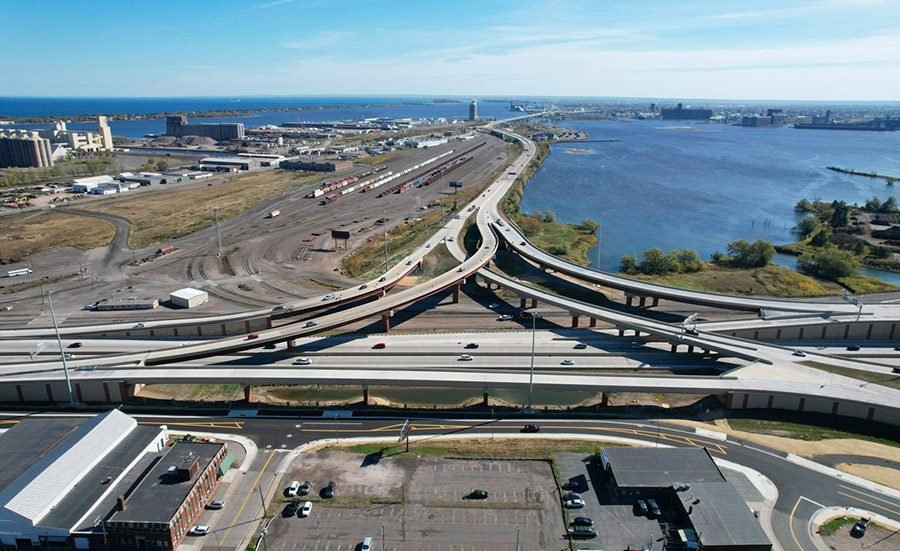

A half-billion dollar, five-year project to rebuild the Interstate 35 and Interstate 535/US Highway 53 interchange in the heart of Duluth, Minnesota, commonly known as the “Can of Worms” for its complexity, is now substantially complete and officially open to traffic. The interchange is part of a major maritime and industrial hub that includes Superior, Wis.
Project construction manager/general contractor Kraemer North America, who worked in partnership with Ames Construction, called the project “Minnesota’s largest progressive development CM/GC project.”
The work included a new design, relocating all exits and entrances along one side of the roadway, eliminating merge conflicts and fabric issues near the interchange, and lane continuity for I-35 traffic.
“Complex traffic management and innovative phasing were needed to eliminate blind merges and left exits and improve freight movement at the aging interchange known as the Can of Worms,” Kraemer North America says on its website. “It reduced the number of load-restricted bridges while using ground improvement techniques to build the interstate on an elevated fill section. The project featured restricted right-of-way corridors, multiple railroad crossings and 18 bridges.”
“Kraemer’s team maximized winter work, including bridge removal, piling and Miller Creek substructure and culvert construction, so earthmoving, concrete pours and paving could begin during the summer months,” the company added.
The interchange carries around 80,000 vehicles daily, including an average of 5,320 heavy commercial vehicles. It provides a first and last mile connection to the public terminal at Clure, an intermodal facility with freight connections by road, rail and waterway.
“The can of worms is officially no longer a thing, something to be celebrated,” Duluth Mayor Roger J. Reinert said at a ribbon cutting in October.
Reinert said the Duluth area is experiencing an increase in manufacturing and infrastructure is needed to support that growth.
“Manufacturing relies on connecting rail, road and airports, and the Twin Ports are the only true port in the state of Minnesota,” added Reinert, who calls it the largest port by tonnage in the Great Lakes.
“These multimodal transportation connections matter not only for our convenience but for our economy,” he said.
“For the last seven years we’ve been a part of this project and for a year before that,” said Ben Levin of Ames Construction. “Before, we were working to get our team together and decide how to approach the project and win it. These eight years of investment have turned into a project that is unlike most other projects – the way the team has come together, the procurement team, our subcontractors and MnDOT. [Minnesota Dept. of Transportation] people, it’s something really unique.”
MnDOT will now turn its attention to replacing the existing Blatnik Bridge, which opened in 1961 and carries I-535/US 53 over Bay St. Louis between Duluth and Superior, Wisconsin. The bridge is nearing the end of its useful life and, without a replacement, is slated to close in 2030, according to the Wisconsin Department of Transportation.
A contractor has not yet been selected for the $1.8 billion bridge replacement, which will be built over the existing alignment and include a pedestrian/bike path. Construction is expected to begin in late 2026.
