

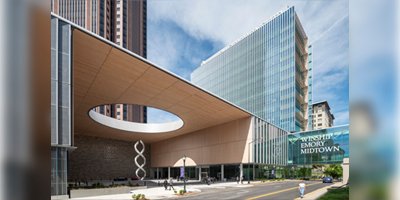
The new Winship Cancer Institute at Emory University in Atlanta, the only National Cancer Institute (NCI)-designated comprehensive cancer center in Georgia, has been designed with the patient experience in mind, resulting in a design and an organization “never before seen or imagined.” of hospital spaces.
the goal
In 2018, stakeholders Emory Healthcare and Emory University’s Winship Cancer Institute embarked on a quest for the unseen and unimagined cancer care center. His vision was to revolutionize the treatment of cancer patients, challenging conventional hospital design practices, seeking to fundamentally change the way cancer patients are cared for. Simultaneously, for architects Skidmore, Owings & Merrill (SOM) and May Architecture, this project presented an opportunity to redefine the role of architecture in healthcare.
the model
Located in Atlanta’s Midtown neighborhood, the hospital’s new 17-story building is 41,800 m.2 (450,000 square meters). Drawing on SOM’s experience in various architectural typologies, the project was guided by principles that sought to minimize or eliminate patient waiting times, rather than focusing solely on creating impressive waiting rooms.
The architecture challenged the traditional floor organization found in hospitals, which typically involves moving patients throughout the building. Additionally, at street level, Winship at Emory Midtown was designed to enhance the public realm, deviating from the typical stand-alone facility approach.
At the heart of this change lies the organization of the floors, which was developed through a process involving more than 160 stakeholders, including Winship leadership, patients, physicians, volunteers, hospital staff and the construction team Together, they determined how to organize the medical facility from the patient’s perspective.
Using scaled cardboard models representing different clinics and services, SOM introduced a new concept: a medical facility structured not around teams and departments, but rather composed of “care communities,” each focused on a specific cancer.
This model is well suited for cancer treatment, as cancer patients require frequent visits.
Care communities
Care communities create smaller, more efficient, supportive units that address specific patient needs. Each care community functions as a miniature hospital within a hospital, integrating inpatient units, outpatient clinics, infusion services, diagnostics and procedure spaces. These communities are connected by two-story community lobbies, facilitating interactions and ensuring that specialists can visit both inpatients and outpatients without leaving their designated floors.
In contrast, many conventional urban medical facilities follow a “block and stack” arrangement, with inpatient departments placed above diagnostic services, which are stacked on top of outpatient departments. However, this cancer center took a different approach to completely reinvent the building type. By creating communities within the centre, patients and families who are going through similar experiences come together, ensuring that no one feels isolated. In addition, specialists can easily visit both inpatients and outpatients without having to leave the two floors.
The disposition
SOM and May Architecture turned the traditional hospital floor on its head. Instead of the typical grid layout with windowless exam rooms and segregated clinical offices, the design team inverted this layout. They placed wide, well-lit corridors along the perimeter, while exam rooms and clinical spaces were placed in the center of the floor. These day-lit spaces and generous common areas deviated from the norm seen in medical facilities. This approach also extended to workspaces, where clinicians benefit from an efficient, centralized design that promotes collaboration. These spaces, which also serve for clinical research, contribute to the development and sustainability of Winship Cancer Institute’s unique oncology programs by attracting and retaining faculty, staff, and trainees while fostering engagement.
The architectural structure of the facility, a rectangular tower, was informed by the duplex care communities. The exterior design features two-story facade increments that create a welcoming staircase along Peachtree Street, an Atlanta landmark. Two-story lobbies at either end of the care communities enhance the building’s aesthetics, incorporating wood ceilings and floors that extend outward, contrasting the taut, high-performance glass and steel facade with natural materials
The outside
A two-level pedestrian bridge connects the new cancer care center to the existing Emory hospital complex. Supported by a steel truss with geometry optimized using research tools developed by SOM, the bridge was prefabricated and installed on the street over a weekend. Emory Hospital became the first beneficiary of this unique truss design.
The ground floor of the tower has a transparent storefront that connects to the street. The visitor’s journey begins with a dignified garage door, where valet service is offered. This outdoor space, protected by an impressive roof with an oculus that offers views of the sky, creates games of light and shadows at the entrance of the building. Set back from the street, the drop-off area provides easy access to the building and parking for patients.
Inspired by the principles of hospitality design, the porta cochera gives access to the main lobby, a double-height space adorned with marble and wood finishes, which allows access to all areas of the building. The lobby connects patients and visitors with a simplified centralized check-in process reminiscent of hotel check-in, with clear visibility of each destination from anywhere in the lobby.
The amenities
The building offers a comprehensive and holistic approach to patient care, evident through various amenities that go beyond medical treatment. These amenities include a retail store, a pharmacy, a wellness center, a coffee shop, and multipurpose spaces for activities such as yoga, music, education, and art. Many of these new additions offer patients, staff and visitors spaces to relax within the vibrant urban environment. Informal living areas, with natural materials, are integrated throughout the building.
In addition, the lower roof houses an elevated garden, which serves as a peaceful and biophilic urban sanctuary for lounging, dining and events.
Sustainability objectives
Through a holistic design approach to energy efficiency, the building aims to reduce energy consumption by nearly 40 percent, compared to the average hospital in Atlanta. It is expected to achieve a predicted energy use intensity (pEUI) of 136 kBtu per m2 (sf) per year, which is a 32 percent improvement over typical US hospitals, which average 220 kBtu per m2 (sf) per year.
The high-performance facade optimizes glass and window-to-wall ratios, while the building incorporates energy-efficient mechanical equipment, including chilled beams and direct outdoor air units with recovery capability.
Water use is minimized by collecting and reusing rainwater for irrigation and cooling plants. Inside the building, emphasis is placed on natural light, views and thermal comfort, creating an environment conducive to recovery. The use of low-volatile organic compound (VOC) materials further contributes to a high-quality indoor environment, and the project is seeking Leadership in Energy and Environmental Design (LEED) silver certification.
