

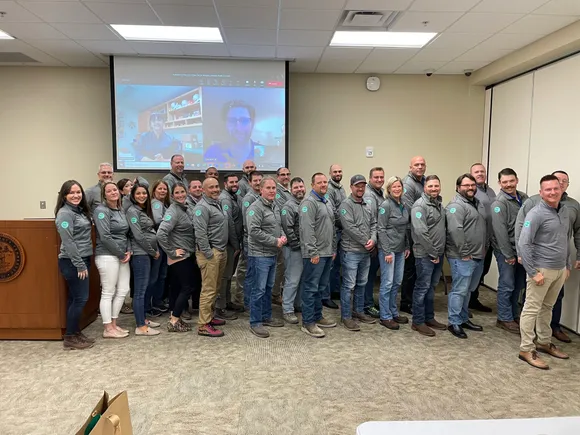
Chris Hopper said his leadership in mental health education began in 2018, when a colleague gave an emotional speech at an event about losing his father to suicide.
Knowing that the construction industry has a high suicide rate, Hopper, executive vice president and general manager of Indiana, Ohio, Kentucky and Tennessee for Skanska USA, partnered with the Lindner Center of Hope. The Ohio-based mental health facility helped Hopper implement the Start the Conversation program, in an attempt to de-stigmatize sensitive topics in the workplace.
Hopper launched Start the Conversation in Nashville, Tenn., before also trying the Green sticker programa method of identifying leaders in the workplace who are trained to provide emotional support through an indicator on their hat, which Skanska piloted in the UK.
Here, Hopper talks to Construction Dive about the effectiveness of these programs, real-life success stories, and how the industry’s view on the issue has evolved.
The following has been edited for brevity and clarity.
Immersion in CONSTRUCTION: Have you seen progress around mental health in the workplace culture?
Chris Hopper: Yes, I would say so. The Start the Conversation program was a first for us. That was mainly to educate our people to talk to your family, find out if there is a family history of mental illness and what those family members did to deal with it or overcome it.
That’s really where we started to destigmatize it, right? Make people feel comfortable talking about it. I think there is a statistic that a large majority of people are still not comfortable with. Some 70% of employees responded to a survey saying they would not discuss mental health issues with co-workers because of shame and stigma. Internally, we wanted to make it so people feel comfortable doing it.

Chris Hopper
Permission granted by Skanska USA
It wasn’t just about affecting the people at Skanska. Much of our work is done through subcontractors, so we started posting signs at work sites with phone numbers and websites where people could get help for substance abuse or stress or whatever. We do orientations for all workers who come to our projects, so we put some statistics on the slide table and educated our subcontractors so they could feel free to talk about it.
And the Green Sticker program – we had a specific instance in Nashville where one of the masons on one of our projects approached one of our assistant superintendents because he was having issues with his mental health. I needed help. And because our assistant superintendent had been trained in green tag, he was able to get help from that person. And the person got that help and then came back to the project a few weeks later and thanked him very much.
I think what we’re doing is making a difference, and I’m seeing improvements in our workplaces and hopefully within the industry as a whole.
Are younger workers more open about these issues?
I mean, we hope so, right? That was the intention of our programs, to make people feel more comfortable around them. And really, I think it’s the language that we’re using. Before people just talked about “mental illness”. But then the phrase “mental health” came up. “Mental illness” seems like a negative thing. “Mental health” is obviously a positive thing.
Simple things like that, having the right phrases and ways that people can talk about it more freely, I think it’s helpful. And if you see people in leadership positions open up and talk about it, I think that allows new people coming in to feel comfortable sharing their own stories.
I think that’s all we can do – just make sure people feel comfortable.
How has the feedback from industry partners been?
There’s a really good example: When we started putting up the job site signage and putting up the orientation slides, an owner of one of our general contractors came forward and shared with me a story about how his son he had tried to kill himself. Fortunately, he was unsuccessful and is healthy today, but he said, “How can we partner on this? How can we help you with this?”
So it’s gratifying for me to know that our subcontractor partners want to dive in here with us and help us and talk to their workforce about the same things.
How would you encourage other contractors, especially smaller companies, to think about mental health at work?
Well, it’s EHS, right? Environment, health and safety. Everyone focuses a lot on the security part, because you have to. There are OSHA requirements, everyone must train their employees. But I think the environmental health piece of EHS sometimes gets lost.
These smaller contractors are still responsible for the safety training of their employees. Regardless of the size of your company, you need to train your employees. So if you interweave health with safety, I think they’re symbiotic and can play into the same conversation. If you’re training someone on scaffolding safety or fall protection or anything else, you can include the mental health piece at the same time, in the same training.
There’s a phrase I’ve heard recently that I’ve been sharing: “If you don’t make time for your wellness, you’ll be forced to make time for your illness.” And that really resonated with me, so I’ve been trying to use that kind of to encourage people to take time to take mental health breaks and whatever they need to stay healthy.
