

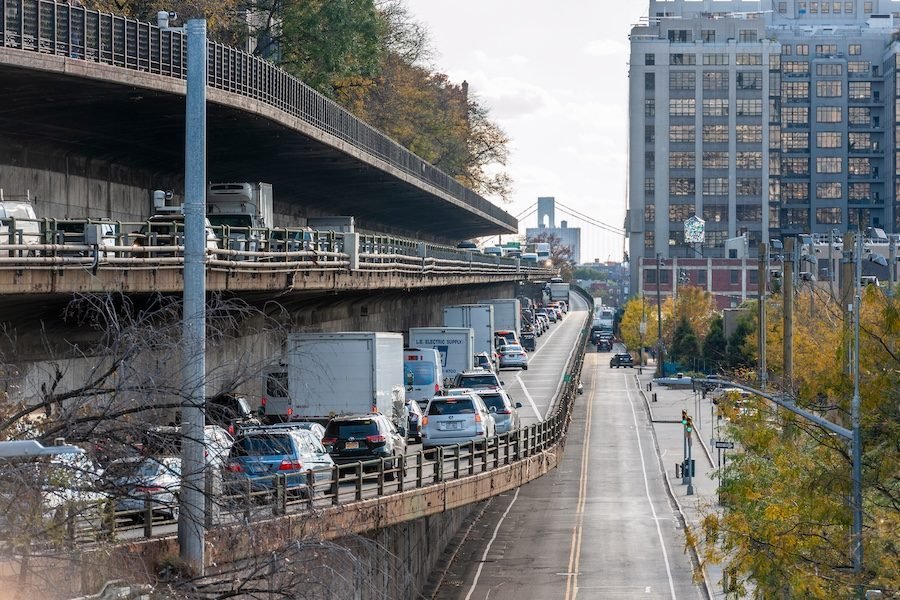
New York City’s Brooklyn-Queens Expressway (BQE) serves as a test bed for better addressing the national problem of overweight trucks, which contribute to wear and tear on roads and bridges and increase maintenance and repair costs.
A C2 Smart studio found that overweight vehicles in New Jersey were responsible for 63% of the cost of truck damage to bridges and pavement assessed. The Federal Highway Administration is leading a research program on truck size and weight develop tools to assess impacts at the national level.
From They weighed 400 million trucks by portable and fixed platforms or weigh-in-motion (WIM) sensors in the US in 2021, 300,000 received an overweight violation. These tickets were the result of a cumbersome and inefficient process: space to set up a scale, a police officer to pull the vehicles over, and a scale operator to weigh them, even in cases where the WIM sensors were initially used to identify violations.
“For any urban environment … to be able to pull a truck [and] to put [it] on a portable scale, it’s very labor-intensive and takes up a lot of space,” says Tanvi Pandya, executive director of the New York City Department of Transportation’s bridge division.
Pandya is an advocate of direct enforcement of weight limits, a legal enforcement mechanism that relies only on WIM sensors: no roadside scales for initial or secondary weight, no police officer to issue a ticket. Direct application through WIM is recommended by the World Road Association (PAIRC) among other organizations and agencies.
In 2023, armed with weight data from a federal research grant and the state’s permission, New York City became the first and only municipality in the country authorized to use direct enforcement for limits on weight, applying the technology and process to the city-owned tract. of the BQE, an 11.7-mile partially elevated road connecting Brooklyn and Queens.
“We have to be able to enforce,” Pandya says, “and we have to design [infrastructure] to a known load rather than guessing based on codes.”
New York leads the way
Overweight trucks are accelerating the structural deterioration of the BQE, parts of which are more than 85 years old, according to the NYCDOT. This is for two reasons: the current legal load of 80,000 pounds per vehicle is higher than the 1940s design load of 72,000 pounds per vehicle.
In 2019, with a federal research grant, NYCDOT began working with Professor Hani Nassif and his team at Rutgers University and C2 SMARTERto analyze the data from the WIM sensors installed on the BQE and understand the magnitude of the problem.
“We had a lot of anecdotal evidence [but] actually, because it’s so difficult to enforce weight limits in New York City or any other urban environment … we knew there was more weight to the structure” than had previously been quantified, Pandya says.
The results did not surprise Pandya. Ten percent of truck traffic weighed over the legal limit, some by more than 115,000 pounds. They found that the site-specific load was 22% higher than what they would get if trucks followed the limits for the BQE direction in Staten Island, and 30% higher in the Queens direction.
Weight data were collected using quartz sensors made by Kistler, a company that invented WIM sensors in the late 1990s, according to JT Kirkpatrick, Kistler’s director of sales for Traffic Solutions in North America. He says the quartz censor is “the ideal product to use to weigh a vehicle going 100 miles per hour…[it] gives you an instant accurate voltage reading.

When the data revealed how many vehicles were over the weight limits, the NYCDOT sounded the alarm to the city.
“The mayor at the time issued an executive directive, reminding everyone of the legal weight,” says Pandya. “We also let people know even if you have one [overweight] permission, you are not allowed in this section because you are too overweight for this structural capacity.
But the warning was not enough. NYCDOT needed a way to use WIM technology to enforce the law, and there was no way to do it.
“Because there is no established national standard for high-speed WIM systems, New York City was unable to use them through existing law enforcement,” says Kirkpatrick, who has been involved in the campaign to standardize WIM censors.
In 2021, the New York State Legislature authorized NYCDOT to conduct automatic enforcement of overweight vehicles on portions of the BQE, providing a temporary legislative basis for enforcing BQE weight limits.
In August 2023, the NYCDOT began to 90 day notice period for trucks on the Queensbound BQE. Using roadside sensors to detect vehicle weight and documentation through cameras, the NYCDOT issued warnings to drivers. The number of Queens-bound overweight trucks on the BQE’s triple overhang dropped 55 percent between the first and last weeks of the notice period: 344 notices to 153.
Pandya says that based on this data alone, it’s hard to tell whether drivers are simply reorienting, rather than reducing, their weight. “But they are certainly avoiding that section of the BQE, which is what we need.”
After the 90-day notice period, ticketing began in the Queensbound direction and overweight trucks were subject to a $650 fine for violating the weight limit. During the implementation period, from November 2023 to May 2024, there was a 64 percent reduction in overweight vehicles along the triple overhang of the Brooklyn Queens Freeway, according to a statement by NYCDOT. The proportion of overweight trucks fell from about 6.3% of all trucks on the road to 1.9% in recent months.
“We’re hoping that the more we can make the app 24/7 and do that [in] the more places, the more beneficial it will be to fulfill [drivers]” says Pandya. “And so we don’t have this uneven playing field where the truckers who are actually compliant are losing out in the current system [in which] whoever is willing to take advantage of the opportunity is likely to make a profit.”
There’s also a public safety benefit to discouraging overweight trucks, Pandya says, because heavier trucks take longer to stop. And reducing overweight vehicles can be reduced the impacts of tire wear on respiratory health in communities near roads.
The New York DOT plans to launch the direct app for Staten Island-bound traffic later this year.
Scaling up
The BQE is not the only road where WIM sensors are used: 84% of reported violations in 2022 nationally were measured using WIM scales. But in other municipalities, the standard protocol is for a censor to spot an overloaded truck, and a photo of the truck is uploaded to a website and an officer retrieves it somewhere along the road, Kirkpatrick says. The officer then pulls the truck over and weighs it again, as required by law, because standards for WIM scales have not yet been established.
In order to qualify for direct enforcement, New York City had to come up with standards from scratch—defining the scale’s calibration technique, how often it should be calibrated, and test, and more—and incorporate the standards into state law. It is a heavy effort for most municipalities.
Beginning in 2021, Pandya, Kirkpatrick, and others began advocating nationally to amend the National Institute of Standards and Technology (NIST) Manual 44 to include standardization and specifications for WIM sensors.
“By setting a national standard in the Weights and Measures Council, which is led by the Department of Agriculture … any other state that wants to legislate direct enforcement just has to refer to the national standard,” says Kirkpatrick.
On July 17, at the National Weights and Measures Conference, representatives voted on a proposal which would allow the use of mobile weighing vehicle scales for direct law enforcement, but the proposal did not pass.
According to NIST weights and measures coordinator Loren Minnich, opponents claimed that the proposed test procedures for the sensors were extensive and cited a lack of funding, personnel and time needed to carry out the test procedures.
But the NYCDOT intends to continue the conversation nationally.
“We will continue to advocate for national standards related to this technology to be updated for the benefit of other cities and states that maintain the infrastructure,” NYCDOT Commissioner Ydanis Rodriguez said in a statement to ENR.
