

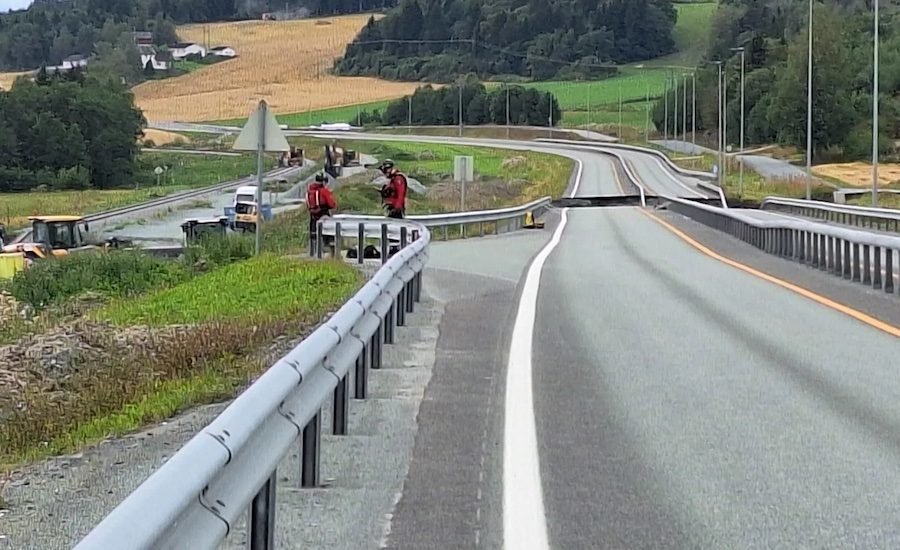
An investigation has concluded that ground stabilization work inadvertently triggered a landslide that killed a man who was part of a crew operating a deep cement mixing platform for a railway project in Levanger, Norway, on August 30, 2025.
Engineers hired by rail operator Bane NOR to investigate the incident determined that more extensive monitoring would be needed to detect the risk early.
Witnesses reported hearing scraping and grinding noises coming from beneath the platform for about three minutes before the floor began to slide, and workers had completed installing their 29th morning column in the area, out of 90 to be installed, just one minute before the landslide. They shut down the platform and moved to leave the area, but the only man, identified only as a man in his 30s employed by the Danish engineering company Niras, was trapped in the slide. It took almost two weeks for his body to recover.
The slide displaced more than 72,000 cubic meters of material, according to the report prepared by Norwegian engineering firm Dr.techn. Olav Olsen AS. In addition to killing the worker, more than 550 feet of the existing railway line and 320 feet of the neighboring E6 highway were destroyed when the material slid into nearby Lake Nevastnet.
The report takes a closer look at cement slurry injection
The project was planned to add a 3,126-foot-long crossing lining to the railroad, improve two grade crossings and replace four culverts. Soil stabilization was necessary due to the quick clay in the area, which is prone to liquefaction.
The columns were formed by injecting a cement slurry and mixing it with ground material as part of the deep cement mixing process. The research engineers found that the process weakened the altered clay before the columns could heal. The injection process also caused pressure to quickly build up in the layer of permeable sand and silt about 20 feet below the surface, displacing water faster than the quick clay could drain it. The material, already weakened, failed under the added stress.
 Image courtesy of Dr techn Olav Olsen AS
According to the report, the initial failure of the clay block occurred in the area directly under and around the platform at the eastern end of the site, sliding south toward the lake. This then caused further southward and westward movement of the initial fault, which in turn removed support for the uplift zones containing the freeway. The freeway also collapsed and pushed the initial block into the lake bed.
Looking for quick answers on construction and engineering topics?
Try Ask ENR, our new intelligent AI search tool.
Ask ENR →
Quick clay is relatively common in Norway, but is also found in parts of North America and elsewhere. In the United States, quick clay was involved in a 1964 landslide in Anchorage, Alaska, triggered by a large earthquake.
 Image courtesy of Dr techn Olav Olsen AS
In this case, the permeable layer had been detected in boreholes during pre-work geotechnical investigations, but had not been fully mapped. Doing that, along with placing pore pressure monitors in that layer instead of just in the clay, and monitoring them in real time, could have helped identify the risk, the report said. The authors recommended mapping these layers thoroughly as standard practice in future deep cement mixing work and placing pressure monitors in these permeable layers.
Gunhild Hernes Synnestvedt, Bane NOR’s executive vice president of compliance and safety, said in a statement that the railroad hopes the findings will lead to improvements in the industry that prevent similar incidents in the future.
While the investigation by Bane NOR engineers is complete, the incident is also being investigated by the police and the Norwegian Labor Inspection Authority. Niras, the company that employed the man killed in the landslide, expressed its condolences in a statement and said it is helping police with their investigation.
