

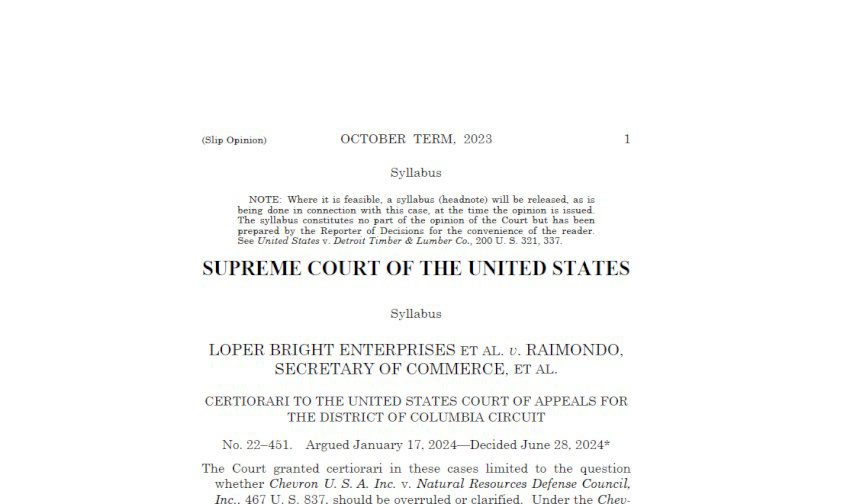

The United States Supreme Court ruled on June 28, in a 6-3 decision, that Chevron vs. Natural Resources Defense Council—the 1984 ruling that allowed federal agencies to interpret laws on everything from environmental protection to labor and trade issues is unconstitutional and returned that power to federal and state judicial authorities.
“Chevron cannot reconcile with the [1946] Administrative Procedure Act assuming that statutory ambiguities are implied delegations to agencies,” Chief Justice John Roberts said. Loper Bright Enterprises vs Raimondo. “This presumption falls short of reality. A statutory ambiguity does not necessarily reflect Congress’ intent that an agency, as opposed to a court, resolve the resulting interpretive question.”
The decision comes in a case brought by the owner of a family-run herring fishing business, which challenged a rule by the U.S. Commerce Department’s National Marine Fisheries Service, but has broader implications for the framework than federal agencies have used for 40 years to reach decisions on issues affecting many areas of environmental, construction, labor and other regulations.
Environmental groups criticized the decision, with many pointing out that it was overturned Chevron opens many settled federal oversight issues to judicial reviews that would dull processes for everything from environmental review to project feasibility studies.
“This is a profound and terrible change,” the National Resources Defense Council said in a statement. “It’s part of this court’s broad and concerted effort to make it difficult for our government to function.”
“We are still assessing the impacts of the decision,” said Brian Turmail, vice president of public affairs and labor for the Associated General Contractors of America. “However, it will certainly put more pressure on Congress to clarify intent when crafting new laws. It will also encourage agencies to heed the statute more closely than they have done in recent years, which AGC of America has long advocated.”
The six justices who concurred in the ruling cited an existing ambiguity: Roberts and Justices Clarence Thomas, Samuel Alito, Neil Gorsuch, Amy Coney Barrett and Brett Kavenaugh. It’s that deference to the interpretation of what any federal law means for the executive branch agencies that won the last presidential election creates what Gorsuch argued was an ever-changing regulatory environment based on elections rather than written law.
Citing the Marbury v. Madison ruling as precedent, Gorsuch wrote in his concurring opinion that “applying Chevron deference, the justices began to defer to the views of executive agency officials about the meaning of federal statutes. Over time, the error of this approach was widely appreciated.” He stated that … Chevron deference rests on a “fictitious statement of legislative intent,” that is, a judicial assumption that Congress implicitly intends judges to defer to executive agencies’ interpretations of the law until and all when he hasn’t said anything about it. “
Justices Elena Kagan, Ketanji Brown Jackson and Sonia Sotomayor dissented from the ruling.
A major change in regulatory authority
The Associated Builders and Contractors of America, a group whose members are mostly non-union contractors, and the Center for a Democratic Workplace filed a brief friend in the case, he celebrated the decision, saying in a statement: “The Supreme Court has rightly recognized this Chevron Deference gave too much authority to federal agencies. Agencies such as the National Labor Relations Board have taken advantage of this decision to interpret their statutes in a radical and expansive way never intended by Congress. He also maintains that “Chevron it allowed the Board to engage in incessant back-and-forth on issues with each change of administration, resulting in unmanageable uncertainty for the employer community. The court’s new decision “will lead to more reasonable policies on the part of the executive,” he adds.
Ben Jealous, executive director of the Sierra Club, sees the decision as highly consequential for the future of environmental regulation.
“The Supreme Court majority has just affirmed a power grab that will give unelected judges more room to indulge their own political preferences and to override the considered judgment of public officials with the scientific and technical knowledge, experience and accountability necessary to protect the public from corporate exploitation,” he said in a statement after the decision was announced. “His decision will jeopardize the federal government’s ability to protect our air, water and health, address the climate crisis, and enact the common-sense guarantees of our basic public interest law.”
