

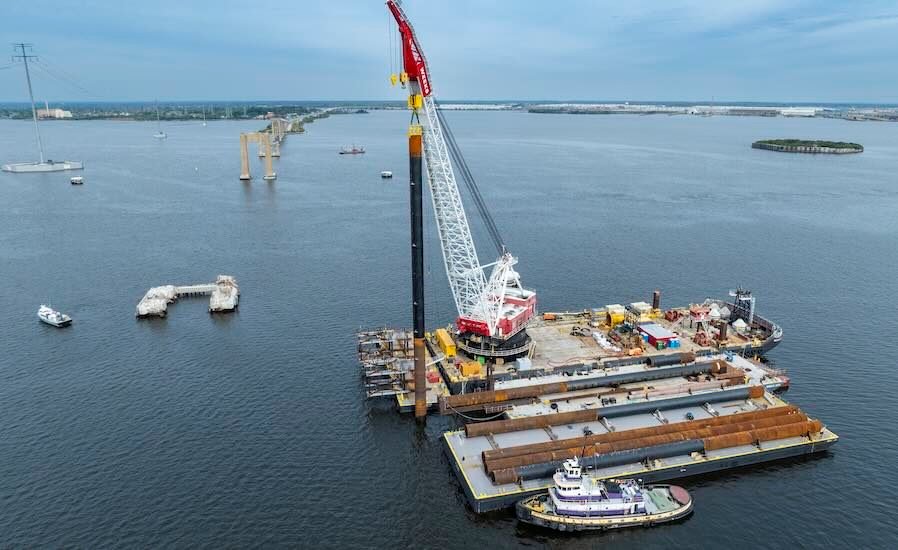

As the last remaining spans of Baltimore’s original Francis Scott Key Bridge are demolished, a test pile program currently underway is helping shape the foundation strategy for its planned successor structure.
Initiated in late September by the Maryland Transportation Authority (MDTA), the program calls for twelve 220- to 235-foot, 8-foot diameter. Test piles to be driven into the Patapsco River along the route of a new two-mile-long cable-stayed structure designed by Kiewit Infrastructure Co. under the $73 million first phase of a progressive design-build contract. Weighing approximately 340,000 pounds each, the test piles are being driven by barge-mounted cranes and hydraulic equipment through the soft top layer approximately 60 feet deep from the riverbed to an underlying bedrock.
Driven by an estimated 10 million pounds of force, test piles are being driven even deeper to determine the optimal depth for the new bridge’s permanent foundation piles, MDTA says. Instrumentation installed on the piles is recording how they respond to vertical and horizontal pressure exerted by a 35×35-foot loading frame. Bubble curtains adjacent to test piles mitigate the effects of pile-lifting activity on marine life.
MDTA expects the testing program to conclude this month. Some of the test piles may be incorporated into the permanent piles, whose installation could begin later this year, according to the agency. Demolition of the remaining river spans of the old bridge is more than half complete, with several structures in the river yet to be removed. The MDTA expects that work to be completed next spring. Earlier this year, the agency announced a change in the alignment of the new bridge to better facilitate simultaneous demolition and new construction activity.
Meanwhile, MDTA reports that the design of the new bridge is about 70 percent complete, about the point the agency previously said it would negotiate a defined and guaranteed maximum price and schedule with Kiewit. Previous reports estimated the new span would cost $1.8 billion, with completion expected in the fall of 2028. MDTA officials have told local media that the agency is moving at “breakneck speed” to replace the original 1.7-mile steel bridge, which collapsed after being struck by the disabled container ship M/VM/V. meeting on November 18 to determine the probable cause of the incident, which killed six construction workers.
Although then-President Joe Biden promised full funding for a key new bridge, the Trump administration has been less receptive to Maryland’s policy of having at least 26 percent ownership by minority-owned, women-owned and veteran-owned companies on contracts of more than $100,000. In a letter to Gov. Wes Moore (D) last September, Transportation Secretary Sean Duffy wrote that hiring decisions based on “race or sex-awareness factors” could introduce significant legal vulnerabilities and inefficiencies in project management, putting federal funding support at risk.
In addition to highlighting the important role the Key Bridge plays in both the state and national economy, Moore promised to continue collaborative efforts “to find ways to reduce costs and rebuild faster.”
Maryland is also pursuing litigation against Dali’s owners and operators for compensation that it says will help offset the cost of building the replacement structure. The first trial date, in which a federal judge will begin the process to determine whether Dalí’s owner, Grace Ocean Private Ltd., can limit its liability for the incident under maritime law, is scheduled for June 2026.
