

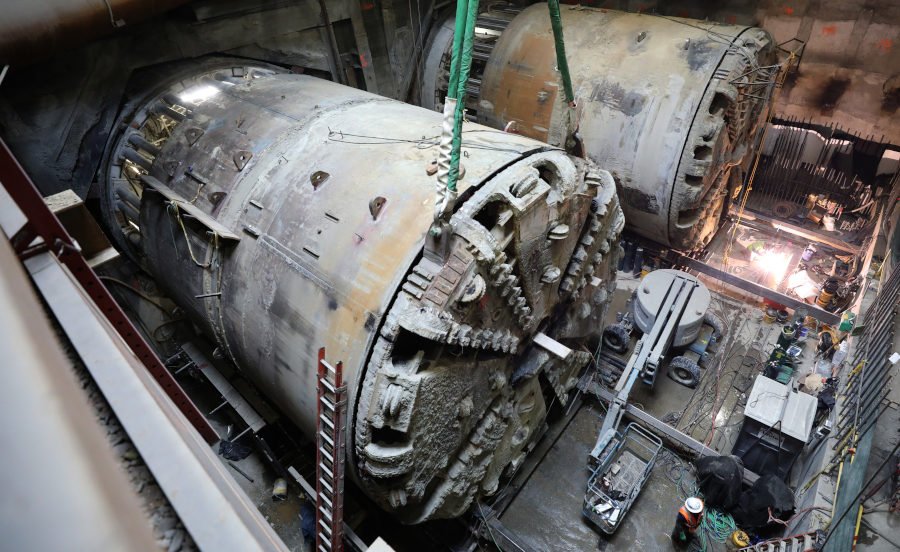
A five-year odyssey under the streets of Los Angeles came to an end when a duo of tunnel-borers named “Aura” and “Iris” reached the end of their journeys earlier this year. Its arrival marked the end of the tunneling of the third and final section of the Los Angeles County Metropolitan Transportation Authority’s (Metro) $9.5 billion D Line subway extension project earlier this year. year.
The nine-mile-long expansion is a step forward in Metro’s plan to build a subway connecting downtown Los Angeles with a new Westwood/VA hospital station.
“The D Line subway extension is one of the most complex engineering feats Metro has ever undertaken,” said Lindsey Horvath, Chairwoman of the LA County Board of Supervisors and Metro Board Member in a ceremony marking the achievement on April 2.
For the tunneling aspect of the project, contractors used Tunnel Boring Machine (TBM) technology to excavate approximately 40-60 feet per day. The 400-foot-long, 21-foot-diameter Herrenknecht earthmoving machines used in Section 3 featured closed-face pressure TBM technology that minimizes soil settlement during excavation.
“This safe completion of the tunnel through this part of Los Angeles is a milestone in Metro’s work to expand fast and reliable public transit throughout the region,” said Karen Bass, Mayor of LA City and Chair of the Metro board at the closing ceremony.
Continuing where the Purple Line currently ends at the Wilshire / Western station in Koreatown, the project will add seven new stations in some of LA’s busiest destinations, including the Miracle Mile, Beverly Hills, Century City and Westwood. When the project is complete, riders will be able to travel between downtown Los Angeles and Westwood in just 25 minutes.
With the tunnel complete, Metro says it will continue to work with its JV contractors, Skanska-Traylor-Shea and Tutor-Perini/O&G, to complete seven new subway stations on Section 1 between Wilshire/Western and Wilshire/La Cienega, Section 2 between Wilshire. /La Cienega and Century City, and section 3 between Century City and Westwood.
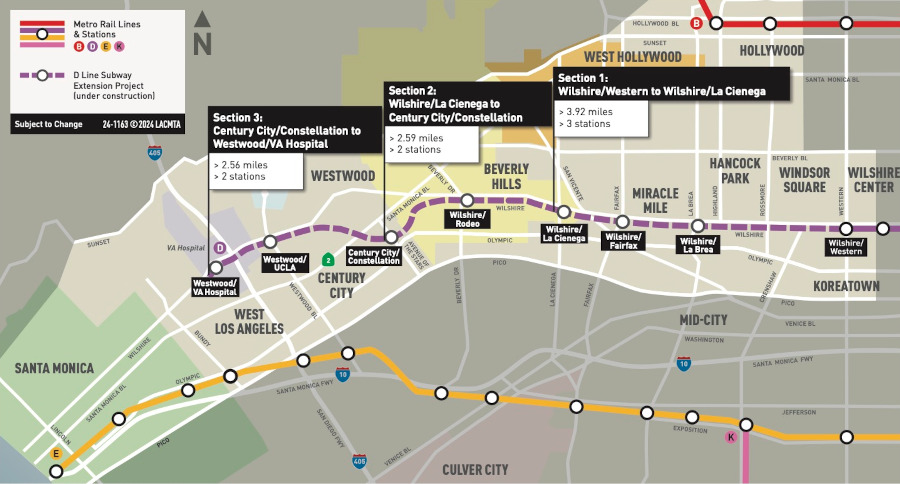
Map courtesy of Metro
- The construction of section 1 is 91% complete. Remaining work includes completing the entrance structure and ancillary activities, as well as continuing with the installation of systems and MEP. This will be followed by systems testing and commissioning operation before the planned opening in 2025.
- Section 2 is 66 percent complete, with remaining work including concrete construction and architectural finishes for the Wilshire Rodeo and Century City Constellation stations, concrete lining of crosswalks, tunnel inversion, routing of roads, system installation and street restoration. This section is expected to open in 2026.
- Currently, the construction of Section 3 is 50% complete, and the remaining work includes the excavation of the finishing station and the construction of two underground stations and tunnel cross passages. The most fascinating part of this project was successfully tunneling under critical infrastructure, major utilities, Interstate 405 and Sepulveda Boulevard. In addition, the PLE 3 project is currently on budget and is expected to open in 2027.
During five years of tunneling, the project faced many technical challenges, including gaseous soils, tar sands and abandoned oil wells. Near the La Brea Tarpits, the TBMs had to travel through tar sands and used horizontal directional drilling to probe the earth so contractors could identify and remove potential objects to project the tunnel machine.
Metro also safely used the same methods to identify and avoid abandoned and unmapped oil wells beneath Beverly Hills High School, Metro officials say, adding that all problems with the school have been resolved. resolved
The project, which “currently operates within the Board-approved budget for all three sections,” secured local funding through the 2008 Measure R and 2016 Measure M voter-approved sales tax measures transportation These local funding sources were matched with federal funding, which ultimately accounted for approximately half of the total cost of the project.
