

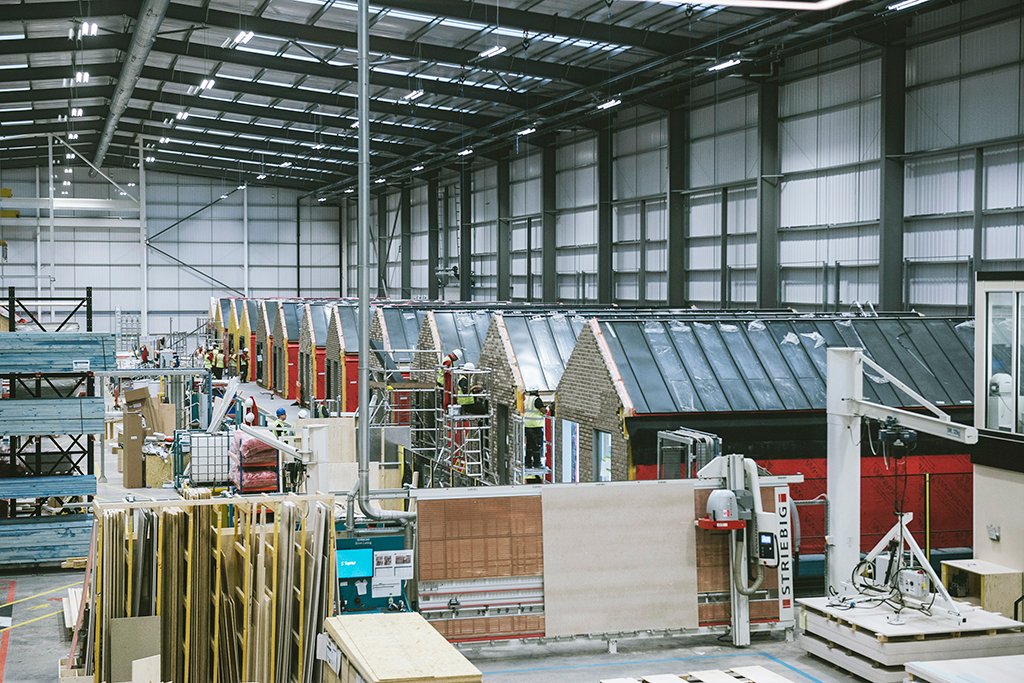
The chairman of modular builder Top Hat has said he is “extremely concerned” about government-backed plans to create a standardized kit of parts for modern methods of construction (MMC).
In May, the Department for Building, Housing and Communities appointed a consortium to create sector standards for modular parts and buildings to remove barriers to innovation and promote wider use of MMC in industry.
But Top Hat chairman Carl Leaver has dismissed the plans, saying: “Government doesn’t build houses, it’s not the customer, so defining design standards, how they’re built, how they’re transported… that’s central . controlled economy – it’s very surprising to be faced with this.”
Speaking before the House of Lords built environment committee on Tuesday (October 24), he added: “We need a vibrant industry, an innovative industry that is able to keep pace and solve problems and look for more opportunities because we have a crisis.”
Leaver also warned there was “zero chance” the government would meet its homebuilding target without modular construction, noting that building homes on this scale had never been achieved before.
He added that the traditional construction sector now faces a chronic shortage of skilled workers.
“Without category 1 modulars (3D structural systems), there is absolutely zero chance of building 300,000 homes in this country, I mean zero,” he told colleagues, referring to the Conservative Party’s 2019 manifesto promise.
“If you look at what’s happening in the labor universe of traditional construction, it’s terrifying,” he added.
Before the global financial crisis, there were 2.6 million construction workers, he said, but now there are 400,000 fewer, and almost a quarter of those who remain are over 55.
“These falls are absolutely devastating for SMEs and contractors,” Leaver said.
“While the major housebuilders were able to recover the volumes they were producing, SME volumes are still half of what they were before the financial crisis because people are just giving up, they’ve had enough.”
Asked by committee chair and Conservative Daniel Moylan why there had been so many failures in the MMC sector, notably the withdrawal of L&G and the collapse of Ilke Homes in June, Leaver said there had been strategic and operational weaknesses in these companies.
Problems included expensive materials and the inability to offer design variations, as well as some MMC companies choosing to develop their own sites, which tied up capital and exposed them to the risks associated with groundworks.
“We can control everything in a factory, but when it gets to the sites, that’s when things can go really wrong,” he said.
All these factors made companies more vulnerable to the difficult economic context, he added.
“When the wheels came off post-Covid and more recently with the downturn, perhaps both companies made decisions to price very tightly to fill their factory, and they didn’t take into account … the period of super-inflation. .. which made the projects that were now committed not profitable”.
The “frankly very slow and somewhat dysfunctional” planning system is an additional barrier for the sector as a whole, he added.
Michael Stirrop, commercial director of Category 2 MMC (2D structural systems) housebuilder and developer Vistry Group, agreed that the system was a major limitation, and implementing the planning process at a local level proved problematic.
“It’s very difficult for us to build standard-shaped houses across the UK in a consistent way,” he said.
“There is no impetus in the planning world to push MMC schemes over traditional brick and mortar… [and ] not enough thought is given to the embedded carbon that is attached to the houses we build with open panels.”
