

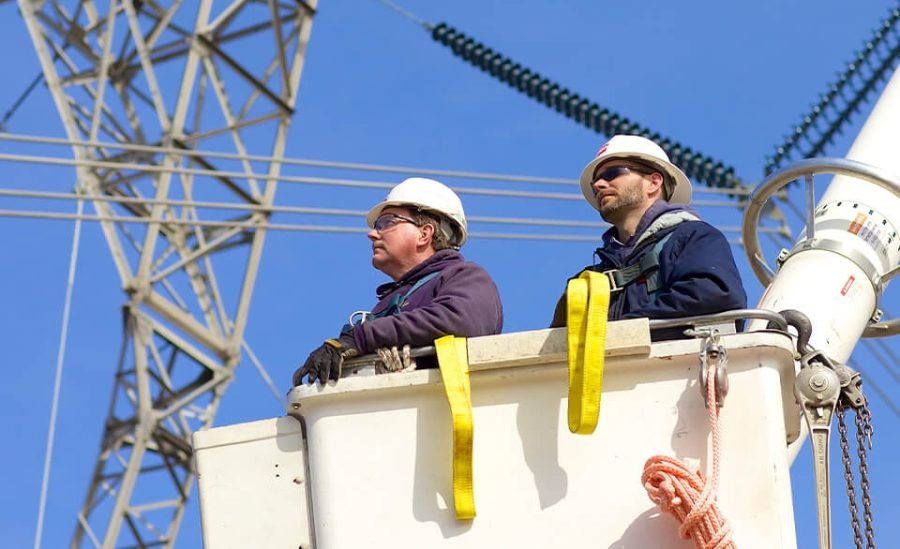

The U.S. Department of Energy has finalized what it said is the Trump administration’s first loan guarantee: $1.6 billion to public utility American Electric Power to support the rewiring and reconstruction of 5,000 miles of high-voltage transmission lines in Indiana, Michigan, Ohio, Oklahoma and West Virginia that carry mostly fossil-fuel power.
The project received conditional funding from the Biden-era department’s Office of Loan Programs in January as part of a $23 billion package offered to eight utilities to support investments in transmission, energy storage, grid and pipeline improvements.
AEP funds won final approval for the now-renamed “Energy Mastery Funding Program,” Energy Secretary Chris Wright said during a media briefing Oct. 15, noting he was “pleased to move forward” to support the work, which is said to bring 1,000 construction jobs.
The conditional loan commitment was announced in January as part of $23 billion in assistance the DOE provided to eight utilities for investments in transmission, energy storage, grid modernization and pipelines.
According to AEP, the total cost of the project in the five states is $3.56 billion.
AEP “is experiencing growth in energy demand not seen in a generation,” said company president Bill Fehrman.
About 2,000 miles of line work in Ohio and 1,400 miles in Oklahoma, costing $1.9 billion and $767.2 million, respectively, are the first and largest projects supported by the loan, according to the company. Contractors will be selected “on a project-by-project basis,” an AEP spokesman said.
“This is a good project,” Energy Secretary Chris Wright told the media. “Not all of them [Biden-era] the projects were nonsense.”
He defended the agency’s cancellation in July of a $4.9 billion Biden-era department loan guarantee to the planned first phase of the Grain Belt Express, a new high-voltage transmission line developed by Invenergy to deliver solar and wind power from Missouri to Indiana.
Wright pointed to the project’s higher cost per mile as a new line, with unclear power buyers. “Ultimately, it’s a commercial enterprise that needs private capital,” he said, also questioning whether the project could meet the strict financial terms of the loan required.
