

This audio is automatically generated. Please let us know if you have any comments.
The great thing about digging yourself out of a hole is that your work on the ground tends to go much more smoothly.
This is where the civil construction giant Tutor Perini is today.
After years resolve disputes over legacy megaprojectshas reduced pending litigation from about 50 cases to 12, executives said Feb. 26 at their Call for results for the fourth quarter and for the year 2025. That helped the Los Angeles-based contractor return to full-year profitability last year.
“We’ve spent a lot of money over the last few years on litigation expenses,” Gary Smalley, the company’s chief executive and chairman, said on an earnings call to discuss the results. “Legal fees are something that of course are necessary in business and certainly in this industry. But I think you’re going to see less and less legal fees from us, and that’s only going to increase profits as well.”
But it’s not just reduced legal fees that are helping the company. Smalley said the company was driving greater profitability across its various segments by negotiating better terms on major jobs.
By the numbers
The company reported a profit of $80.4 million for 2025, reversing a loss of $163.7 million in the previous year. For the fourth quarter, it was also in the black, with net income of $28.8 million compared to a loss of $79.4 million in the year-ago period.
“We had our best year ever in 2025,” Smalley said, noting the firm’s $20.6 billion portfolio at the end of 2025, a 10% increase over the previous year. “With this huge backlog, we are confident in our ability to deliver double-digit revenue and earnings growth and continued strong annual cash flow into 2026 as our newest projects move through design and construction.”
The company’s revenue totaled $5.54 billion for the year, up 28% from 2024. For the fourth quarter, Tutor Perini posted revenue of $1.51 billion, up 41% from the last quarter of 2024.
However, an unfavorable settlement of $54.7 million in a legacy dispute involving a tunnel project in Canada largely offset favorable settlements of $57.6 million through 2025, the company reported.
Better terms
What has really gone well for the company, Smalley said, was getting better contract terms from customers, who have been more willing to negotiate as fewer contractors are bidding on multibillion-dollar megaprojectswhich present a greater risk due to complexity and longevity.
“What we’ve been able to do with the limited competition is work with our customers, our landlords, to push for, you know, better payment terms,” Smalley said. “There’s no harm in delay, especially in New York.”
In that regard, Smalley said the contractor was returning to work on the Manhattan Tunnel portion of the Hudson Tunnel project in New York City, after Federal funding was restored by court order. “We’re back to work after about two weeks of suspension,” he said.
Great prizes
That global bidding environment has helped Tutor Perini win nine of 11 bids on jobs of $1 billion or more in the past three years, Smalley said, for a total of $16 billion.
Smalley listed a slew of 2025 wins that brought $7.4 billion in new prizes to his portfolio last year, including:
- The $1.87 billion Midtown Bus Terminal Replacement Phase 1 project in New York City.
- The aforementioned $1.18 billion Manhattan tunnel project.
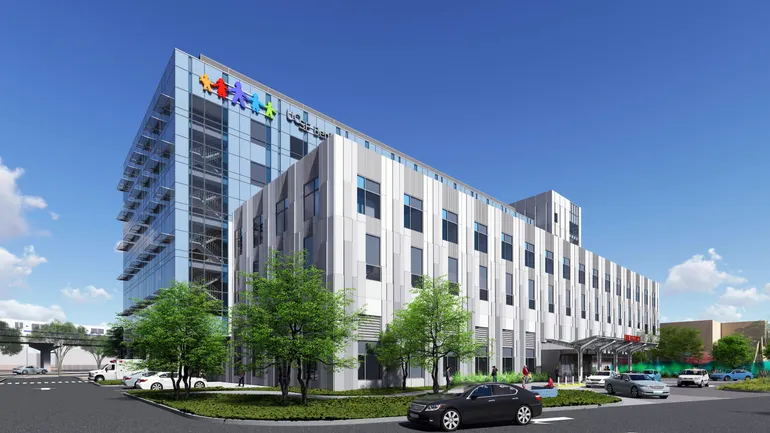
- The roughly $1 billion UCSF Benioff New Children’s Hospital in Oakland, California.
- A $538 million healthcare project in California.
- $241 million in additional funding for the Apra Harbor Shoreline Repairs Project in Guam.
- A $182 million military defense project in Guam.
- The $155 million Diego Rivera Performing Arts Center at City College of San Francisco.
- $131 million in additional funding for a power project in Texas.
- A $100 million-plus electrical project at Cook Children’s Medical Center in Fort Worth, Texas.
He also listed several new tender opportunities the company plans to pursue in the next 12 to 18 months, including:
- A program of approximately 12 billion dollars for the Sepúlveda traffic corridor in southern California.
- The $3.8 billion Southeast Gateway line in Los Angeles.
- The approximately 700 million dollars Extension of the foot of the gold line of the metroalso in Southern California.
- The multi-million dollar Penn Station Transformation project in New York City.
- The $3 billion Newark Liberty International Airport Terminal B project in New Jersey.
- The $1.4 billion I-535 Blatnik Bridge project in Duluth, Minnesota.
- The billion dollar I-69 ORX Section 2 project connecting Indiana and Kentucky.
Smalley said the company was benefiting from a continued focus on infrastructure spending, something that had been lacking in years past.
“For decades and until recently, our country has inadequately funded and prioritized the kinds of substantial infrastructure investments that are being made today,” Smalley said.
However, going forward, Smalley cautioned that Tutor Perini’s backlog could have some “abundance,” due to the timing of awards in mid-2026 and early 2027.
Still, with a positive funding environment, Tutor Perini had the wind at his back, Smalley said, and could afford to be selective about the projects he has to move forward.
“We remain very selective about which opportunities we pursue, with a continued focus on bidding projects with favorable contract terms, limited competition and higher margins,” Smalley said.
