

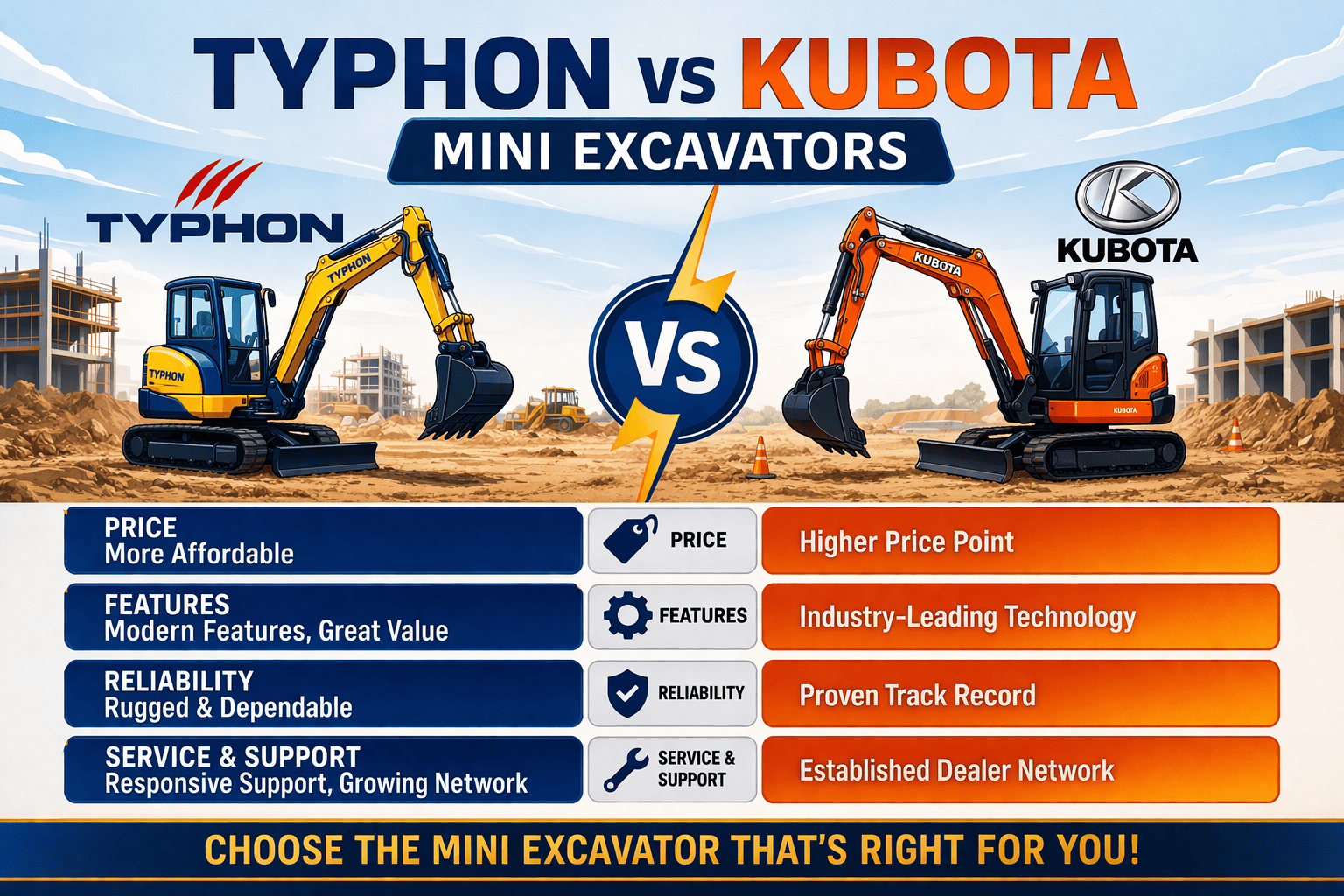
Typhon vs Kubota Mini Excavators: Features, Pricing & Best Use Cases
The American landscaping and construction scene has changed a lot over the ten years. Because the housing market is doing well more people are doing things themselves at home, and many people are starting their own small construction businesses people really need small and versatile heavy equipment like never before.
When people in the United States want to buy an excavator, they face a big decision: should they spend money on a well-known and expensive brand, or choose a new and cheaper brand that is trying to change the way things are done, namely the mini excavator? And this decision is about the mini excavator.
Two common options that constantly dominate this conversation are Typhon vs Kubota mini excavators.
At first glance, comparing the two may appear to be a difficult task. After all, both brands serve entirely different segments of the market. Typhon represents the new wave of budget-friendly, highly accessible compact machines designed to democratize earthmoving. Kubota, on the other hand, is a heritage brand synonymous with premium construction equipment, high-end dealer networks, and commercial-grade heavy lifting.
However, for a buyer standing at the crossroads of a purchasing decision, the choice isn’t always obvious. Does your weekend farm project really justify a $40,000 piece of equipment? Conversely, can a $7,000 budget machine hold up to your daily landscaping business needs in the harsh soils of the Midwest or the rocky terrain of the Northeast?
This comprehensive guide compares their features, pricing, performance, and ideal use cases to help you make the right, most financially sound decision for your specific geographical and operational needs.
Brand Overview
To truly understand which machine is right for you, we have to look at the philosophy and market positioning behind each brand. Heavy equipment is a massive investment, and knowing who built your machine and why they built it is just as important as the horsepower it outputs.
Typhon Mini Excavators
Over the last few years, the USA market has seen a massive surge in direct-to-consumer heavy machinery, and Typhon has positioned itself as a notable player in this space. Typhon’s core philosophy is simple: earthmoving equipment shouldn’t require you to take out a second mortgage.
Typhon focuses primarily on ultra-compact and micro-excavators (typically in the 1 to 3-ton range). These machines are stripped down to the essentials, bypassing the luxury electronics and complex proprietary computer systems that often inflate the price of modern machinery.
By focusing on affordable, compact equipment, Typhon has become the go-to brand for the “weekend warrior,” the small-scale farmer, and the startup landscaping contractor.
- Ideal for small contractors, farms, and residential work: Because of their micro-footprint, Typhons are perfect for squeezing through standard residential backyard gates in suburban American neighborhoods.
- Strong value-for-money option: They utilize standard, off-the-shelf parts (like Briggs & Stratton or Koop engines), making DIY repairs incredibly straightforward for anyone with basic mechanical knowledge.
- Growing popularity in the USA market: Thanks to e-commerce, nationwide direct shipping, and a growing community of online users, Typhon has carved out a dedicated niche among budget-conscious buyers who want to own their equipment outright rather than renting.
[ecwid widgets=”productbrowser” default_category_id=”167967260″ default_product_id=”0″ minicart_layout=”MiniAttachToProductBrowser”]
Kubota Mini Excavators
If you have driven past any major construction site, municipal road repair, or large-scale agricultural operation anywhere in the United States, you have undoubtedly seen Kubota’s signature bright orange machinery. Founded in Japan but boasting a massive manufacturing and distribution presence in the USA, Kubota is an undisputed titan of the heavy equipment industry.
Kubota doesn’t just build mini excavators; they build complete ecosystems of premium industrial machinery. Their excavators range from 1-ton micro units all the way up to 8-ton midi-excavators equipped with enclosed, climate-controlled cabs, hydraulic thumbs, and proprietary zero-tail-swing technology.
- Established global brand: Kubota brings decades of engineering research and development to the table, resulting in incredibly smooth hydraulics and fuel-efficient, proprietary diesel engines.
- Known for premium build quality and reliability: These machines are built to run for 8 to 10 hours a day, 5 days a week, in the most grueling environments imaginable.
- Widely used in large-scale construction projects: From laying municipal sewer lines in Texas to heavy commercial landscaping in California, Kubota is a staple for major contractors.
- Strong dealer network across the USA: This is perhaps Kubota’s biggest selling point. If a machine breaks down, there is almost certainly a certified dealership within a 50-mile radius that has the OEM parts and factory-trained technicians ready to get the machine back to work immediately.
Key Specifications Comparison
When you line these two brands up side-by-side, the differences in their target demographics become incredibly clear. Below is a high-level comparison of what you can expect when shopping between the two.
| Feature | Typhon Mini Excavator | Kubota Mini Excavator |
| Price Range | Budget-friendly ($5K–$15K approx) | Premium ($20K–$60K+) |
| Machine Size | Compact (1–3 ton) | Wide range (1–8 ton) |
| Maintenance | Low-cost, DIY-friendly, standard parts | Higher maintenance cost, proprietary parts |
| Availability | Online + direct delivery/shipping | Dealer-based, showroom floors |
| Best For | Small jobs, farms, startups, trenching | Heavy-duty professional work, large sites |
| Hydraulics | Basic, functional, geared toward simple tasks | Advanced, load-sensing, multi-functional |
| Cab Options | Mostly open canopy (ROPS) | Open canopy or fully enclosed with HVAC |
Analyzing the Specs in the Real World
The specifications table tells a story of two different user experiences. Typhon’s compact size makes it highly maneuverable. Weighing in at 1 to 2 tons, you can easily tow a Typhon behind a standard half-ton pickup truck (like a Ford F-150 or Chevy Silverado) without needing a commercial driver’s license (CDL) or heavy-duty trailers. This is a massive win for solo operators.
Kubota’s wider range means you can buy a machine specifically tailored to massive tasks. If you need to rip up a six-inch concrete driveway or lift heavy boulders for a retaining wall, a 5-ton Kubota has the breakout force and counterweight to handle it safely. However, transporting a 5-ton to 8-ton machine requires a heavy-duty dually truck, specialized trailers, and potentially commercial licensing, adding to the overall operational footprint.
Pricing Comparison (USA Market)
The financial aspect is where the Typhon vs Kubota debate gets the most heated. The capital required to start or expand a business is a major hurdle for many Americans. Let’s break down the economics of both brands.
Typhon Pricing Economics:
✔ Affordable entry point: At roughly $5,000 to $15,000, you can purchase a brand new Typhon excavator outright for less than the cost of a used sedan.
✔ Ideal for first-time buyers: If you are a startup landscaping company, taking on massive debt can sink your business before it even starts. Typhon allows you to operate debt-free.
✔ Lower upfront investment: When you factor in the cost of renting a machine from a big-box hardware store (often $300 to $400 a day), a Typhon pays for itself in just 15 to 30 days of active use. Once it’s paid off, every hour you use it is pure profit.
Kubota Pricing Economics:
✔ Higher cost due to brand + dealer support: You are paying for the badge, but that badge comes with peace of mind. A new Kubota will easily run between $20,000 and $60,000+ depending on the tonnage and cab options. You are funding the massive R&D and the nationwide support network.
✔ Better resale value: Premium brands hold their value exceptionally well in the USA. A well-maintained, 5-year-old Kubota with 2,000 hours on the meter can still fetch a very high price on the used market.
✔ Long-term durability: Kubotas are engineered for a 10,000+ hour lifespan if maintained properly. For a company running multiple crews daily, this longevity offsets the initial sticker shock.
👉 Insight: > Your purchasing decision ultimately boils down to capital and application. If budget is your priority and you want to achieve a rapid Return on Investment (ROI) without taking on a multi-year loan, Typhon is the clear winner. If brand reputation, continuous long-term heavy use, and access to immediate dealership servicing are critical to preventing costly downtime, Kubota is the industry standard.
Best Use Cases
Still on the fence? Let’s look at some geo-specific and task-specific scenarios common in the USA to see where each machine shines.
Choose Typhon if you need:
- Backyard or farm work: Whether you are digging a koi pond in suburban Ohio, trenching irrigation lines for a small orchard in Florida, or mucking out horse stalls in Kentucky, a Typhon is the perfect size.
- Landscaping projects: Perfect for planting mature trees, spreading topsoil, or building small decorative retaining walls.
- Small contractor jobs: Plumbers laying residential PVC pipes or electricians burying conduit will find the narrow track width of a Typhon invaluable for getting close to residential foundations.
- Budget-friendly equipment: Perfect for the property owner who has a long “honey-do” list and realizes that buying a Typhon is actually cheaper than renting a machine every weekend for a year.
- Quick ROI for small businesses: A sole proprietor can buy a Typhon, take on a few local trenching or stump removal jobs, and have the machine completely paid off within the first quarter of the year.
Choose Kubota if you need:
- Large construction projects: If you are part of a crew building a subdivision in Texas or laying commercial foundations in New York, you need the breakout force and hydraulic flow rate that a Kubota provides.
- Continuous heavy-duty usage: Ripping through frost-heaved ground in Minnesota or digging through the solid clay and rock of Georgia requires heavy, robust machinery that won’t overheat after 8 hours of continuous operation.
- Dealer servicing & support: If a machine goes down on a commercial site, you are losing thousands of dollars a day in payroll and project delays. Having a Kubota dealer drive out to the site to swap a hydraulic pump that same afternoon is vital.
- High resale value equipment: Fleet managers who cycle their equipment every 3 to 5 years rely on Kubota’s strong secondary market to recoup their initial investment.
Pros & Cons (Neutral View)
To wrap up the technical comparison, here is a balanced, honest look at the advantages and disadvantages of both equipment brands.
Typhon Pros:
✔ Affordable pricing: Unbeatable entry price that opens the door to mechanical earthmoving for virtually anyone.
✔ Compact & easy to transport: Lightweight enough to be towed by standard consumer pickup trucks; narrow enough to fit through standard doorways and gates.
✔ Good for small-scale operations: Mechanically simple, making DIY maintenance, oil changes, and track adjustments incredibly easy for the average user.
Typhon Cons:
✖ Limited dealer network: Because it is primarily a direct-to-consumer model, you cannot just drive down the street to a local showroom for parts; you will need to order standard replacement parts online.
✖ Not designed for heavy industrial use: The lighter weight means lower breakout force. Pushing a micro-excavator beyond its intended limits on heavy rock or massive tree stumps will lead to premature wear.
Kubota Pros:
✔ Industry reputation: Decades of proven reliability. Kubota is a status symbol of professional contracting for a reason.
✔ Highly durable: it is made with quality metals and it has special hydraulics and diesel engines that work well.
✔ Dealer support all over the US: You can get help from a dealer almost anywhere in the US. This means you can get the parts you need away and they can fix your machine if it is broken. They can also help you with money. Lend you a machine to use while yours is being fixed.
Kubota Cons:
✖ Costly: It is expensive to buy one of these machines. You have to have a credit score for your business and you have to sign a contract that lasts for many years.
✖ Higher maintenance costs: The parts for a Kubota are special. Only the dealership can fix them. The people who work at the dealership charge a lot of money, per hour than $150. This makes it very expensive to fix your Kubota machine. It would be cheaper to fix a machine by yourself.
Which One Should You Choose?
Making the final call between a Typhon and a Kubota shouldn’t be based on emotion; it should be based strictly on your math, your location, and your daily workload.
If you’re a small contractor, farmer, homesteader, or startup →
Typhon offers excellent value and faster ROI. For those who need a machine to augment their manual labor, clean up their property, or start a zero-debt landscaping hustle, Typhon provides exactly what you need without the financial burden of a massive loan. It is the ultimate tool for working smarter, not harder.
If you’re a large-scale contractor or construction company →
👉 Kubota offers premium performance and long-term reliability. When heavy machinery is the lifeblood of your multi-employee operation, and downtime means missing strict commercial deadlines, the heavy-duty engineering and robust dealer network of Kubota make it the necessary choice.
Take the Next Step for Your Business
Looking for an affordable mini excavator in the USA?
Don’t let high equipment costs hold your business or personal projects back. If you have decided that a compact, budget-friendly, and highly capable machine is the right fit for your needs, we are here to help you get digging.
✔ Get a quote today. See just how affordable it is to own your equipment.
✔ We offer fast shipping right to your home, farm or job site anywhere in the US.
✔ We have financing options to make your purchase more budget-friendly.
Contact Typhon now for the deals and take charge of your earthmoving projects today!
⚠️ Disclaimer: Kubota is a registered trademark of its owner. This comparison is for information, and it is based on what people can find out in public and how things are generally seen in the market. The price of the Kubota is what it can be. If you can buy it, it can change. Before buying a machine, consider your project’s needs and consult experts.
