


UPDATE: Offshore wind developer Orsted on Jan. 6 announced a new federal lawsuit in Washington, DC to reverse the Trump administration’s initial 90-day stoppage of work through the end of 2025 on its 924 MW Sunrise Wind project in New York, to join its existing legal action against the shutdown of the 704 MW Revolution Wind project in New England, and a new action to speed up the development of the federal action against the federal shutdown. 810 MW Empire Wind project, which will also power New York.
A hearing on the new lawsuits by Orsted and Equinor is set before Washington Federal District Court Judge Royce Lamberth on January 12. The administration has until Jan. 8 to respond to its claim of new “national security” risks from the projects.
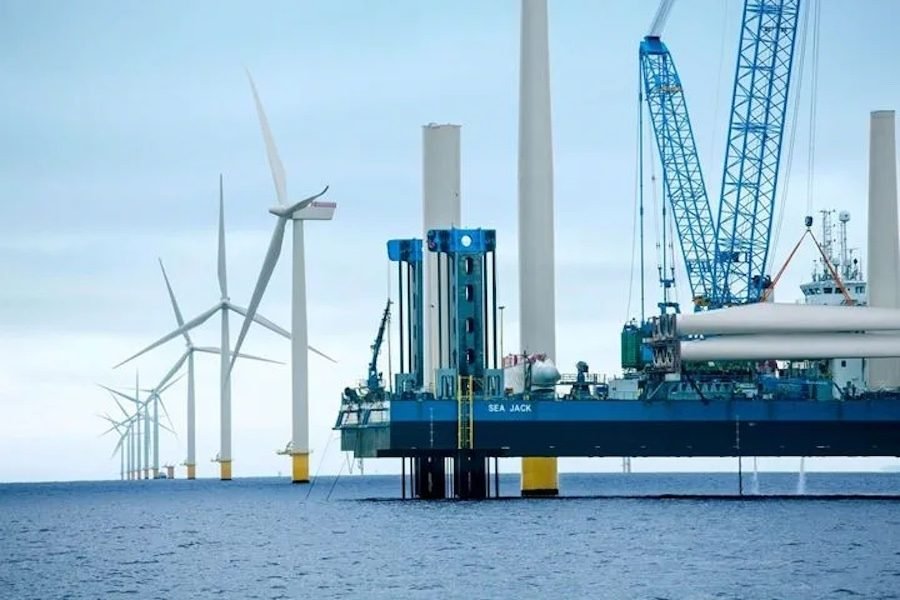
About 45 percent complete with billions of dollars spent and set to begin generating power next October, Orsted said Sunrise Wind has installed 44 of the 84 monopile foundations, as well as the offshore converter station, with construction of the onshore electrical infrastructure substantially complete and near-shore export cables.
According to a military.com report, attorneys for Empire Wind, which had filed a lawsuit on Jan. 2 against Trump’s order, added a motion for an injunction and stay of the measure. They said the threat of ending the project “became more acute” on January 5 when the government took the position that certain ongoing construction activities deemed necessary for security reasons were prohibited. “This development turned a dire situation for Empire Wind into a near-terminal one, necessitating immediate relief,” they said, according to the publication.
Attorneys General William Tong in Connecticut and Peter Neronha in Rhode Island also said on Jan. 5 that they would seek a preliminary injunction against Revolution Wind’s work stoppage. “Donald Trump is stepping up his lawless and erratic attack on Connecticut taxpayers and workers. Every day this project is stalled is costing us hundreds of thousands of dollars in inflated energy bills,” Tong said. “Revolution Wind was reviewed and approved, and the Trump administration has yet to reveal a shred of evidence to counter that thorough and careful process.”
The lawsuits claiming significant damage to the $5 billion Revolution Wind and Empire Wind projects were filed in early 2026 against Trump’s Dec. 22 order halting work on five major Atlantic wind projects for claimed national security reasons.
The Jan. 1 legal response from owner Orsted and partner Skyborn Renewables, a unit of private investor BlackRock, seeks to block the U.S. Department of the Interior’s suspension of the lease for Revolution Wind, which the owners say is 87 percent complete and could begin generating power for 350,000 users in Connecticut and Rhode Island this month. The developers had also challenged an August 2025 administration stop-work order on the project, which was overturned a month later in a federal court action.
In its Jan. 2 filing, developer Equinor, Norway’s state energy company, said it was seeking a similar block for the Empire I wind project, with investment so far estimated at $4 billion and now at 60 percent completion, including the expansion and improvement of an assembly port in Brooklyn, New York. The project, with 52 turbines of 15 MW each. it is scheduled to be fully operational by 2027. The project previously faced a Trump-ordered shutdown in the spring of 2025 that lasted several weeks until it was reversed. That change followed discussions between the president and New York Gov. Kathy Hochul (D), with unconfirmed reports that she agreed to consider new pipelines in the state as part of the deal.
Both lawsuits seek to allow work to continue while their case plays out in court, citing impacts on a workforce of thousands of people currently on all the projects that research group BloombergNEF has estimated at a total investment of $28 billion.
The legal actions follow a Dec. 24 federal lawsuit against the order by Dominion Energy, which will also soon end the estimated $11 billion Coastal Virginia Offshore Wind 2.6 GW project off the coast of Virginia Beach. A federal judge in Norfolk, Virginia. will hear this lawsuit on January 16.
In their new legal filing, the developers of Revolution Wind also claim that the work stoppage violates federal laws and would cause substantial harm to the project, despite their stated effort “to work constructively with the administration and other interested parties” to resolve the dispute. The department did not specify what the risks were, but said they had previously been identified as potential interference with military radar.
Equinor said “Empire Wind and its contractors are complying with the order, while continuing the necessary activities to prevent health, safety and environmental impacts.”
The 800 MW Vineyard Wind project, which now partially generates power in Massachusetts, has not yet publicly confirmed the legal action.
Revolution Wind’s developers say the project “secured all necessary federal and state permits by 2023 after extensive reviews … and multi-year consultations” with the US Air Force, US Coast Guard, US Army Corps of Engineers, National Marine Fisheries Service, US Department of Defense and other federal agencies, resulting in “formal agreements” outlining “measures of mitigation”. Equinor stated similar actions taken and approvals obtained in the execution of its Empire 1 project lease in 2017. is being developed under contract to the New York State Energy Research and Development Authority (NYSERDA) to provide short-term power for the New York City grid, the company said.
All 65 Revolution Wind wind turbine foundations have been installed, as well as offshore substations, export cables and 58 turbines, each 11 MW, Orsted said. The project has 20-year power purchase agreements with utilities Eversource, United Illuminating and National Grid for power supply in Connecticut and Rhode Island, which include “supporting the growing power needs of data centers and AI,” the company said, adding that independent grid operator ISO New England has warned “that stopping the project could increase electricity costs and reduce reliability for the region.”
If the project does not begin generating power by December 31, 2026, utilities may have the right to terminate their power contracts, according to the Providence Magazine in Providence, RI
The previous work stoppage had also cost the project more than $2 million a day, Orsted said.
