

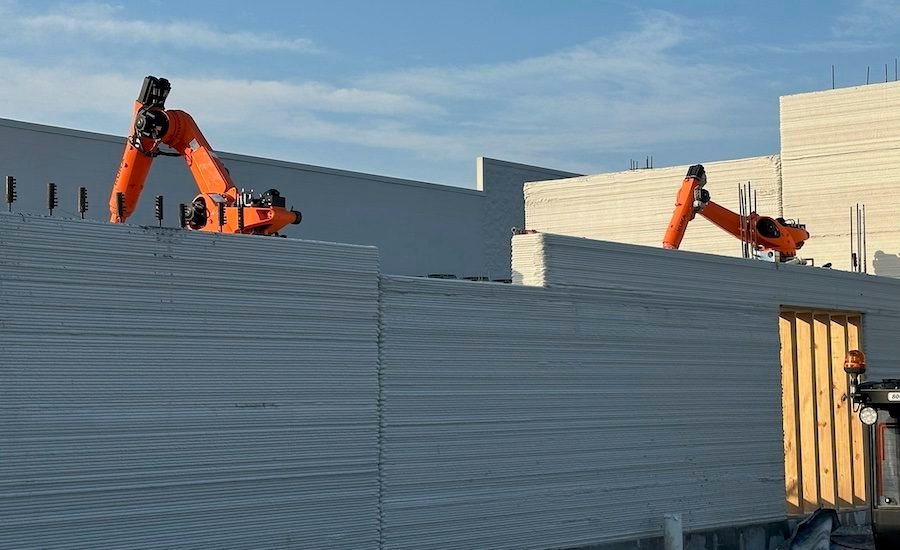
The use of 3D printing for construction in the US has so far been largely limited to a small boom in residential projects in a few key markets, mainly in the South and Southwest. But one provider of concrete 3D printing technology appears to have made inroads in a key market, with Alquist 3D securing an order from Walmart to 3D print more than a dozen buildings to augment the retail giant’s supercenters across the country.
The first project will be built in Lamar, Miss., this month and will be the third building the Greeley, Colo.-based tech company has delivered for Walmart.
The 3D printing company has partnered with Atlanta-based FMGI general contractor and Little Rock, Ark.-based equipment rental company. Hugg & Haul in Walmart projects, which will primarily be ancillary online pickup buildings at existing Supercenters. Alquist developed the techniques to deliver these structures with his contractor and equipment supplier during the two pilot projects he did for Walmart, which taught them all the key lessons about 3D printing buildings for the commercial market.
Related: 3D printed concrete finds its footing
“The 8,000-square-foot addition we did for Walmart in Athens, Tennessee, … was the largest 3D-printed building [of its type] in the world,” says Patrick Callahan, CEO of Alquist 3D. “There were a lot of trials and tribulations on that one, as it was the first of its kind — a lot of learning for (us) and our GC partner.”
The second project, a more modest 5,000-square-foot addition to a Walmart in Owens Crossroads, Ala., resulted in a huge schedule savings, with the entire building going up in seven days with four workers with two printer robots.
“We shaved off three weeks off the clock there and saved them some money,” Callahan recalls. “And we thought ‘wow, this could be something’ and started discussing it [Walmart] about increasing that.”
 Operators monitor the fall during the printing of the building in Athens, Tennessee. Photo courtesy of Alquist 3D
While many 3D printing companies are limited regionally by having their own robots and staff going to sites, Alquist is gearing up for nationwide operations. The contractor’s employees are trained to operate the 3D printing robots, which consist of six-axis robotic arms with concrete extrusion nozzles.
Alquist leases the robots to contractors, who also develop and support the software that drives them. It has signed a national agreement with Sika to provide the specific concrete it needs. To avoid questions about structural stability, the concrete printed by Alquist in the first two Walmart pilots had a requirement of 7,500 psi, more than twice that of traditional Portland cement.
Callahan says Alquist works to greatly exceed local building codes for masonry. The Athens, Tenn., project taught the team a lot about their printer’s performance, including new techniques on how to extrude concrete into the CMU block and maintain structural strength.
The Alquist robot, which moves on a site-installed rail system, has a vertical reach of 20 feet, which can be further extended by using platforms for the rails. Callahan says each robot can fit on a standard trailer pulled by a pickup truck, with about an hour needed to set it up or break it down. Several robots can work together on a structure working with the same design file, saving time. “It’s a big change from the big gantry-style robots you’d see in the past,” he says. “They could be very expensive and difficult to handle, with longer setup times.”
Licensed for 3D printing
Ease of use has been a goal for Alquist’s team, which would prefer to step back and let contractors 3D print the structures. “Our model for scaling this is that we’re focused on being a technology company,” Callahan says. “We’re doing 3D printing technology, upgrading our own robotics platform, forming partnerships with our material partners. We have licensing agreements with all of our GCs and suppliers, and it can be different configurations depending on the region or industry sector.”
Alquist is not locked into a business model and is willing to sell, rent or lease its robots, and can provide training to contractors to run them independently. FMGI has signed on to build most of the planned Walmart projects, with support from Alquist.
“What attracted us to Alquist was how practical this technology really is: it’s faster to mobilize, cleaner on-site and delivers consistent quality on every print,” FMGI President and CEO Darin Ross said in a press release. “For us, this partnership is about transforming how large-scale projects are done.”
The deal with Hugg & Haul, which has locations in Arkansas, Louisiana and Mississippi, will also allow Alquist to outsource some of the work of maintaining and managing fleets of the robots as they go out on site, Callahan explains. “It means they can rent or lease the robots, but also be ready to do maintenance around the country if a piece of our equipment goes down.” The need for support staff is an obstacle that prevents many 3D printing companies from expanding, he notes, and partnering with local equipment companies can solve that.
“In 3D printing, if we can keep the robots going, the projects will go faster,” he adds.
