

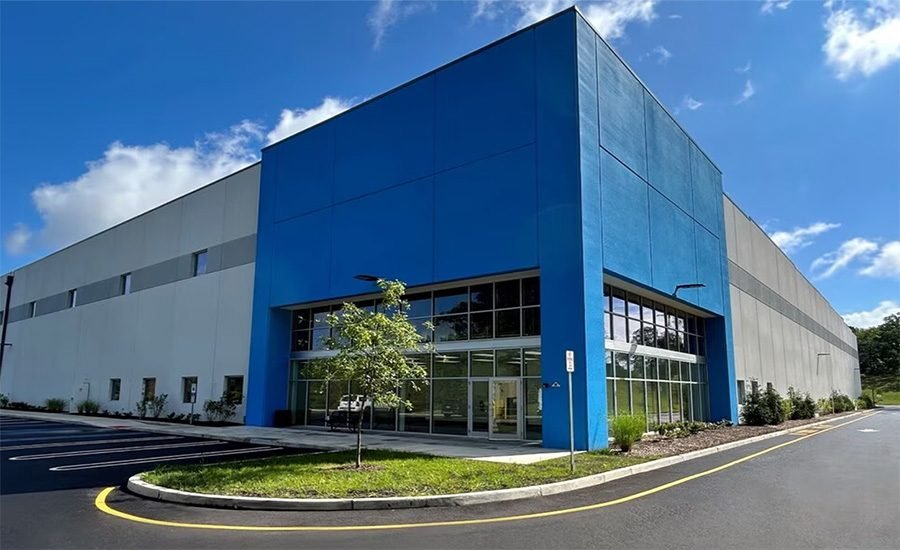
As the U.S. Department of Homeland Security expands its push for more capacity to detain undocumented workers by acquiring warehouses across the country, square footage is just the starting point.
Last month, ENR examined a recurring concern expressed by communities opposed to these projects: overloaded municipal water and wastewater systems. As acquisitions proceed, a second layer of construction complexity is emerging: occupancy reclassification, life safety redesign and, in some cases, floodplain permitting.
Two recently acquired facilities—a 470,044-square-foot logistics center in Roxbury Township, NJ, and a 249,090-square-foot warehouse in Romulus, Michigan—illustrate how the adaptive reuse of modern distribution space for detention purposes can prompt regulatory review well beyond interior fit-out.
RELATED
Municipal water and sewer capacity constrains DHS detention facilities
From warehouse to institutional employment
In Roxbury Township, located in western Morris County, the department paid $129.3 million for the warehouse at 1879 Route 46, according to public records cited by news channel NJ.com. The transaction amounts to about $275 per square meter.
With a stated capacity to house up to 1,500 detainees, the acquisition of the facility alone involves a capital investment of about $86,000 per bed before any conversion work begins.
Completed in 2023, the building was delivered as a Class A logistics facility with 40-foot clear heights, early suppression, a rapid response sprinkler system, a 3,000-amp, 480-volt three-phase power supply and underground plumbing laterals along the office wall, according to marketing materials from vendor Dalfen Industries. These specifications reflect the design of the distribution center, not the occupancy of the institutional detention facility.
Looking for quick answers on construction and engineering topics?
Try Ask ENR, our new intelligent AI search tool.
Ask ENR →

Aerial view and site plan of the 470,044-square-foot Roxbury Logistics Center at 1879 Route 46 in Roxbury Township, NJ, a Class A distribution facility acquired by the U.S. Department of Homeland Security that would require occupancy reclassification and interior reconstruction for detention.
Images courtesy of Dalfen Industries
Under the International Building Code, as adopted in both New Jersey and Michigan, warehouse space is typically classified as a Group S occupancy, while detention facilities fall under Group I-3 institutional occupancies, defined as facilities where occupants are restrained and cannot evacuate.
The distinction significantly affects safety, egress and fire resistance requirements. A change between these classifications may require re-evaluation of fire protection zoning, compartmentation, egress capacity and smoke control measures, even when the outer shell is of new construction.
The existing rapid response and early suppression sprinkler system, designed for high rack storage hazards, would require evaluation against institutional standards. The 40-foot headroom offers volumetric flexibility, but requires significant interior modifications to add housing units, medical wards, intake processing areas, kitchen facilities, recreation areas, and controlled circulation within what was originally intended as open storage space. 3,000 amp industrial power service supports HVAC loads, security systems and commercial kitchen equipment, potentially reducing the need for major electrical upgrades. The plumbing distribution, however, presents a more complex remodeling.
The density of warehouse bathrooms is minimal compared to detention standards that require showers, toilets and medical fixtures in specified proportions.
The retrofitting of slab-to-grade space for distributed wetlands may involve trenching, slab demolition, and backfill unless the existing lateral capacity is sufficient. Local officials in New Jersey have questioned whether water and sewer systems can support detention-scale demand. Whether Roxbury’s municipal infrastructure can accommodate sustained institutional loads remains a central engineering question.
The flood permit adds site-level risk
Similar conversion dynamics apply in Romulus, Michigan, where Homeland Security acquired the warehouse at 7525 Cogswell St. for potential use as a holding facility. Crain’s Detroit Business reported in February that the previous owner confirmed that the building is now owned by the US government, but declined to disclose the purchase price due to a claimed non-disclosure agreement.
Public records show the 27-acre site was encumbered by a $58.5 million mortgage before the transfer. While this amount does not reveal the sale price, it does show the level of pre-financing on the property. As in Roxbury, the building was designed for industrial use rather than continuous residential detention.
In Romulus, however, the analysis goes beyond interior modernization. The department has publicly stated that the property is within a Zone AE floodplain mapped by the Federal Emergency Management Agency, a special flood risk area with a 1% annual probability of flooding with designated base flood elevations. The notice details exterior security fences, recreational courts, generator replacement and possible sanitary sewer modifications.
Michigan Attorney General Dana Nessel, in a Feb. 27 letter to U.S. Immigration and Customs Enforcement, wrote that “permits will certainly be required for activities in the floodplain,” adding that the federal agency had not requested such permits or contacted state regulators as of the date of her letter.
Floodplain development in the AE Zone may trigger local floodplain development permits and statewide reviews related to elevation, stormwater management, and site disturbance under Michigan environmental law, even when a federal agency has issued a notice under Executive Order 11988.
Whether the proposed site work, including fencing, recreational trails and generator replacement, requires additional permits from the Michigan Department of Environment, Great Lakes and Energy may affect both the schedule and scope.
Permits and zoning become pressure points
New Jersey Gov. Mikie Sherrill criticized the Roxbury acquisition in a letter to Homeland Security officials, citing anticipated infrastructure strain and compliance issues.
“Placing a mass immigration detention center in Roxbury raises environmental and quality-of-life concerns, including increased sewage and trash, increased pressure on municipal services, and increased traffic in the vicinity of the site,” he wrote, adding that there are “concerns about potential conflicts with state and local building codes and zoning laws.”
Michigan’s two Democratic U.S. senators, Gary Peters and Elissa Slotkin, sent a letter to Homeland Security Secretary Kristi Noem calling for the cancellation of the Romulus plan. They wrote that “This warehouse facility is not zoned or developed to house people,” Detroit News reports.
In Maryland, Prince George’s County officials are working to avoid similar federal acquisitions through permit controls. County Executive Aisha Braveboy signed an executive order directing the Prince George’s Department of Permits, Inspections and Enforcement not to issue use and occupancy permits to ICE for the detention facilities, WTOP News reports.
RELATED
Section 122 rates leave construction cost exposure largely intact
Braveboy said he plans to officially codify the order into legislation by the County Council.
“We are taking decisive action to protect our diversity and those residents who chose to call America and Prince George’s County home,” he said, adding that buildings and facilities in the county would be designated as “spaces … safe from ICE operations,” WTOP reported.
Without a local use and occupancy permit, a completed modification could not legally open for operation. If challenged by Homeland Security, the directive could test the boundaries between local permitting authority and federal supremacy over the location and operation of detention facilities.
The combination of municipal resolutions, state executive opposition, permit controls, and environmental review shows how detention conversions can evolve from adaptive reuse projects to complex regulatory processes.
Nor are Roxbury and Romulus isolated cases. National reports indicate that Homeland Security has acquired or is targeting at least a dozen large industrial warehouse properties in several states as part of a multibillion-dollar expansion of detention capacity.
The department’s strategy appears to favor the rapid acquisition of modern logistics facilities rather than building from the ground up, shortening timelines but adding complexity through adaptive reuse, such as occupancy reclassification, plumbing redistribution, fire protection redesign and, in some jurisdictions, environmental or floodplain permitting.
For contractors, engineers and municipal authorities, the central issue is not whether a warehouse can be reused, but the extent of system reconfiguration, infrastructure needs and regulatory triggers needed to convert a code-compliant distribution center into an operational detention center.
