

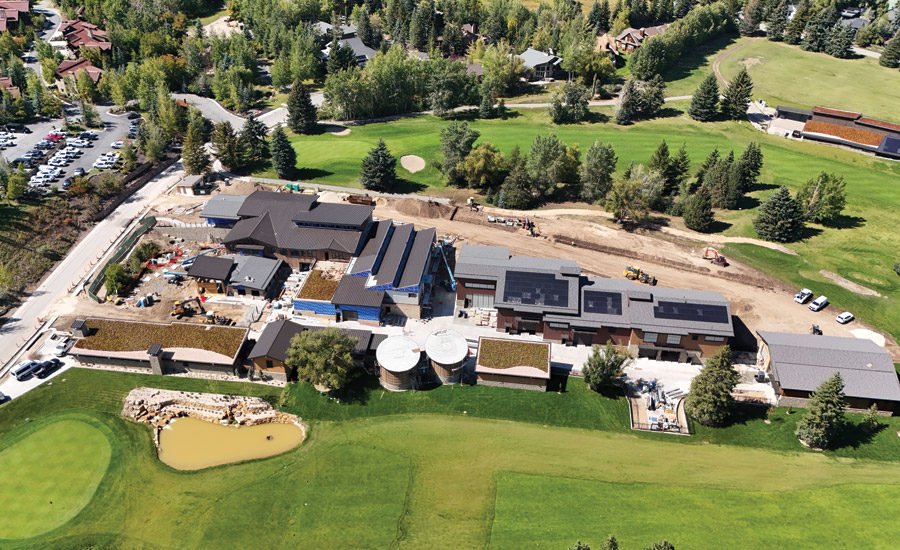
For city water managers and residents of 1860s silver mining town turned posh mountain resort Park City, Utah, there is light at the end of the tunnel. The $80 million, 60,000 square meter Three Kings Water Treatment Plant (3KWTP), the crowning feature of a $135 million capital improvement program launched in 2013, is nearing completion. Part of that program includes the Judge and Spiro mine drainage tunnels, which supply 30 percent of the drinking water supply to the town of nearly 9,000 people 40 miles southeast of Salt Lake City.
While the project will improve the quality of the city’s drinking water supply, that wasn’t the driving force behind the need for the new facility, explains Roger McClain, Park City Public Utilities engineering manager.
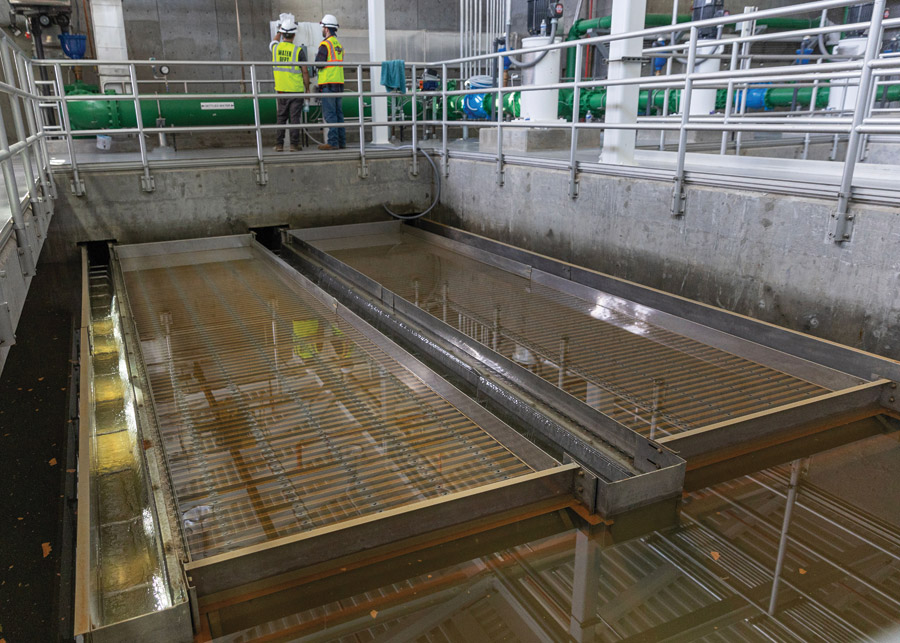
Fitting everything into the tight spot involved deep digging and stacking operations. Plant operators work on floors above the raw water basins. On the left, raw water enters the first stage of treatment.
Photo courtesy Park City Public Utilities
“Improving water quality in the streams is what’s driving this,” McClain says, noting that in addition to contributing to the city’s drinking water supply, the tunnel flows are also the headwaters of McLeod Creek, a tributary. on the Weber River and the Great Salt Lake.
Known by the EPA as mining-influenced water, the tunnel water contains varying levels of arsenic, iron, manganese, cadmium, lead, zinc, iron, antimony and thallium. While some of the water is treated to potable levels, some of the raw water has traditionally been discharged into local streams.
“The requirements for water going into streams are actually more stringent than for drinking water,” says Michelle DeHaan, manager of water quality and treatment for Park City’s public works department. “Wild life in the stream and [the animals] who drink stream water are actually more sensitive to lower levels of pollutants than people are.”
In 2015, the city entered into a stipulated compliance order with the Utah Division of Water Quality, which established a schedule for compliance and water treatment.
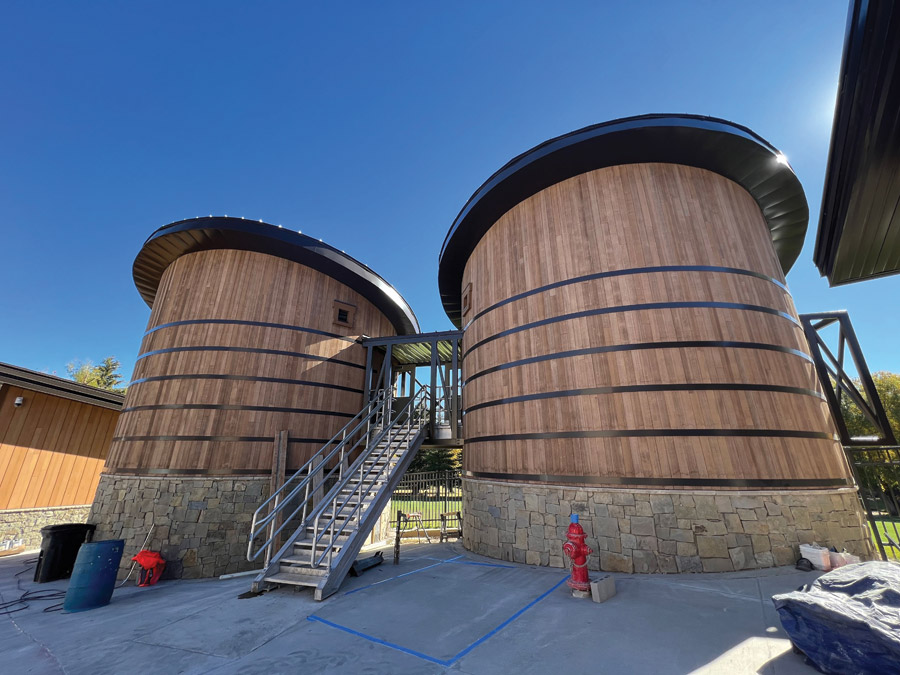
Instead of the open concrete pools in typical water treatment plants, the two 84,000-gallon gravity thickeners are enclosed. The deposits are wrapped in material that reflects the mining history of the site.
Photo courtesy of Park City Public Utilities
Entering the tunnel
The new facility occupies the same site as its predecessor, the Spiro treatment plant, which was demolished. In anticipation of removing one of the city’s two treatment facilities, as well as future growth, Park City built a small treatment plant known as Creekside that opened in 2017.
According to Joseph Zalla, principal process engineer and deputy project manager in the Salt Lake City office of Texas-based engineering firm Jacobs, the 3KWTP facility presented the engineering team with unique challenges .
“It’s a pretty amazing facility, but it wasn’t easy to build.”
—Eric Alder, President, Alder Construction
The facility treats water for discharge purposes and also treats it to drinking water standards. “It has the same initial process no matter where it goes,” Zalla says. “What is unique is the treatment required to meet both standards.”
While the removal of toxic metals from drinking water was not uncommon, Zalla says the presence of so many, along with antimony and thallium, added a level of complexity to the process.
“The thallium and antimony itself require unique processes that most municipal drinking water treatment plants don’t need to deal with,” he says.
“The last step is the titanium dioxide sorbents, and those will remove the antimony and at that point the city can decide to send it into the creek or into the drinking water system,” Zalla says.
Zalla and the design team and city officials developed virtual models before building and testing a full-scale model for a year in 2016 to demonstrate their concepts. The modeling was also helpful in determining how buildings on the site could be placed and where separations could occur to distribute the overall mass.
DeHaan says the water going into the drinking water system is sent through final disinfection with chlorine and UV light, and the pH is adjusted from 6.5 to 7.8. The new plant will produce its own chlorine on site to ensure supply and reduce truck traffic in the neighborhood.
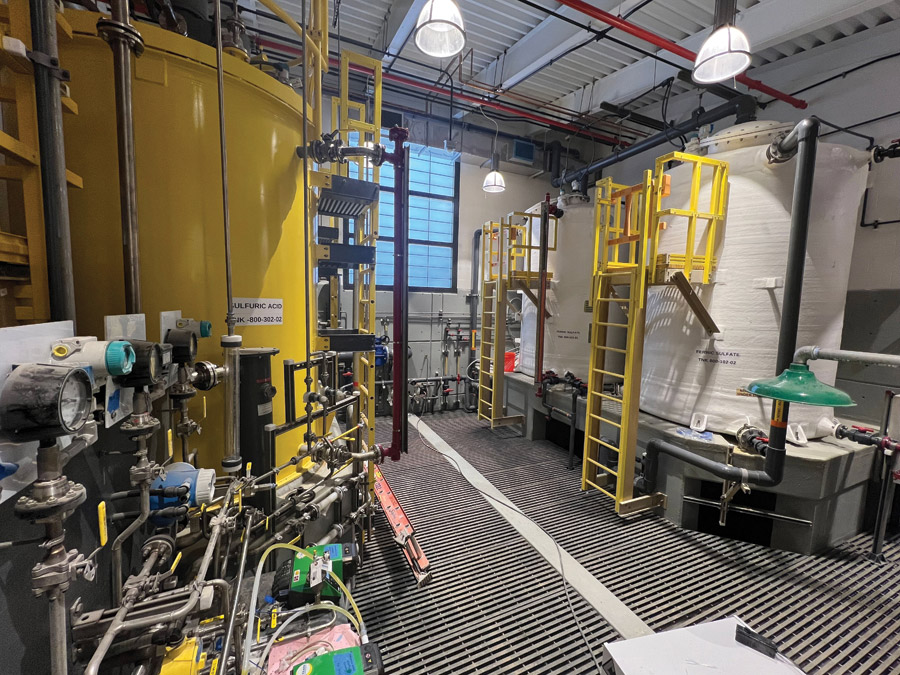
The chemicals are located in one of eight separate structures at the site. The plant generates its own chlorine to eliminate the need to store material on site and reduce truck traffic through the neighborhood.
Photo by Brian Fryer for ENR
Access and complications
“The stream wildlife that drinks the stream water is actually more sensitive to lower levels of pollutants than people.”
— Michelle DeHaan, Water Quality and Treatment Manager, Park City Public Works
“When we looked at how much space we needed, we were at about 60,000 square feet [the finished footprint is 48,000 sq ft], and the city said, “You’ve got 1.92 acres, so make it fit,” says Eric Alder, president of Alder Construction, the project’s construction manager/general contractor. “We had to dig out and put the sumps under the building and just start piling things up.
“It’s a pretty amazing facility, but it wasn’t easy to build,” admits Alder. Excavation at the site went 20 to 30 feet below grade in some areas, and Alder says that even after a year of preconstruction and sequencing work, construction was difficult with limited access to the site , a winter with above-average snowfall and then the surprise of the COVID-19 pandemic.
“We signed all the contracts before COVID-19, and that really put a wrench in everything. We were short on man-hours, the stuff we planned for suddenly wasn’t coming, and so we had to work with the city and the architect to look for alternatives,” he says. Concrete shortages and rationing of local suppliers in 2021 further complicated the concrete-heavy project.
Limited space at the site meant materials were sometimes stored elsewhere on the golf course or at Alder’s warehouses in Salt Lake City. Workers had to be moved from parking lots on the edge of town.
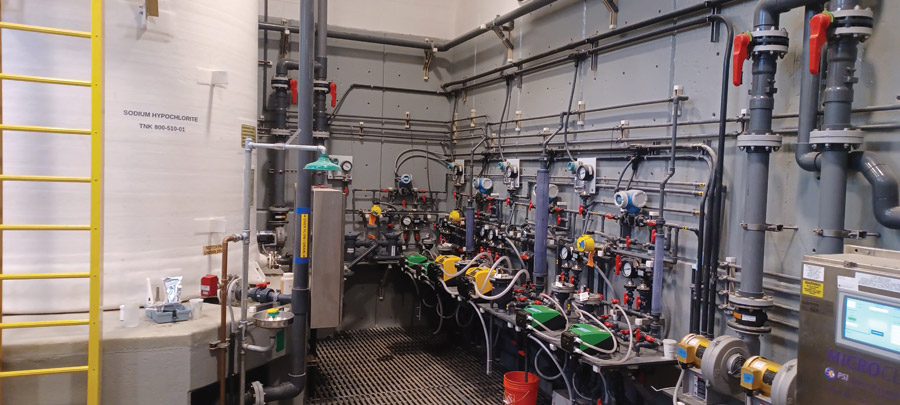
Chemical mixing controls are centralized and can be monitored and operated remotely when needed.
Photo by Brian Fryer for ENR
Design inspired by mining
Project architect David Kaselak with Zehren & Associates of Avon, Colo., says the team drew on the town’s mining history for the exterior shapes and finishes of the buildings and how the overall mass was distributed on the spot. “The design features traditional mining forms and materials mixed with contemporary forms and materials. Parts of the new plant appear to have emerged from the site of the original [Spiro plant]Kaselak says.
The attention to the aesthetics of the mountain village and the processing of water from the old mining tunnels are not the only features that make it different from many other water treatment facilities. While municipal water treatment plants are often out of public view or in industrial areas, the 3KWTP occupies a narrow 2-hectare strip between two holes of the busy municipal golf course on a tree-lined street of upper end mountain. and condominiums.
“The city was very sensitive to the location of the building within a public golf course and surrounded by luxury residential architecture. We were tasked with complementing the context of the site and creating a campus using many forms of smaller-scale buildings instead of a few huge buildings,” says Kaselak.
Other updates
While the Three Kings water treatment plant is the most visible and largest component of a broader upgrade of Park City’s drinking water system, other improvements include:
The $13.6 million Judge Tunnel pipe improvements:
The Judge’s Tunnel produces about 800 gallons of water per minute. The raw water pipes in the Judge Tunnel and the drinking water supply lines to the city’s storage tanks were replaced. In total, 4.1 miles of 12, 16 and 18 gauge metal pipes were replaced with HDPE.
The $7.8 million golf course maintenance and city staff facilities:
The 3KWTP displaced a golf course maintenance and administration facility. A new 8,200 square meter building was constructed elsewhere on the edge of the golf course.
The $4.6 million Spiro Tunnel upgrades:
Park City maintains about 13,000 feet of the Spiro Tunnel, which produces about 3,400 gallons of water per minute, while the Judge Tunnel to the south in Empire Canyon and the artesian Theriot Spring each produce about 800 gpm for the city’s water supply. city An inspection of the tunnels in 2018 showed some destabilization along the first 400 feet of the tunnel, and a mine construction crew placed shotcrete in the walls. A new public square was built at the tunnel entrance with historical information and photographs.
The $3.9 million golf course pond improvements:
Treated water from the 3KWTP is released into a pond adjacent to the golf course where it can be used for irrigation and snowmaking on nearby Park City Mountain.
The $1.65 million surge tank replacement:
The aging 1 million gallon steel tank at Empire Canyon collects water from the Judge Tunnel and controls its release into the system. The tank was demolished and replaced with a 0.2 million gallon underground concrete tank.
Net Zero
The mass of the facility is distributed on the site and divided into separate buildings. Some roofs carry photovoltaic panels or are planted with living grass like those often found in European alpine environments. The building is designed to meet the city’s 2017 mandate that all new municipal buildings meet net zero energy performance.
A system of heat exchangers uses cold water entering the facility to help heat and cool the building, and the natural water pressure in the raw water supply lines is used to hydraulic microgenerators to produce electricity. The photovoltaic systems on the roofs and the hydroelectric micro-generators should produce around 30% more energy than the building uses, according to information from those responsible for the project.
The 3KWTP can produce up to 7.2 million gallons of potable water per day.
In August 2023, engineers began 60 days of commissioning testing of processing equipment. After successful tests, the plant started supplying water at the end of November. The building includes offices for public works staff, along with interior finishing work that will continue throughout the winter with an official opening scheduled for June.
