

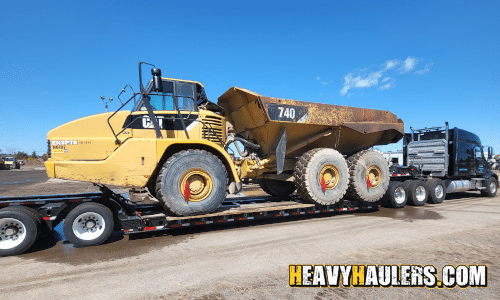
When you are shipping equipment or goods, a driver with a commercial driver’s license or CDL is required. Here’s what you need to know about CDLs and why they’re so important in the equipment transportation industry.
What is a commercial driver’s license?
A CDL, or commercial driver’s license, is a special type of driver’s license that allows you to drive commercial vehicles. Most people get a Class C non-commercial driver’s license, which means they can drive vehicles weighing less than 26,000 pounds. Getting your CDL allows you to drive vehicles that weigh more than 26,000 pounds.
A CDL is also required if you are driving a vehicle with more than 16 passengers (including yourself) or if you are transporting hazardous materials. Driving a commercial vehicle without a CDL can result in federal fines of $2,500 to $5,000 and up to a year in jail.
In addition to having a CDL, drivers may be required to have special endorsements to drive certain types of vehicles. Special approvals may be required to transport hazardous materials, trucks with double or triple trailers, and trucks with tanks.

Why is a CDL required for HGV driving?
Drivers need a heavy duty CDL because driving heavy commercial vehicles is very different from driving a car or small truck. Everything is different in a commercial vehicle, including acceleration, braking and turning. Driving a massive truck carrying heavy equipment requires a particular skill set, and CDL drivers are equipped for the job.
Most commercial vehicles also have more complex controls and gauges, so drivers need to know what to watch for and how to keep their trucks running smoothly. When you hire experienced drivers with their CDL, you don’t have to worry about accidents keeping you out of work or costing you money.
Things to know about getting (and losing) a CDL
The process for obtaining a CDL is very similar to obtaining a standard driver’s license. The first thing you should do is apply for a CDL through your DMV, DOT, or whoever handles state licenses.
Before applying for a CDL, drivers must meet certain requirements, which include not having their driving privileges suspended in any state. Once drivers have met these requirements and applied for their CDL, they must wait for scheduled physical and written driving tests. Once they pass these tests, they can start applying for heavy equipment dispatch jobs that require a CDL.
Here are some of the jobs that require a CDL:
- Heavy transport truck
- Transport of oversized loads
- Transport of vehicles
- And more

Transferring a CDL to another state
Drivers can only hold a CDL in one state at a time, so they will need to transfer their CDL to another state if they move. To transfer a CDL, drivers will need to visit their local DMV and fill out a form to begin the transfer process. The transfer process includes providing all the information used to obtain the previous CDL, including proof of address and a background check. Some states also require drivers to pay a fee and retake the test to transfer a CDL.
Can you lose a CDL?
An individual can lose a CDL in a number of ways. Serious traffic violations, repeated traffic violations, and ignored traffic violations can all be grounds for losing a CDL. Drivers who have a CDL must drive carefully. If a CDL driver receives a traffic violation, it is imperative to pay the fine and/or appear in court if necessary.
When hiring someone to transport heavy machinery for you, make sure they have a valid CDL. Even if someone had their CDL at a given time, there are several violations that can lead to a suspended or revoked CDL.
If you’re interested in hauling oversized loads, it’s time to get your CDL
Whether you need heavy machinery for a construction job or a tractor for your farm, you need a driver with a valid CDL. If you are interested in this line of work, a CDL is a must. It’s your first step to getting the right credentials for transporting large loads.
