

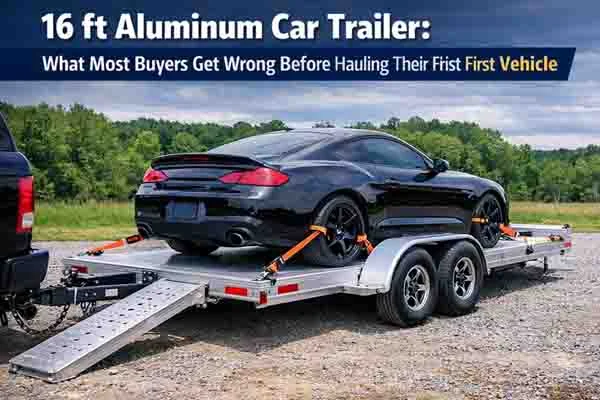
16ft Aluminum Car Trailer: What Most Buyers Get Wrong Before Hauling Their First Vehicle
Buying a 16-foot aluminum trailer seems simple at first. You just need a trailer long enough to haul a car, right? In reality, many first-time buyers make costly mistakes when choosing their first car hauler trailer. The most common problems come from misunderstanding load capacity, trailer weight, trailer compatibility and deck dimensions. These mistakes can result in unsafe trailers, damaged vehicles, or trailers that simply aren’t up to the job.
A sixteen-foot aluminum car trailer is in one of the most sought-after trailer categories because it fits most passenger vehicles while still being manageable for pickup trucks and mid-size SUVs. Drivers who regularly haul vehicles from auctions, racetracks or repair shops often find that this trailer size offers the best balance between capacity and maneuverability.
But the key question most buyers ask isn’t just “Will a car fit on a 16-foot trailer?” The real concern is whether the trailer can carry the vehicle safely, tow it smoothly, and last for years without constant repairs.

Why are so many people looking for a 16 foot aluminum trailer?
The popularity of the 16-foot aluminum car trailer stems from a simple fact. Most vehicles on the road today fall into the perfect size range for this trailer length. Typical sedans are thirteen to fifteen feet long. This means that a sixteen-foot deck provides enough room for the vehicle itself, plus additional room for tie-down straps and cargo space.
Longer trailers like eighteen or twenty feet certainly provide more room, but they are heavier and more difficult to maneuver. A shorter trailer like a fourteen foot model may have trouble fitting larger vehicles. This leaves sixteen feet as the most versatile size for general vehicle transportation.
Many dealerships, small trucking companies, and motorsports enthusiasts rely on this size trailer because it is capable enough to haul daily vehicles, yet still easy to tow long distances.
Your car will actually fit on a 16 foot car trailer
This is one of the most common concerns of buyers. The answer depends on the length of the vehicle and the wheelbase. Most passenger vehicles fit comfortably on a sixteen-foot trailer deck, but proper positioning is important.
When loading a vehicle onto a trailer, the goal is not simply to place the car on the deck. The vehicle must be positioned so that the weight is balanced between the trailer axles and the hitch connection. This ensures safe towing and stable braking.
For example, sedans, compact SUVs, sports cars, and many small trucks usually fit well within the confines of a sixteen-foot deck. Extremely long trucks or large SUVs may require longer trailers.
In the towing industry, car trailers are transport platforms specifically designed to transport vehicles safely behind a towing vehicle. These trailers incorporate axles, suspension systems, lighting systems, brake systems and anchor points to secure the load during transport. :contentReference[oaicite:0]{index=0}
Why aluminum trailers are replacing steel car carriers
For decades, steel trailers dominated the vehicle transport market. Today, aluminum trailers are becoming more and more popular, especially for car transport trailers used for long-distance towing.
The biggest advantage is weight reduction. Aluminum trailers are significantly lighter than comparable steel trailers. This means that the towing vehicle works less during acceleration, braking and hill climbing.
Another important advantage is corrosion resistance. Aluminum does not rust like steel. Drivers who live in coastal areas or regions with snowy winters often choose aluminum trailers because they resist damage from moisture and road salt.
Because of these advantages, aluminum car trailers are often preferred by people who frequently transport vehicles over long distances.
How much weight can a 16 foot aluminum trailer carry?
Understanding load capacity is essential before purchasing a trailer. Two key measurements determine how much weight a trailer can safely carry. These are GVWR and payload capacity.
GVWR stands for Gross Vehicle Weight Rating. Represents the maximum total weight of the trailer and cargo combined. The payload capacity represents the amount of cargo that the trailer can carry after subtracting the trailer’s own weight.
Most 16-foot aluminum car trailers fall within the following range:
Trailer weight typically ranges from about 1200 pounds to 1800 pounds. Payload capacity often ranges from 5000 pounds to 7000 pounds, depending on axle configuration and frame design. These ratings make the trailer suitable for hauling most sedans, sports cars and compact SUVs.
Common features found in a quality car hauler trailer
A reliable car trailer is more than just a flatbed with wheels. Several structural components work together to ensure safe transport.
The axles carry the load of the trailer and the vehicle. Many car carriers use tandem axle configurations because they improve stability and allow for greater load capacity.
Suspension systems absorb road vibrations and help maintain trailer balance during transport. Brake systems provide additional stopping power when hauling heavy vehicles.
Lighting systems include brake lights, side marker lights and tail lights. These lights guarantee visibility and compliance with road safety regulations.
Attachment points such as D-rings allow the straps to secure the vehicle firmly to the trailer cover so that it remains stable during transport.
Loading problems that most new trailer owners encounter
One of the biggest challenges new trailer owners face is loading a vehicle safely. Improper loading can shift the trailer’s center of gravity and create dangerous towing conditions.
Loading systems usually include ramps or tilting deck platforms. Sliding ramps are common on car hauling trailers, but tilting deck trailers are becoming more popular because they create a smoother loading angle.
Proper positioning of the vehicle is also essential. Too much weight toward the rear of the trailer can cause sway while towing. Too much forward weight can overload the hitch connection.
Load balancing ensures smoother towing and safer braking performance.
How the right manufacturer affects the durability of the trailer
The durability of the trailer depends largely on the quality of the materials and manufacturing processes. Trusted manufacturers use engineered frame designs, reinforced structural components, and consistent welding processes to ensure long-term durability.
Large-scale trailer manufacturers such as Three Horses Trailer invest in professional engineering teams and mechanized production equipment. Their trailers are exported to dozens of countries and are designed to meet a wide range of transport requirements while maintaining consistent build quality. :contentReference[oaicite:1]{index=1}
Maintenance errors that reduce the useful life of the trailer
Although aluminum trailers resist corrosion, they still require regular maintenance. Ignoring simple inspections can lead to costly repairs later.
Before each trip, drivers should check the tire pressure, inspect the wheel bearings, verify that the trailer lights are working and confirm that the hitch connection is secure. These small steps prevent many common problems down the road.
Regular trailer cleaning also helps remove dirt and road salt that could affect mechanical components.
Frequently asked questions about 16-foot aluminum car trailers
What vehicles can a 16 foot aluminum trailer carry?
Most passenger vehicles fit comfortably on a sixteen-foot car trailer. This includes sedans, compact SUVs, sports cars, and many small pickup trucks. Because the deck offers enough space to place the vehicle and tie them down, it is one of the most versatile trailer sizes for general vehicle transportation.
How heavy is a typical 16 foot aluminum car trailer
The weight of a sixteen-foot aluminum trailer usually ranges from 1200 to 1800 pounds. Exact weight depends on axle configuration, frame design, and optional features such as ramps or winches.
Aluminum trailers require special maintenance
Aluminum trailers require less maintenance than steel trailers because aluminum does not rust. However, regular inspections are still important. Checking tires, bearings, lights and brake systems helps ensure that the trailer remains safe and reliable.
A tandem axle trailer is better than a single axle trailer
Tandem axle trailers generally offer greater stability and greater load capacity. Because they distribute weight over two axles instead of one, they handle heavier vehicles more safely and provide improved braking performance.
Can a person load a vehicle on a car trailer?
yes Many car trailers are designed so that a single person can load a vehicle using ramps or tilting roof systems. Adding a winch can make loading easier when transporting vehicles that cannot move under their own power.
How long can an aluminum trailer last
With proper maintenance and storage, an aluminum trailer can last twenty years or more. Because aluminum resists corrosion, it often has a longer service life than traditional steel trailers, especially in environments with moisture or road salt.
