

The White House’s proposed ballroom addition would rise more than 20 feet below the balustrade of the Executive Residence, according to updated elevation drawings headed to the National Capital Planning Commission for a March 5 vote.
The meeting comes as below-grade construction progresses and a federal judge weighs a request to halt the project entirely until the federal review concludes.
.jpg "Elevation of the site---North-South-(2)")
North and South site elevation renderings submitted to the National Capital Planning Commission show the proposed White House State Ballroom (circled) sitting below the roof line of the White House Executive Residence.
Presentation courtesy of the National Capital Planning Commission
Presentation materials submitted before the NCPC vote show the proposed ballroom ceiling at approximately 88 feet, 11 inches above finished grade, compared to 113 feet, 11 inches at the White House balustrade and 122 feet, 11 inches at the roof ridge of the Executive Residence. In profile, the ballroom would sit materially lower than the historic structure it adjoins.
Sixteen simulated views from vantage points, including Pennsylvania Avenue, Lafayette Square, the Ellipse, the United States Capitol, and the Jefferson Memorial model the visibility of the project in Washington’s monumental core. The materials were submitted in response to previous requests from federal design reviewers for additional context on scale and sight lines.
By placing the ballroom ceiling more than 20 feet below the White House balustrade and more than 30 feet below the ridge of the main roof, the design aims to preserve the visual dominance of the Executive Residence in long-range views. Federal design review typically evaluates whether new construction competes with or detracts from historic mass.
Commission action covers preliminary and final approval of the site and construction plan, which governs compliance with federal planning requirements in the National Capital Region. Building above grade would require commission approval.
Demolition of the old East Wing was completed last fall. The underground work progressed under the administration’s interpretation that NCPC’s jurisdiction ascribes to “vertical construction.”
Looking for quick answers on construction and engineering topics?
Try Ask ENR, our new intelligent AI search tool.
Ask ENR →
In affidavits, National Park Service liaison John Stanwich said excavation was ongoing and foundations and structural concrete were expected to begin in January and February.
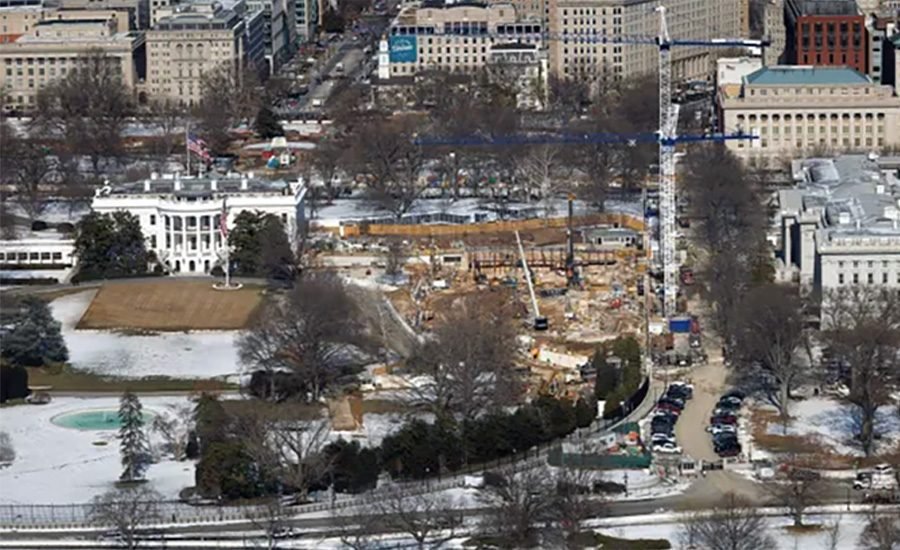
Foundation work below grade is progressing, while the architectural mass above grade remains under review. Satellite images reviewed on February 18 show no visible vertical construction at the site. Construction above grade has not started.
RELATED
Private funding may provide the Trump White House ballroom, but what pays for the rest?
CFA review under reconstituted panel
Separately, the United States Commission on Fine Arts, which evaluates the architectural compatibility and visual impact of federal property, requested additional contextual materials and 3D modeling in January to assess the massing and fit of the campus.
As previously reported, President Donald Trump removed all six CFA commissioners in October 2025. Five new members were sworn in earlier this year to restore the quorum, allowing the commission to resume formal review of the East Wing proposal.
The reconstituted group is chaired by White House staff secretary Will Scharf. Its composition continues to change during active deliberations. With a vacant seat, the new appointee is Chamberlain Harris, a 26-year-old White House aide who is due to be sworn in on February 19. The Washington Post first reported that Harris has worked as an executive assistant in the White House and has no professional background in architecture or design.
CFA review focuses on height, mass, and visual compatibility rather than construct sequencing.
RELATED
White House lounge construction progresses as oversight gaps emerge
Judicial control of legal authority
As ENR previously reported, the National Trust for Historic Preservation filed a lawsuit on December 12, 2025 in the U.S. District Court for the District of Columbia to stop the project.
The Trust’s preliminary injunction motion asks the court to enjoin “any and all actions to further the physical development of the ballroom project,” including demolition, excavation and foundation work, until federal review and congressional authorization requirements are met.
During a recent hearing, US District Judge Richard Leon questioned whether the executive branch has independent authority to proceed with construction without explicit authorization from Congress. According to CNN, Leon appeared skeptical of the administration’s position and pressed government lawyers on the statutory basis to move the project forward without additional legislative approval.
The government has moved to stay any mandate pending the appeal and argues that below-par work does not predetermine above-par design. The dispute centers on whether the executive branch can fund and advance the ballroom project under existing authority or whether it must first obtain explicit approval from Congress.
The injunctive motion is still pending.
