

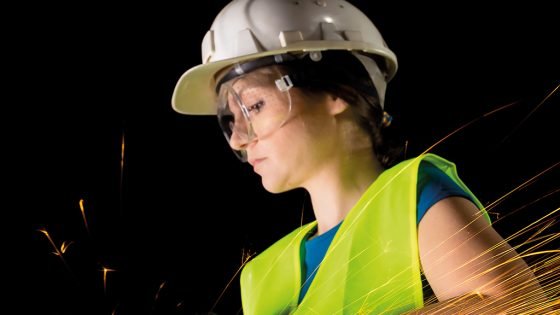
With the number of women in construction on the rise, leaders are being asked to continue to do some scheming to bring about change
More women are working in the construction industry than ever before. At 18.8 percent of the construction workforce, according to the latest figures, it is the highest proportion on record and a significant increase from the 14.5 percent total recorded before the pandemic.
Still, the industry has a long way to go to recruit more women and overhaul its image. More also needs to be done to retain them, by welcoming and promoting them, creating a safe space to talk about issues such as menopause and introducing appropriate maternity policies.
In October, more than 300 people came to London’s Leonardo Royal Hotel to discuss these issues at the annual Inspiring Women in Construction and Engineering event, sponsored by Construction news i New Road Engineer.
“Eyes followed me around the room”
“On my first day, I walked into a room full of men and they all stopped what they were doing,” says keynote speaker Katie Kelleher, recounting her first job as an apprentice in the industry. Now technical and development manager for the Construction Plant Hire Association, she recalls that day: “Eyes followed me around the room. I got to the back of the room, they were still looking at me, they hadn’t continued what they did. In that moment, I questioned my life choices.”
After a decade of unsatisfying jobs in advertising sales and recruitment, Kelleher had joined Laing O’Rourke as an apprentice crane operator. “If I was a younger apprentice, that would have been my first day and my last day, and I would never have gone back,” he says. Her story shows the difficulties women can face from day one in a male-dominated industry. But now he is passionate about the industry and his work as an officer of the association.
Kelly Cole, general manager of electrical power at Cat equipment supplier Finning, emphasizes the importance of supporting emerging talent. Of Finning’s 80 students, 20 have various conditions including autism, dyslexia and attention deficit hyperactivity disorder. Finning offers learners different types of support, depending on individual needs, such as colored papers, tinted glass and extra time for assessments.
“We know these things really help. [Apprentices are] a lot less anxious if they know they have extra time to complete an assignment or exam,” she says. Finning also works with suppliers to provide appropriate workwear, rather than the oversized, ill-fitting gear that many women endure.” We know things like this can have a big impact.”
Willmott Dixon HR Director Rick Lee also emphasizes the scale of the untapped workforce: “There is a skills shortage in construction; 46.8% of the available workforce are women and 19% of the construction workforce are women. What a no-brainer.”
Another untapped demographic, according to Cole, is the 16 million disabled people in the UK, of whom only 46.5% are in work. “We want the best engineers, and if you ignore large parts of the population, you’re excluding a large percentage of the talent pool,” he says.
How to take advantage of all this potential? Many speakers point out that female job seekers respond to certain cues in job advertisements. Anne Nortcliffe, founding director of Canterbury Christ Church University’s school of engineering, technology and design, cites research from the Netherlands that suggests how powerful the use of feminine language in job adverts can be. The study found that women are often put off by masculine-coded words (for example, “leadership” instead of “management”), while men tend to apply for these jobs regardless of the tone of the ‘announcement
Another way to attract women to your company is to proudly advertise your diversity policies. Sharon Vibert, director of Henpicked, which advocates for a better understanding of menopause in the workplace, says she was recently told by an employer that they missed out on some strong candidates because they didn’t have a menopause policy.
However, the struggle for a more diverse workforce does not end at the hiring stage. The construction industry is struggling to retain its female workforce. “It’s real chicken-and-egg stuff: Do we get more women first, or do we fix the industry first?” Kelleher asks.
Vibert presents some startling statistics: one in four women have considered leaving work because of menopausal symptoms, and one in 10 have already left. She says, “Knowing that everyone is talking openly about menopause, and that menopause is being cited as a reason for absence, can make employees feel supported.”
| Proportion of women employed in construction | ||||||
| period (April-June) |
Women (thousands) | men (thousands) |
% female | |||
| 2010 | 246 | 1.961 | 12.5 | |||
| 2011 | 258 | 1,940 | 13.3 | |||
| 2012 | 243 | 1,928 | 12.6 | |||
| 2013 | 262 | 1,894 | 13.8 | |||
| 2014 | 270 | 1,947 | 13.9 | |||
| 2015 | 265 | 1.931 | 13.7 | |||
| 2016 | 281 | 2,034 | 13.8 | |||
| 2017 | 294 | 2,033 | 14.4 | |||
| 2018 | 284 | 2,048 | 13.9 | |||
| 2019 | 304 | 2,057 | 14.8 | |||
| 2020 | 284 | 1,917 | 14.8 | |||
| 2021 | 303 | 1,810 | 16.7 | |||
| 2022 | 321 | 1,885 | 17.1 | |||
| 2023 | 340 | 1,812 | 18.8 | |||
| Source: National Statistics Office | ||||||
Too comfortable
However, making changes in an organization can be difficult. “What exists in most organizations is permafrost,” says Naheem Ahmed, group equality, inclusion and diversity manager at Strabag. “We often find it in the middle management of an organization [where] people who have been very comfortable haven’t been challenged in a long time.”
Ahmed argues that members of marginalized communities could bring about change by coming together. “You have a lot of minority groups operating in your company. Bring them together […] When you get together and [address] that personal privilege sitting in the boardroom with those people, you knock on the door and go with the voice of those people. That’s when you’ll be heard and that’s where change will happen.”
Solidarity does not have to end with members of marginalized communities. People in power who are committed to fighting discrimination in the workplace can also be allies, using their power to call out sexism and effect change. “We need people to amplify our voices because it’s so difficult sometimes,” says Faye Allen, director of construction consultancy JS Held.
Vibert adds that he has seen positive signs of men wanting to support their female colleagues. “Men want to engage in the conversation, but they don’t know where to start,” she says. “If they’re given help and advice, and advice and advice on how to do it, they have a lot more confidence to be able to do it.”
Allen agrees with this approach: “If you want to show someone how to be an ally, tell them your story. Tell them you didn’t want them to say ‘I’m sorry that happened’ after the meeting; they have to ‘to have said in the meeting. Let them be wrong but make it clear [allyship] must play an active role.”
Vibert says allies in high places are especially important. “My advice is to find senior people within your business who are willing to be your ally and advocate on this topic in the workplace,” she advises. “It is this senior acquisition that is critical to a long-term strategy.”
High-ranking allies can also act as mentors. Gillian Charlesworth, chief executive of research body Construction Research Institute, encourages women to discuss their goals more with older people. “If you don’t talk about your ambition, people will make assumptions about how ambitious you are or aren’t,” he says. “Make sure you have an ally or mentor and practice talking about ambition with that person. You can talk about it together and prepare your words.”
Not everyone will be receptive to the cause – among construction managers, there is often little knowledge of women’s experiences in the workplace – but the key message from those present at the event is to persevere. “Some people you can’t help, and that’s okay,” says Allen. “If we can hit 70 percent of the people, we’re going to make a big difference in this industry. Keep the conversation going and don’t let aggressive defensiveness stop you from speaking up.”
