

✕
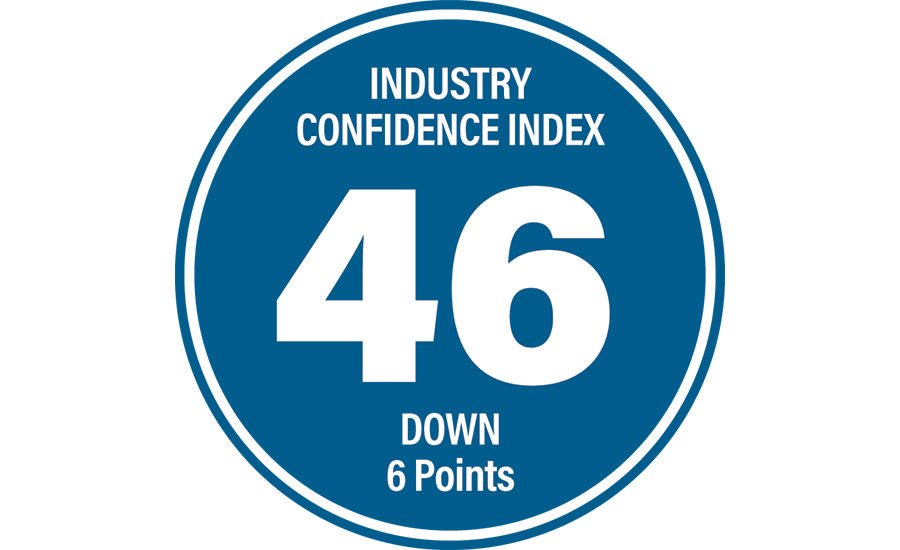
This quarter’s Construction Industry Confidence Index survey results show a drop in confidence among construction industry executives. The global confidence index fell 11.5% to 46 this quarter, from 52 in the first quarter. The economic index has also dropped, dropping four points to 44.
The CICI measures executive sentiment about where the current market will be in the next three to six months and over a period of 12 to 18 months, on a scale of 0 to 100. A rating above 50 indicates a growing market. The measure is based on responses from US executives at major general contractors, subcontractors and design firms on ENR’s top lists to surveys sent between May 13 and June 17.
As with last quarter, GCs and CMs are more pessimistic than designers or subcontractors; however, this gap widened significantly in the second quarter. GC/CM confidence reaches a confidence index of 37, down from 47 in the first quarter for this group. Although less extreme, confidence among both designers (from 56 in the first quarter to 54 in the second quarter) and subcontractors (from 57 to 51) also fell. Over 40% of GCs and CMs see a declining market both now and 3-6 months from now.
Confidence is highest among companies doing business in the Midwest, with a confidence index of 49, down from 55 last quarter. Companies working in the Far West/Pacific region are the most pessimistic this quarter, with a rating of 40, down significantly from 52 last quarter.

CFO trust boxes
CICI’s results largely mirror those of the Construction Financial Management Association’s (CFMA) Confindex survey in Princeton, NJ. Each quarter, CFMA consults CFOs of general and civil contractors and subcontractors about markets and business conditions. The resulting Confindex is based on four separate financial and market components, each rated on a scale of 1 to 200. A rating of 100 indicates a stable market; higher ratings indicate market growth.

Source: ENR/BNP Media
All indices tracked by the Confindex fell between the first quarter and the second quarter of 2024, with the exception of the “current conditions” index, which rose 2.9% to a rating of 106. The overall Confindex is down 2.8% this quarter to a rating of 109. “Business conditions” and “Financial conditions” are also down, down 3.7% and 0.9% respectively.
Higher interest rates and tighter credit conditions are affecting a growing proportion of contractors, believes Anirban Basu, CFMA advisor and CEO of Sage Policy Group. Interest rates do not appear to be falling much, if at all, this year. “I think it’s pretty clear that the Federal Reserve will cut rates between zero and two times this year, most likely a rate cut later this year.” Basu expects several rate cuts in both 2025 and 2026.
The biggest fall among the Confindex indices was in the “Year Ahead Outlook” index, which fell 7.8% to a rating of 107. This decline reflects growing concern over demand for construction services, says the CEO of Sage. The upcoming election in November is another factor, which will likely cause owners to hold on to some projects.
Rising material prices and current skills shortages add to the concern, with 66.7% of ENR respondents reporting upward pressure on material prices this quarter, compared to 59.8% last year.
Margins seem to be shrinking. “[CFMA’s Confindex survey] indicates that the proportion of companies reporting increasing profit margins is now fully offset by the proportion reporting shrinking margins,” Basu notes.
CICI respondents report a sort of stabilization when it comes to their customers’ ability to finance. While 37.8% of companies say their customers’ access to finance is somewhat or much worse than six months ago, this number is down significantly from the 63.9% reported in Q4 2023. Basu believes that this number could be boosted by the increased flow of federal funding: “Although private funding has become more expensive and difficult to obtain, public funding is abundant to support industrial and infrastructure projects “.
However, the clock is ticking on some of that public funding. This is likely to mean fewer megaprojects moving forward, given the federal grant component of many of these projects. “America cannot continue to spend the way it has been. It is not sustainable with a national debt approaching $35 trillion, along with the insolvency of Social Security and Medicare,” explains the Sage economist.
Fixed price issues
Continued supply chain issues and rising input prices have caused problems for fixed-price contracts initiated just before or at the start of the pandemic. “The result has been a lot of lawsuits involving force majeure, force majeure and similar contract language,” says Basu. Zachry Group’s Chapter 11 filing on May 21 is an extreme example of the trend. “I don’t think what happened with Zachry Group is a one-time thing, but a function of the structure of the deal,” says Neil Shah, CFMA president and CEO. Shah expects more disputes on the horizon, though not as impactful for a contractor as with Zachry.
