


President Donald Trump on April 30 signed a presidential permit for a 645-mile crude oil pipeline from the US-Canada border in Montana to Wyoming, clearing a key hurdle for a project that would move up to 550,000 barrels a day of Canadian crude to US markets.
“Slightly different than the last administration,” Trump told reporters after signing, according to the group’s reports. “They wouldn’t sign a pipeline deal. And we have pipelines going up.”
Bridger Pipeline Expansion LLC, a wholly owned subsidiary of Casper, Wyo.-based True Cos., submitted an overview of the project to the Montana Department of Environmental Quality on Jan. 28, detailing engineering parameters.
The permit refers to Bridger’s application, placing the pipeline under the jurisdiction of the Pipeline and Hazardous Materials Safety Administration. Before breaking ground, Bridger must still secure a certificate of compliance with the Montana Major Facilities Siting Act, a Bureau of Land Management right-of-way permit, and a full environmental impact statement that complies with both the National Environmental Policy Act and Montana’s equivalent statute.
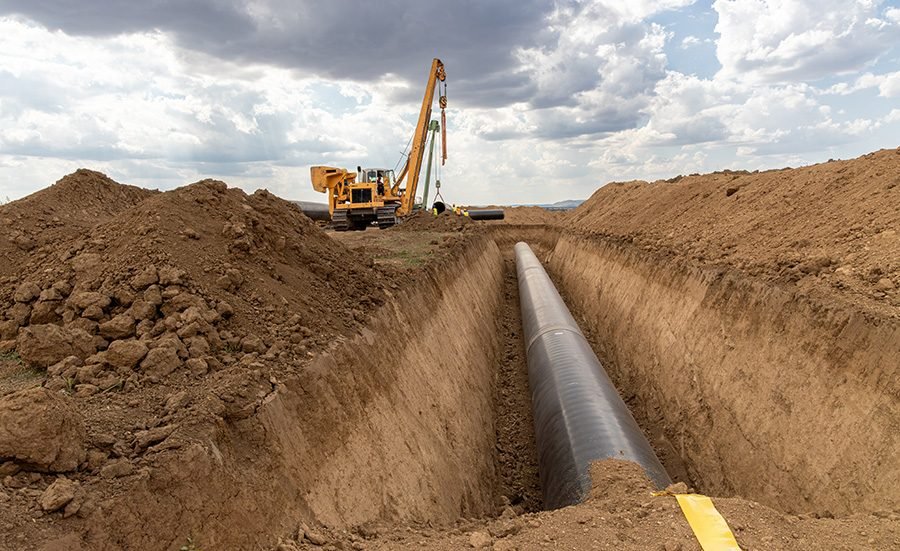
Documents reviewed by ENR show the pipeline would be constructed of API 5L X70 PSL-2 high-strength steel with a 36-in. outer diameter
Standard sections would have a 0.5-in. wall thickness with fusion bonded epoxy coating of 14-16 mil; Horizontal directional drilling and boring sections, which are used at all major water and highway crossings, would increase to 0.625-0.750 inches. wall thickness with an additional abrasion resistant coating of 30 mil.
At full operating force, pressure could reach 1,440 psig, with a minimum burial depth of 48 inches.
Looking for quick answers on construction and engineering topics?
Try Ask ENR, our new intelligent AI search tool.
Ask ENR →
Eight pumping stations would be distributed along the route, with one located on federal land near the border crossing. The system would also include 72 sets of mainline valves at intervals of no more than 15 miles, placed on either side of major water passages to allow rapid isolation in the event of a release. A 50-foot permanent right-of-way shall be flanked by a 100-foot temporary construction easement.
At major river crossings, including the Yellowstone and Missouri, disclosures show Bridger would pass 30 to 40 feet below the river bed. The company’s leak prevention program includes 24/7 SCADA-based remote monitoring, intelligent online pig inspection and cathodic protection.
Spokesman Bill Salvin said the company expects to begin construction in the fall of 2027 with completion in late 2028 or early 2029. “We designed the pipeline with integrity and safety in mind,” Salvin said. “We have emergency response plans if something happens where oil comes off the line, which is pretty rare.”
No contractor has been named and no cost estimates for the project have been released.
The route travels approximately 435 miles through nine Montana counties and 210 miles through five Wyoming counties before reaching central Guernsey, where it would connect with existing infrastructure providing access to the Cushing, Oklahoma and Gulf Coast markets.
Canadian segment, environmental hurdles still ahead
On the Canadian side, South Bow, successor to the company behind the canceled Keystone XL project, whose cross-border permit former President Joe Biden withdrew on his first day in office in January 2021.
The rollback cost Alberta more than $1 billion in provincial investment. South Bow says it is evaluating what the company calls the Prairie Connector, leveraging roughly 150 km of Keystone XL pipeline already installed in Alberta to deliver crude to the Bridger line across the border.
“South Bow continues to evaluate the Prairie Connector project, a potential expansion of its Canadian asset base that would leverage existing infrastructure and permitted corridors to improve access to the Canadian crude oil market,” spokeswoman Solomiya Martoiu said in an emailed statement to the media.
At maximum capacity, the Bridger expansion will move about two-thirds the volume that Keystone XL was designed for.
Environmental groups have vowed to challenge the project through state permitting and the required federal environmental impact statement.
In a comment letter submitted May 1 to the BLM and the Montana DEQ on behalf of 15 organizations, Earthjustice argued that the pipeline puts the environment and communities at risk. “The question is not whether a pipeline will spill oil, but when oil will be spilled,” the letter states.
Bridger Pipeline and True Companies subsidiaries have a documented spill history, including a 2015 rupture that spilled more than 50,000 gallons of crude oil into the Yellowstone River, a 2016 failure in North Dakota that released more than 600,000 gallons into the Little Missouri River and a tributary, and a 45,000202022 diesel oil spill. Wyoming. True Affiliates paid a $12.5 million civil penalty to settle federal litigation over the Montana and North Dakota incidents.
