

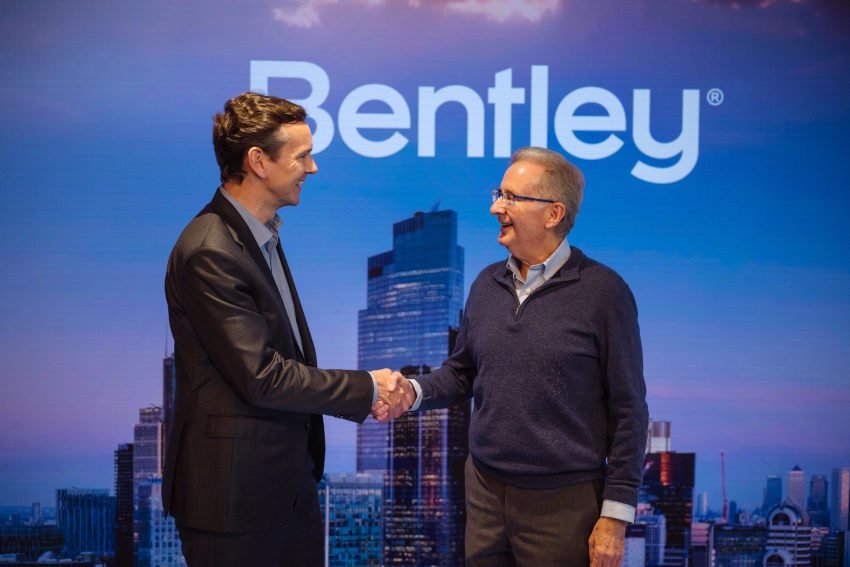

Bentley Systems, Inc., the Exton, Pa.-based technology company behind ProjectWise, MicroStation, Synchro and other widely used design and engineering software, is undergoing a generational change in leadership as Nicholas Cumins takes the CEO position on July 1.
Cumins is the first person outside the Bentley family to lead the company since its founding in 1984. Greg Bentley, who has served as chairman and CEO since 1995, will become executive chairman of Bentley’s board.
“The executive chair is an increasingly common role in technology companies, for the former CEO, and especially as many technology companies are founded and run by family,” says Greg Bentley. “It’s 15% of all companies in the S&P 500 that have an executive chair. I feel really well prepared for this role, and especially I feel like the culminating aspect for me is that we’ve now completed a transition of our team executive, to a literally new generation.”
Cumins has been Bentley Systems’ chief operating officer since January 2022. He joined the company as chief product officer in September 2020 and was previously general manager of SAP’s Marketing Cloud.
“I really want to make sure that we keep that engineering ethos, of Bentley Systems as a company by engineers for engineers, and make sure that when we engage with our users as peers and as partners,” says Cumin .
Greg Bentley is the oldest of the five Bentley brothers who founded the company. Keith, Ray and Barry Bentley retired in recent years, but all remain as directors of the company. Scott Bentley left the company in 2002 to found VideoRay. Greg Bentley notes that the new executive team is in their forties and well-positioned to lead initiatives in emerging technologies such as AI-enabled engineering tools. It’s also been a time of change for Bentley Systems in a broader sense since it became a publicly traded company in 2020.
“The next four years hold really exciting opportunities, including AI, so I’m invigorated,” says Bentley. “As executive chairman and I will continue for the foreseeable future to have regular responsibility for investor relations.”
A rejected takeover bid and the broader strategy
The 4,000-employee company made headlines in recent months after France-based Schneider Electric made a public bid to acquire the company. Schneider Electric dropped the takeover bid in May.
“Obviously, we don’t comment on M&A speculation, but throughout Bentley’s history, we’ve had conversations about transformative options to accelerate our vision and also create value for our shareholders,” says Cumins. “This particular opportunity happened to get some press, there was a press release that was issued by Schneider, so we had to follow suit, but I will say it’s a no-brainer situation here, so to speak. There was a conversation and a conversation is over.”
Cumins says the company will continue to focus on tools that help engineers design and build public works and infrastructure.
“It’s the majority of the business and it’s growing very strongly,” Cumins explains. “There’s no reason for us to shy away from that core market. And there’s a lot of investment going on. We have very strong relationships, we have strong product capability in transportation, yes, but also water, utilities, electricity. If we look investments in the US with IIJA, it’s mainly transportation, but we’re also starting to see financing in the power grid.”
Cumins stresses that there aren’t enough engineers to do the work needed to meet today’s global sustainability goals, not to mention the problems of aging infrastructure.
Engineering firms and owner-operators of infrastructure assets are looking to software like Bentley’s to help them overcome talent shortages, he says.
“Infrastructure is at an inflection point. Despite massive capital investment in infrastructure projects and jobs after the pandemics, much remains to be done to make infrastructure more resilient. Our ability to save this gap will literally determine the quality of life for future generations.”
