

Long-term infrastructure, transportation and institutional projects are fueling the AEC industry in Cincinnati, says Chris Hopper, executive vice president and general manager of Skanska USA Building in Ohio.
“Major transportation initiatives, including the Brent Spence Companion Bridge program, along with the Duke Energy Convention Center’s modernization and utility upgrades, continue to support confidence throughout the AEC regional community,” says Hopper.
Groundbreaking is expected this spring for the $4.5 billion Brent Spence Bridge Corridor project, which will include a new supplemental bridge west of the existing span. The companion bridge is planned as a two-story structure with a cable-stayed design with independent decks.
Modernization and utility upgrades were central to the convention center’s $264 million, 18-month renovation, completed in December 2025. The project aims to transform the aging 55-year-old facility into a competitive, energy-efficient and technologically advanced venue.
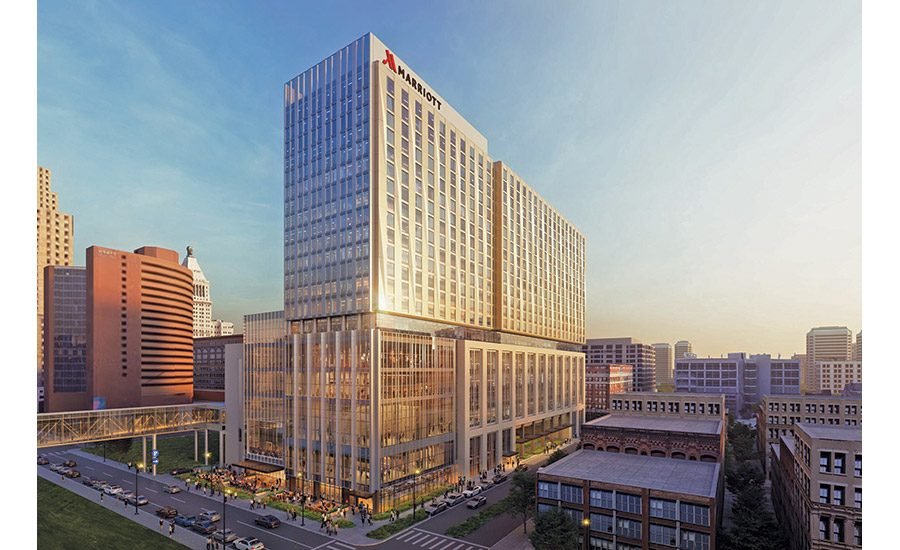
Hopper says the Marriott Convention Center Hotel Cincinnati, which will be adjacent to the convention center, is part of Cincinnati’s broader push to strengthen its hospitality and convention infrastructure.
“The city is in the midst of a major development cycle, with multiple high-profile hotel and mixed-use projects reshaping the downtown core. These projects reflect a regional strategy to support business travel, expand event capacity and elevate the downtown visitor experience,” he notes.

Plans for the 700-room hotel include a direct skybridge connection to the convention center. It is intended to serve as the flagship hotel for Cincinnati’s convention headquarters and as a cornerstone of the city’s $828 million Convention District Revitalization Plan. The first works on the site are underway, with full construction expected by the end of this year.
In addition to the hotel, Hopper says his company is supporting major development activity at Cincinnati/Northern Kentucky International Airport (CVG), which he calls one of the region’s strongest economic drivers. The airport recently launched a $220 million terminal overhaul to modernize passenger facilities, improve circulation and expand capacity.
The Findlay Community Center represents a major public investment in neighborhood amenities, offering a new 65,000-square-foot facility with expanded recreation, child care and community programming.
The region is also experiencing continued growth in academic and research facilities, including the expansion of the Northern Kentucky University Science Center, which will consolidate programs and improve laboratory capacity as part of a broader campus modernization effort. In the private sector, the Medpace N300 reflects the region’s expanding life sciences and biomedical development. At the University of Cincinnati, the demolition of the Crosley Tower and the planned construction of a new STEM facility reinforce a citywide trend of modernizing research and innovation infrastructure, an area Hopper says continues to see significant capital investment in the Cincinnati area.
Those investments are benefiting the Cincinnati market at a time when broader global uncertainty has made homeowners more cautious elsewhere. “While international volatility has affected material prices and logistics, major regional projects such as the Brent Spence Companion Bridge program and the convention center modernization have advanced in construction and completion, providing stability to the local market,” says Hopper.
Cincinnati’s construction market continues to outperform peer metro centers.
“Cincinnati is one of the fastest growing construction markets in the country.”
—Chris Hopper. Executive Vice President/General Manager, Skanska USA Building
Construction employment in the Cincinnati area grew between 4.5 percent and 9.6 percent year over year, according to data from the Bureau of Labor Statistics, while the Associated General Contractors of America reports an annual increase of 11 percent.
“This reflects sustained demand rather than near-term volatility, with activity strongest in the infrastructure, higher education, healthcare and specialist trade sectors,” says Hopper.
While he is optimistic about the AEC industry, he acknowledges that there are obstacles.
“Cincinnati is one of the fastest-growing construction labor markets in the country, and the shortage of skilled labor continues to influence delivery schedules and strategies,” he says.
“In this environment, robust forecasting tools and data-driven planning help teams anticipate pressure points early, while our strategic supply chain stays ahead of market changes, price volatility and availability risks that could affect project outcomes,” he says.
Workforce pressures, amplified by global uncertainty, reinforce the need for early planning, workforce development and delivery approaches that reduce risk and improve predictability.
Looking ahead, Hopper says “the region appears positioned for measured and steady growth. High borrowing costs have tempered speculative office and industrial development, but demand remains resilient for purpose-driven facilities, public infrastructure and modernization work.”
