

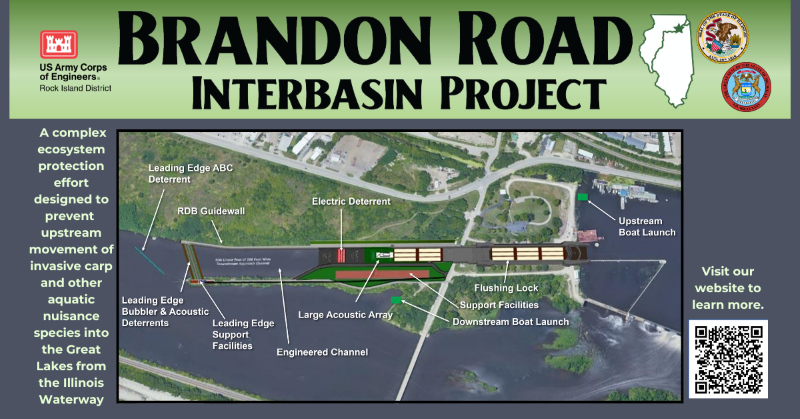

A $1.2 billion project to prevent Asian carp and other invasive species from moving into the Great Lakes through Illinois waterways will begin construction early next year after a funding deal was reached in ‘July 1 by Illinois, Michigan and the US Army Corps of Engineers.
The cost-sharing agreement unlocks $274 million in federal funding, including $226 million from the federal Jobs and Infrastructure Investment Act, as well as $114 million in state funds to build the first of three components of the project
The effort to stop the spread of the Asian carp fish population, which originated in China but was introduced to the southern United States in the 1970s to keep aquaculture facilities clean, dates back to the early 2000s.
Since then, the species has become a major nuisance in the Mississippi River Basin, with the Corps of Engineers warning that the carp’s continued upstream trajectory would have a devastating impact on the entire ecosystem of the Great Lakes and in the region’s estimated $20 billion boating and fishing industries.
Best chance of deterrence
Brandon Road Lock and Dam near Joliet, Illinois, has been identified as the critical point where layered technologies could be used to stop invasive carp populations. The Brandon Road Interbasin project will install a complex series of innovative deterrents at the site to prevent the upstream movement of carp and other nuisance aquatic species in the Illinois Waterway, a system of rivers, lakes and canals that form a maritime link between the Great Lakes and Gulf of Mexico through the Illinois and Mississippi rivers.
The technologies will cover both structural and non-structural control components. Structural measures include technologies such as a washout lock, engineered channel with electric barrier, underwater acoustic deterrent, air bubble curtain and an automated barge cleaning deterrent.
Non-structural measures, implemented in conjunction with other federal agencies, could include public education and outreach, monitoring, integrated pest management, pesticides, manual or mechanical removal, as well as research and development.
“Our multi-agency team of scientists and engineers has worked tirelessly over the past three years in combination with outside stakeholders to design what we believe is an effective solution to protect the Great Lakes watershed,” said Scott Whitney, project manager for the Corps of Engineers’ Rock Island, Illinois District, which oversees the project.
Pre-construction engineering and design began in December 2020, when the State of Illinois signed a design agreement with the district. Contracts for fabrication, continued design, cutting edge deterrents and bed rock removal are scheduled for solicitation in the coming weeks.
