


Ken Kaneshige
president
Nordic PCL
The huge wave of Hawaii’s AEC sector has been riding since the pandemic may have reached its peak, but the tide continues to hold steady. Total construction starts in Honolulu peaked at $6.9 billion last year, up nearly 90% from 2021, according to Dodge Data and Analytics.
“The construction market in the Honolulu area has been very robust since the pandemic,” explains Kaneshige. “We expect market strength to continue with demand to build multi-story affordable high-rise residential developments to provide housing in a market that has an inventory shortage of more than 30,000 units.”
The problem facing the industry is that the post-pandemic surge was mainly fueled by the non-construction sector. While residential construction has steadily increased and is expected to exceed $1.2 billion this year, the sector still lags behind the region’s urgent need for more housing.
On the upside, the housing crisis has led to a boom in the reuse and adaptive reuse of office towers into residential units in downtown Honolulu, Kaneshige says.

“As more people choose to live close to where they work, Honolulu’s business district and Chinatown areas could experience revitalization as more businesses, such as restaurants, choose to open where there is a ever-increasing residential population.”
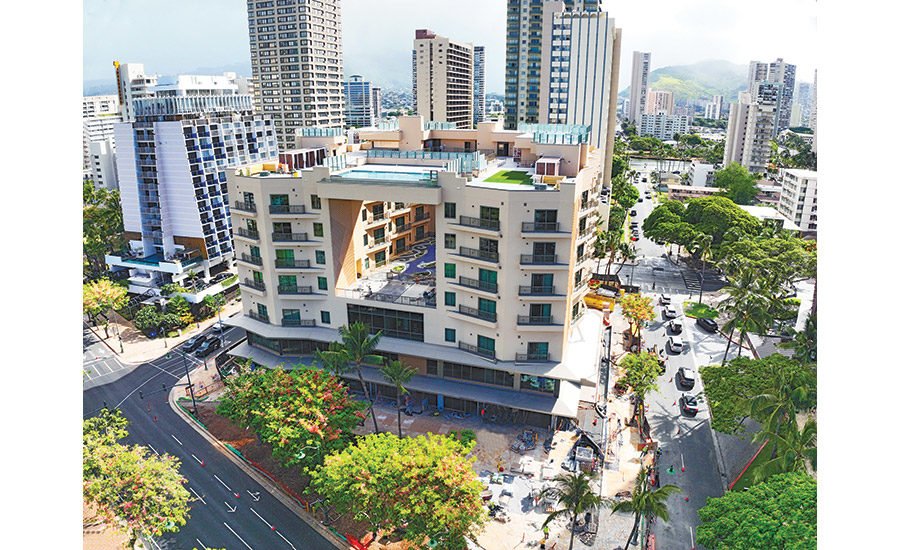
A prime example is Nordic’s repurposing of a defunct shopping plaza in Waikiki, King Kalakaua Plaza. Built in 1996, the four-story structure has been vacant since 2009. The redevelopment will add three additional floors and feature two floors of retail, 110 studio and one-bedroom units, a rooftop pool, a gym, a bar and a 10,000 square meter sales gallery.
In addition, there will be two levels of parking under the building. During construction, the basement had to be flooded to compensate for buoyancy when the structure’s dead loads were reduced during demolition.
On the other hand, the lack of housing has added to the already severe shortage of skilled workers for the sector to cover the current backlog and future work backlog, the No. 1 concern of the region’s AEC community .
The blue- and white-collar work groups in the AEC community are shallow and static, as non-residents can’t just drive to the islands to look for job opportunities, Kaneshige explains.
“The lack of affordable housing and the high cost of living make it unattractive for the non-resident workforce to relocate,” he says. “As a result, the local AEC community struggles to adapt to an expanding workload with a constrained workforce capacity.”
One effort that may feel the impact of the shortage is rebuilding the community of Lahaina on Maui, which was devastated by a fire last fall. Approximately 2,000 structures in an area of 2,000 acres were destroyed by the fire, which killed more than 100 people and displaced more than 13,000 residents. The rebuilding effort is expected to take decades.
“Depending on the speed of the rebuilding effort, the local workforce on Maui will likely be inadequate to handle the amount of work, and non-resident workers willing to relocate will have difficulty finding housing,” he says.
“The local AEC community struggles to adapt to an expanding workload with a constrained workforce capacity.”
—Ken Kaneshige, President, Nordic PCL
Even so, several important projects continue to move forward. Military construction, primarily on the island of Oahu, is very strong as the Department of Defense continues to strengthen its facilities in the Pacific region. Meanwhile, construction of the light rail system on Oahu continues toward downtown Honolulu.
“Ultimately we hope to see residential and commercial developments settling within a half-mile radius of each station located for high-density transit-oriented development. [TOD]”, points out.
An obstacle to development has been bureaucracy. Since the pandemic, getting building permits in a timely manner from the Department of Planning and Permits for the City and County of Honolulu has been a challenge.
“Delays in obtaining building permits after an extended review period have frustrated developers and local residents who are unable to proceed with their projects,” says Kaneshige. “As well as causing significant inconvenience to the permit applicant, delays in the planning permission process have increased the cost of development in a location where affordability is almost unattainable.”
