


The developer of the $7 billion Grain Belt Express high-voltage transmission line that would cross Illinois plans to appeal an Aug. 8 state court decision that overturned a state commission’s approval of it part of the multi-state project.
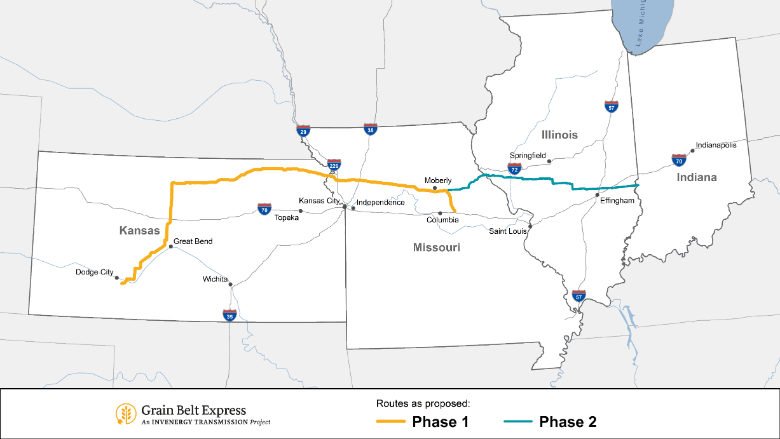
Developer Invenergy and its subsidiary Grain Belt Express LLC plan to build the line that would carry power about 800 miles over parts of Kansas, Missouri, Illinois and Indiana to connect a planned wind farm and other potential renewable energy projects to points interconnection for different networks. regions
As part of the go-ahead for the project, Grain Belt Express received a certificate of “public convenience and necessity” from the Illinois Commerce Commission last year for the 207 miles of line that would cross the state. However, a group called Concerned Citizens & Property Owners, along with the Illinois Farm Bureau and other groups filed a challenge to that approval.
To grant the certificate, Illinois law requires that the project owner be “able to finance the proposed construction without significant adverse financial consequences to the utility or its customers.”
Fifth District Court of Appeals judges found the developer did not meet that requirement when it filed with the commission. The company said it plans to finance the project in part through debt backed by the U.S. Department of Energy or commercial banks, but had not secured such financing at the time of the commission’s approval. Instead, the commission included a condition that the company could not install equipment on the easement property until it had all the necessary financing, which it said met the requirement.
“Ultimately, no substantial evidence was presented to support the commission’s conclusion [Great Belt Express] BX is capable of financing the project,” the judges wrote. “The evidence presented demonstrates this [it] did not have funding at the time of the hearing, had no customers, contracts, commitments to the government or the bank and, as a result, did not comply with the [state law] criteria with nothing more than speculation”.
Dia Kuykendall, director of public affairs for Invenergy Transmission, said in a statement that the company intends to “immediately appeal the decision to the Illinois Supreme Court.”
“This ruling completely misconstrues the law and threatens billions in energy cost savings for Grain Belt Express consumers,” Kuykendall said. “The wrong decision has far-reaching implications beyond Grain Belt Express and runs counter to Illinois’ efforts to secure a reliable and affordable clean energy future.”
The Department of Energy included the Grain Belt Express corridor on a list of high-priority transmission projects for federal funding earlier this year.
Invenergy has planned the Grain Belt Express to be a two-phase project. Phase 1 would cover about 530 miles in Kansas and Missouri, so it is not directly affected by the court decision. Grain Belt Express has said it aims to begin construction in 2025 to begin operations in 2029, and Kuykendall said work is continuing as planned.
Earlier this year, Grain Belt Express issued an open request for up to 800 MW of the planned 2,500 MW Phase 1 capacity.
FERC challenges
In other streaming-related legal cases, the U.S. Judicial Panel on Multidistrict Litigation said Aug. 8 that it selected the U.S. Court of Appeals in Richmond, Va., to hear 11 consolidated lawsuits against the Order 1920 of the Federal Energy Regulatory Commission, a monumental mandate. published in May that requires transmission network operators to carry out long-term planning to anticipate energy needs up to 20 years into the future.
FERC approved the order 2 to 1.
The controversial order faces challenges from some Republican state officials who say it is overreaching and costly, as well as from environmental groups who say the order is not strong enough to meet the goals of the transmission needed in the U.S. , as well as some groups and developers in the electricity sector. , including Invenergy.
