

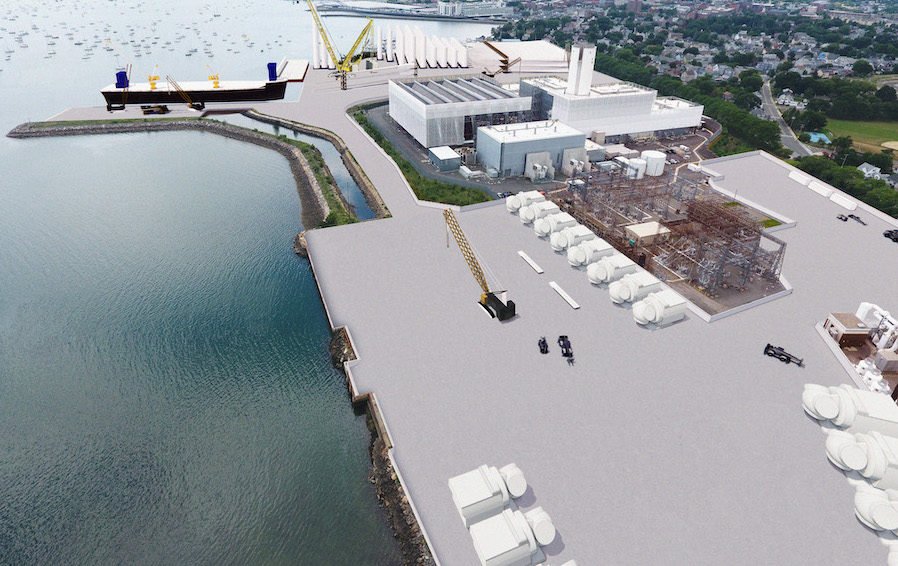

In Salem Harbor. Mass., about 20 miles north of Boston, where a 750 MW coal-oil power plant operated for more than six decades, construction of a $300 million offshore wind staging terminal will start to support project development. and reactivate the growth of the wind sector after the recent setbacks.
The Massachusetts Clean Energy Center last year acquired 42 acres for the terminal in a $30 million purchase of part of the 65-acre former power plant from port developer Crowley Maritime Corp., which bought it in 2022 several years after power generation ended. AECOM is the project design company, with a joint venture of DW White Construction and JF White Contracting Co. appointed general contractor. The works are expected to be completed by the end of 2026.
Funding for the Salem terminal includes a $34 million grant from the US Maritime Administration and about $80 million in state infrastructure funding, as well as private investment. “Crowley will lead the private sector financing and leverage our previously announced partnership with Morgan Stanley Infrastructure Partners for other project financings,” said the marine contractor, which is also the director of the terminal’s construction and will operate it. Crowley did not disclose its stake in the terminal, which would support both fixed-bottom and floating offshore wind projects.
Massachusetts, which has a goal of net zero carbon emissions by 2050, also received $389 million in federal funding to expand offshore wind transmission, along with other New England states. Gov. Maura Healey (D) said the state is “well positioned to support the growing offshore wind industry.”
By virtue of a draft labor agreement signed in July, 20% of the workforce will be union apprentices, with targets also set for the hiring of minority workers and women. In February, Salem finalized a $9 million “community benefits” agreement with Crowley that includes nearly $4 million in investment in education.
More port updates
The Salem site would be the state’s second major port terminal facility, with the 30-acre New Bedford Marine Commerce Center that was completed in 2015 also slated to expand, the agency said. ‘state net energy on August 15. The work will include the redevelopment of an existing one. The agency committed $45 million to the project, which will be completed in December 2026. It also plans to apply for federal grants and seek funding from private sources.
The New Bedford terminal is closer to the planned southernmost New England project sites, but the narrow harbor opening cannot accommodate larger ships built in more recent years.
The port expansions come despite project and developer financial problems in recent years due to inflation and supply chain pressures that led to restructuring of power sales terms and some cancellations of projects
But with the Biden administration pushing harder to meet a 30 GW goal by 2030 for US offshore wind development, the US Department of the Interior in April approved the construction of the 2 New England Wind .6 GW, a two-part project of up to 129 turbines. which will be built about 30 miles off the southern coast of the state. Financially restructured from two canceled projects, its 791 MW first phase could begin construction next year.
The department and the state of Maine also signed the first U.S. floating offshore wind research lease on Aug. 19 in a 15,000-acre area of deep waters in the Gulf of Maine about 28 nautical miles offshore, with up to 12 floating wind turbines for a total of 144 MW. be deployed Maine appointed Pine Tree Offshore Wind as the operator of the research lease. The research “will inform responsible commercial floating offshore wind development in the future,” Interior said, focusing on innovative technology and the protection of marine industries and resources.
Interior is also evaluating the environmental impacts of proposed lease sales at eight Gulf of Maine sites in Massachusetts, Maine and New Hampshire. No dates have been announced for these yet. Bidders could get credits for committing to floating wind labor and supply chain investments. The proposed sales come “at a critical time in New England’s energy transition,” the Sierra Club said earlier this year. The region’s last two coal plants, both located in New Hampshire, will retire in 2025 and 2028.
Heavy lifting terminal
The Salem terminal construction team has obtained city and state permits and is working with the U.S. Army Corps of Engineers and the Maritime Administration to complete environmental assessments, said Graham Tyson, vice president of operations. Crowley harbors.
The facility will include two heavy-lift berths for the delivery of offshore wind components and the mooring of vessels specializing in turbine installations, according to Crowley. Tyson said two heavy-lift berths will be able to dock vessels up to 700 feet long, with enough cargo capacity to handle larger turbine components and support cranes. “Maintain the high load standards of 4,000 and 3,000 [lb per sq ft] in different areas it is also critical to support the storage and lifting operations of sensitive components,” he noted.
Most U.S. ports “were never designed to support the weight of the components that we’re putting together here on site,” Joe Choi, senior director of ports and waterfront structural engineer for Crowley’s Crowley unit, told ENR Wind Services. “The main pier will be supported on piles of steel pipes and a reinforced deck,” he said.
The team will also build a pad supported on concrete piles and on a concrete slab, with dense aggregates to support component storage, Choi said. To manage the large volume of leftover aggregate from the power plant, the contractor team developed a way to crush and cut the material to meet the dense aggregate specifications. “We were able to keep all of this material on site without exporting and importing minimal additional aggregate materials,” Tyson said.
Massachusetts is moving forward despite work being interrupted on the Vineyard Wind 1 project, the first U.S. utility-scale offshore wind facility to begin construction, when a 351-foot-long blade collapsed in mid-July ‘a giant turbine of 13.6 MW. sending litter into the ocean and onto the beaches of Nantucket Island, 20 miles south of Cape Cod.
The megaproject seeks recovery
The event suspended construction of the project’s planned 62 turbines and power production from the 10 currently operating while developer and federal investigations continue. On August 13, federal officials allowed Vineyard Wind to continue installation of the turbine “not associated with the blade event,” such as towers, foundations and 850-foot-tall nacelles containing components turbine generators.
Turbine maker and builder GE Vernova, whose CEO blamed the outage on a production quality control error, said it is inspecting all of Vineyard Wind’s blades in place and awaiting installation , reviewing thousands of ultrasound images captured during the manufacturing of the blades for “abnormalities.”
GE Vernova chief sustainability officer Roger Martella said the company is physically inspecting the blades and is also using advanced remote-controlled robots equipped with video cameras and fiber-optic sensors that can detect stress on the rotating blades . It also developed a new algorithm that will give “several hours or even days of warning of anything like this happening again,” he said.
Resolve Marine, the contractor that also supported recovery after the March 26 collapse of Baltimore’s Francis Scott Key Bridge, is underway to remove debris from the turbine blades. “GE Vernova and Vineyard Wind have developed a comprehensive plan to recover the remaining AW-38 blade in incremental steps,” the companies said.
Steps in the plan include blade rotations “to reduce hanging blade and possible controlled shear,” removing the blade root still installed in the core, recovering fallen debris from the turbine deck and “tackle” the remains of the paddle on the ocean floor. The companies have not disclosed a time frame for the completion of this work. His ongoing investigations and those of the Interior also have unclear completion dates.
“Unfortunately, we expect this to happen again,” said Jerry Leeman, CEO of the New England Fishermen’s Stewardship Association, which opposes the accelerated development of offshore wind. “We still don’t know the cause [the] incident But we know that no human structure can withstand the corrosive power of the ocean forever.”
Governor Healey stressed that the state will “find out and get to the bottom of what happened. [at the Vineyard Wind site]. But let’s be clear: we’re very invested in this industry.”
It’s unclear whether the blade rupture will affect the project’s existing lease at the New Bedford terminal, which expires Dec. 31 with a 90-day extension option. According to a local report, the developers of the SouthCoast Wind project signed a facility lease with the state in April, with an investment of $15 million made and plans to take control in 2029.
Meanwhile, bidders are awaiting word in early September on new project proposals submitted jointly in Massachusetts, Connecticut and Rhode Island. Massachusetts is seeking 3.6 GW as it strives to meet a mandate of 5.6 GW contracted by 2027, with total three-state contracting targeted at 6.8 GW. Those proposed already include the 1.2GW Vineyard Wind 2 project and the 1.2GW SouthCoast Wind project. Avangrid submitted several proposals for the 791-MW New England Wind 1 and 1.08-GW New England Wind 2, and Orsted proposed the 1.18-GW Starboard Wind project in Connecticut and Rhode Island alone.
