

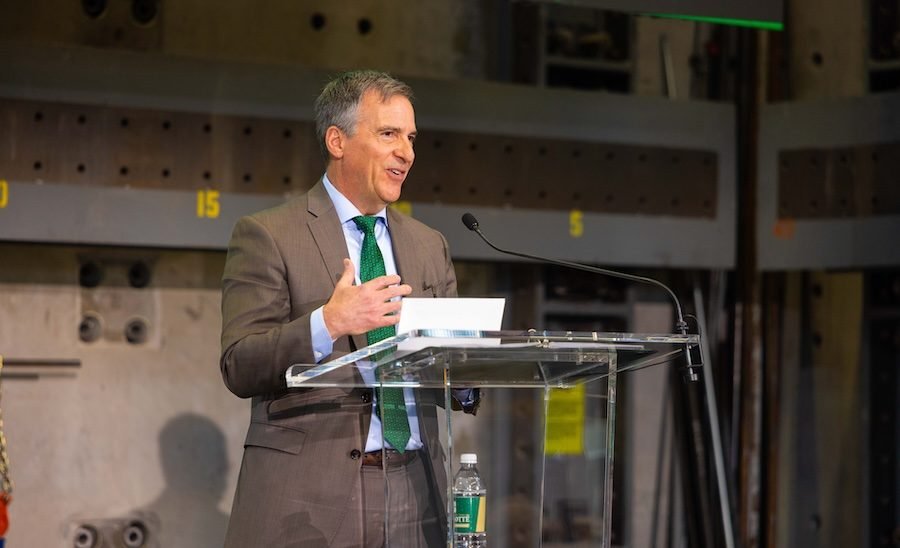

In April, the University of North Carolina at Charlotte announced the creation of the Albert School of Construction. Made possible by a gift of leadership from Bechtel Group President and CEO Craig Albert and his wife, Darla, both UNC Charlotte alumni, the program is the first of its kind in the state to focus on the full project life cycle, a facet Craig Albert sees as critical to the planning, engineering and delivery of increasingly complex infrastructure projects.
Albert began his career at Westinghouse before joining Bechtel in 1998. Since then, he has held a wide range of executive, operational and management leadership roles at the company, including overseeing and directing Bechtel’s global operations since 2020. He chairs the company’s operating committee and serves on the company’s board of directors.
ENR correspondent Jim Parsons interviewed Craig Albert about the new School of Construction and its immediate and long-term goals. This interview has been edited and condensed for clarity.
ENR: What is the impetus for starting the Albert School of Construction?
When we talk about the future, we think of modern energy systems, resilient infrastructure and cities capable of supporting a rapidly growing population. None of this is possible without people who know how to deliver complex construction projects at scale. Engineering schools do an excellent job of teaching and training future engineers. However, there is very little, if any, exposure to what it takes to actually deliver a major project: coordinating thousands of workers and contractors and integrating engineering, business and HR disciplines.
ENR: How will the new school’s focus on the project life cycle differ from those already established at peer institutions?
Construction is inherently cross-cutting, but education has traditionally treated it as a series of separate functions. In reality, project outcomes are shaped by decisions made throughout the entire life cycle. The idea of the Albert School of Construction is to bring these pieces together. Students will learn the fundamentals of engineering and how these decisions affect execution: how work is sequenced, how teams are coordinated, and how engineering, labor, supply chains, and technology come together on site to deliver a project.
ENR: How did your own career help shape your vision for the show?
For over two decades, I worked on and supervised complex engineering and construction projects across sectors, geographies and operating environments: environmental remediation in the US and UK; LNG in Australia and the Gulf Coast, nuclear power in the US and Poland; advanced manufacturing in the US and Taiwan; the main transport infrastructures in Europe, Canada and the Middle East; large-scale mining in the Andes mountain range; and national defense projects in the US. Along this journey, I’ve had the privilege of learning alongside exceptionally talented people whose experiences have shaped my perspective on what it takes to deliver complex projects successfully.
ENR: You also have a strong personal connection to UNC Charlotte and the area as well.
yes It was where my own education began and where my wife, Darla, also studied. It is meaningful to bring these lessons back to the place that helped shape both my career and our family’s connection to the university. While this school will directly benefit the Charlotte region, its opportunity is much broader. The challenges facing the construction industry today are national and global, and there is a real opportunity for UNC Charlotte to play a significant role on this larger stage.
Looking for quick answers on construction and engineering topics?
Try Ask ENR, our new intelligent AI search tool.
Ask ENR →
ENR: Is there any new construction planned for the new school?
We are planning an outdoor construction field laboratory that will serve as a major asset for the school, supporting hands-on learning, applied research and collaboration with industry partners. The lab will also support workforce training and community engagement, helping to strengthen the pool of skilled talent entering the construction industry.
At the same time, the Smith building, where the school is located, will undergo renovations to modernize classrooms and laboratory spaces. Together, these investments will create a more hands-on, industry-connected learning environment and help position the school at the forefront of construction innovation and technology.
ENR: How do you see the program evolving? Are there specific areas of research or education that you hope will be added in the coming years?
We are developing interdisciplinary programs that connect engineering, construction, business, and operations so that graduates understand the whole system and are prepared to manage complexity, coordinate across interfaces, and lead with strong ethical and professional judgment.
On the research side, the school will focus on applied innovation and technology transfer, areas such as digital construction, data-driven project delivery and mega-project execution. The emphasis will be on working closely with industry to address real-world challenges such as supply chain complexity, labor shortages and the growing scale of infrastructure investment.
The goal is that when a UNC Charlotte construction graduate shows up for work, he or she will be the most prepared early career professional in the room.
ENR: Is there a key takeaway or insight from your own educational experience that you hope these students will also gain?
One of the most important lessons I’ve learned is what it really takes to make large, complex projects successful. At the end of the day, it’s about what thousands of people can achieve together when they have the right training, skills, information, tools and organization.
I hope students leave with a clear understanding of how these elements come together in practice, not just theory. This perspective is essential to becoming an effective engineer and leader in today’s construction environment.
ENR: Any other ideas?
What draws me to this endeavor is the belief that construction is a noble, sometimes overlooked profession. I want people to understand that every major innovation that has a huge positive impact on society is made possible by the infrastructure that is custom built to support it, and these projects are often very technical and complex. We ask construction professionals to take on enormous responsibility—billions of dollars, public safety, and national priorities—and this program focuses on the preparation that responsibility requires.
I am proud to be part of an effort focused on preparing the next generation of construction professionals to meet these challenges and lead the future of the built environment.
