

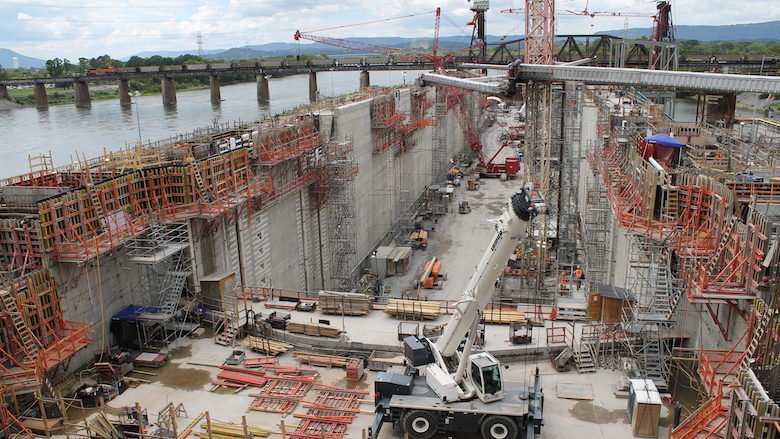
The U.S. Army Corps of Engineers is entering the final stages of construction of a replacement lock at Chickamauga Dam near Chattanooga, Tenn., where deteriorating concrete has caused decades of headaches.
On an Aug. 19 tour hosted by the Waterways Council Inc., corps officials detailed the work to build the new 110-foot-by-600-foot lock, as well as deficiencies in the aging 60-foot-by-360-foot lock that will replace .
USACE’s Nashville District, responsible for waterways in the Cumberland and Tennessee River basins, also supports the Tennessee Valley Authority (TVA) in the maintenance and operation of major locks in Tennessee, including Chickamauga . TVA owns the dam and its 119 MW hydroelectric plant.
Located about 7 miles above Chattanooga, the Chickamauga Dam and Dam were built in 1940, and soon after, it was noticed that the concrete was expanding due to the alkali-aggregate reaction. Since its initial construction, says Capt. Joseph Cotton, USACE Nashville District Project Manager the lock has expanded 1 foot long and 4 inches high. USACE has been busy managing the effects of this expansion, and even with ongoing maintenance, aggregate backlash presents a continuing threat to the facility’s structural integrity and limits its operational life, says the body
Shimmick Construction Co. is the prime contractor for the $275 million project to build the lock chamber. The scope of the project includes the procurement and installation of the 150 cubic meter per hour on-site batching plant and concrete transport system required to meet the requirement of 255,000 cubic meters of structural and mass concrete.
Shimmick is working by excavating nearly 10,000 cubic meters of rock, demolishing 3,600 cubic meters of existing reinforced concrete landfill and installing 43 drilled reinforced concrete shafts. The company will also build a new operations building and gate control decks and install new electrical and mechanical systems.
CJ Mahan Construction Co. is constructing upstream approach walls as part of a $61 million contract awarded in September 2021, which includes the placement of 14 drilled shafts, four intermediate piers, two nose piers and eight wall beams of approach
The final phase, which is expected to be between $100 million and $250 million and could be awarded this month, will be a firm, fixed-price contract, according to solicitation documents as previously reported by ENR. Includes wet commissioning and demolition of spillway, construction of downstream approach walls extending under a nearby railway bridge, as well as closing and backfilling of existing locks, with early completion dates set for November 2027 to have an operation lock and December 2029 for the completion of the project. .
The gate work is scheduled for November, when the team will place 14 metal gate segments weighing 150,000 pounds that will be welded together. The approach walls are fabricated off-site and will be floated intact down the river and installed. The longest of those walls will be 120 feet long, Cotton says, weighing 450 tons.
A June Corps statement listed a total project cost estimate of $954.4 million, approximately $417 million of which had been spent to date. The project has been in the works for decades, authorized by the Consolidated Appropriations Act of 2003 and reauthorized in the US Water Infrastructure Act of 2018, according to USACE. It is funded through a 65/35 split between the federal general fund and the inland waterways trust fund, which is funded through marine fuel taxes on commercial customers.
 A USACE barge prepares to enter the existing lock at Chickamauga Dam on August 19.
 Photo by Derek Lacey for ENR
An estimated average of 1 million tons of goods valued at $175 million annually pass through the existing lock, which also ranks as the busiest lock in Tennessee and the second busiest nationally for ships of recreation, with about 3,500 crossings. the lock annually.
Maj. Jesse Davis, USACE Nashville District Deputy Commander, says the lock will improve the efficiency of the nation’s inland navigation system, reducing lock transit times by 80 percent, while improving conditions of the workers in the lock and on the barges.
He also notes that the 3,500 recreational vehicles, which pass through the lock mostly on weekends during the middle of the year, do not pay anything to go through the lock, nor do other federal initiatives such as sending TVA electrical equipment or aggregate transport departments for road construction. .
Projected over the next 50 years, Cotton says that for every dollar spent on the project, the Corps expects a return on investment of that dollar plus 7 percent, adding that the current lock has worked for more than 50 years, ” so we’re doing much better with that initial investment.”
Traffic is also expected to increase. During the COVID-19 pandemic, tariffs dropped to about 600,000 tonnes of goods through the lock annually, rising to 1.3 million in 2023 and 1.1 million in mid-August 2024.
“Our hypothesis was conservative,” he says. “It turned out to be too conservative. This is still an economically viable product.”
Temperament reactions
An aggressive maintenance strategy over the decades has kept the dam in operation, although disruptions have occurred, blocking navigation 318 miles upstream.
In Chickamauga, stone is the particular problem when it comes to the alkali aggregate reaction, as it reacts with the silica in the concrete mix to create a gel-like substance on the outside of these billions of stone pieces included in the dam, the cotton. he says
“You’re getting a millimeter-thin film, you’ve got forces going in all sorts of different directions,” he says. “Concrete is great in compression. It’s terrible in tension. And that’s what these unconventional forces are causing, it’s a lot of stress on the dam, and ultimately we have to mitigate that through pretty aggressive measures.”
This includes cutting grooves all over the socket with diamond-tipped wire saws. There is so much pressure on the dam, that by the time the cut reaches the bottom, the top has already closed again, sometimes you have to leave the saw in place, Cotton adds.
“There’s some really unique mechanical work that went into keeping the doors working,” says Cotton. “But that’s how we hold the lock together. That’s why it needs a replacement.”
And as in any major civil works project, he says, the lock must be controlled. Normally, that means 100 to 200 sensors, but Chickamauga has around 3,000, making it one of the most controlled lock-and-take systems on the planet.
The Corps also uses a tension system to mitigate backlash impacts by drilling into the bedrock and installing rebars, of which there are 300 cases across the lock and dam.
“I can say with confidence that Chickamauga Lock and the dam are structurally sound,” Davis says. “Every action we’re taking takes this reaction into account and ensures the end product will have long-term reliability and safety.”
