

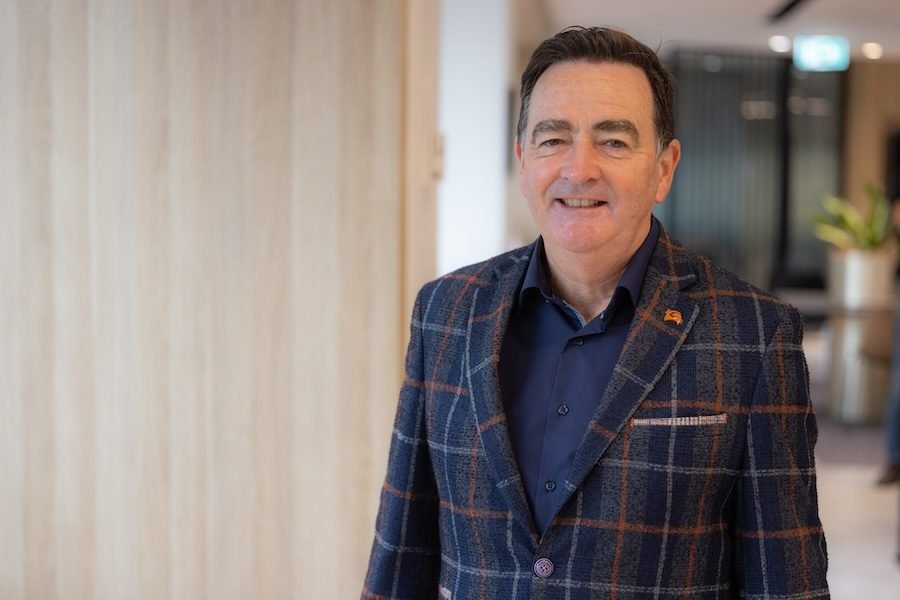

Greg Steele is global president of the Mobility Business Area at engineering giant Arcadis, which employs more than 6,000 people across 12 countries. He has around 15 years of management-level experience in global organizations focused on transport, mobility and infrastructure. Steele is also co-chair of the World Business Council for Sustainable Development’s Transport & Mobility Pathway and chair of Engineering Aid Australia, which supports First Nations youth to pursue careers in engineering or technology.
Steele spoke to Aileen Cho, ENR’s Deputy Infrastructure Editor, about key projects and the future of mobility. This interview has been edited and condensed.
How did you get into this space?
It’s in my DNA. I have been a civil engineer for 40 years—the first 10 in the government—always on the move, whether on highways or railways. I did a lot of transportation planning, then I became a consultant. When Arcadis restructured as a global business four years ago, I was asked to take on mobility.
What are the major mobility trends?
Electric Vertical Takeoffs and Landings (eVTOLs) – The Jetsons-type stuff is one. We are working with the San Diego Association of Governments (SANDAG) and private sector companies on new modes of transportation such as autonomous pods. Active mobility is huge as the world tries to decarbonise. Walking, cycling, e-scooters are all trending all over the world. Mobility centers (cities and precincts with car-free zones) are common in the Netherlands.
What about The Future of Fifth in New York City?
It is in the early stages. We aim for a boulevard similar to the Champs Elysees avenue. The idea is to create shade, vegetation as relief from the heat, a pleasant pedestrian environment for locals and tourists and a precinct that attracts income and finance. There is a lot of stakeholder involvement. We are working on how it can happen. Mobility and traffic and bicycles and pedestrians, and also architecture, to make it look and feel good. It comes down to the details of planting.
I am now in New York for New York Climate Week. I preside over the mobility and mobility itinerary [group]. Many members come together to work and take on challenges. We worked with [Japanese IT equipment and services firm] Fujitsu Ltd. in a project in London: if everyone shared data, what would it look like? Could we coordinate services, travel details? For example, electric vehicle infrastructure: we could save 15% on its costs if we coordinate. We’re looking at electric bus corridors in places like India, Brazil and Mexico. This week, I’ve been talking to financiers, private sector operators, Amazon and [original equipment manufacturers].
Tell me more about Engineering Aid Australia.
I have been President of Engineering Aid Australia for eight years. It has been around for 25 years. We encourage natives to become engineers. About 1,500 students have gone through the program and 25% have gone on to become engineers. We bring them from remote areas to big cities and immerse them for a whole week in projects. It opens their eyes to the possibilities. The goal is to ignite big dreams among indigenous youth.
Do you think that in the future, cities can really be zero?
I think future cities may be zero. They can be automated and coordinated. reducing [vehicle] travel is the best thing we can do. We are working with the northern part of the Netherlands, a region that is working to manage traffic to reach net zero over a period of 10 years.
What about the San Fernando Valley light rail project?
And of course Arcadis is involved with the Hudson Rivers Tunnels project…
It is one of the largest in the world. As a delivery partner, we are looking for the most efficient way to deliver packages [related to] time and cost management. All these elements are under our control. It is complex. Today I learned about a bulkhead wall built by the Dutch in the 1890s that the [project] The TBM must pass. The barges are out there reinforcing the soil. Arcadius [started out as] a Dutch company, so it’s like coming full circle.
