


Growth in the use of electric equipment in construction has been relatively slow in the United States despite successful pilot efforts, but a new coalition of cities, municipal agencies and industry groups is seeking to promote wider adoption.
The New York City Mayor’s Office of Climate and Environmental Justice joined C40 Cities on September 20 to announce the launch of the North American Electric Construction Coalition, “bringing together cities and industry partners committed to developing the electrical construction equipment market in North America,” says a statement from the mayor’s office. “Making the switch to this type of equipment helps reduce noise and air pollution, greenhouse gas emissions and achieve carbon neutrality”.
The statement also notes that New York City has sought in recent years to strengthen its commitments to reduce embodied carbon and promote cleaner building practices. “The city sees electrifying construction sites as an integral part of our environmental justice and decarbonization agenda,” the statement said.
Also joining the coalition are Austin, San Diego and Montreal, as well as Boulder County, Colo. Industry partners include the New York chapter of the American Institute of Architects, the Construction Employers Association and the Carbon Leadership Forum. Continuing Admission will allow additional members to continue to join through the fall and winter. “The construction industry accounts for 23% of global greenhouse gas emissions,” according to C40 Cities, a global network of mayors.
“The decision by North American governments not only to promote electric construction equipment, but also to leverage their capital budgets to support utilization, has great potential to increase the availability of such equipment,” says the President and CEO of the Construction Business Association, Elizabeth. Crowley.
“Major cities like New York and the surrounding area of New Jersey are already making electric construction vehicles more available in the market, ensuring they meet safety and durability requirements. The machines needed on every job site, such as backhoes and electric forklifts are being used in New York, offering the quality and reliability of their fuel counterparts.”
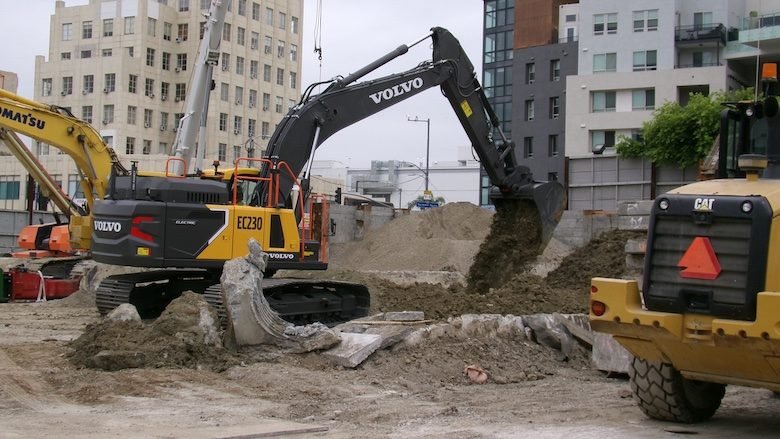
Although overall uptake has been slow, there have been some successful pilots for electric equipment on large urban projects in the U.S. Earlier this year, Skanska completed two all-electric heavy equipment pilots at the project d ‘extension of the Los Angeles D line subway. In February, it deployed a 23-ton Volvo CE EC230 electric excavator to load trucks with debris from an underground tunnel.
Using an electric excavator instead of a conventional diesel engine helped reduce hourly carbon emissions by 66% and hourly costs by 74% during the 90-day pilot, Skanska announced . The goal was to “test the ability of a battery-powered excavator to carry out the required construction work, particularly relative to its diesel-powered counterpart,” he said.
The pilot supported Skanska’s global goal of reducing the carbon emissions embodied in its workplaces. Likewise, it helps support Volvo’s goal of achieving net zero emissions in its value chain by 2040 and net zero emissions for its entire rolling stock by 2050. Skanska also run a pilot on the same project for a HAMM HD 12eVV tandem electric reel, one of five such pre-production models in North America.
Although there are successful pilots, many American contractors are more attracted to hybrids and other intermediate steps than to all-electric machines. Michael Battaglia, president of the Association of Equipment Management Professionals, which represents companies with a combined fleet value of about $23.6 billion, says members are “focused on hybrid technology that is easy to adopt , maintain and manage with a clear return on investment.”
Battaglia acknowledges that electric equipment is one of many approaches to help with carbon reduction for an equipment fleet, and says his group is educating end users about the options available. He adds that the development of mobile fast charging stations will be critical to long-term adoption by the industry.
