

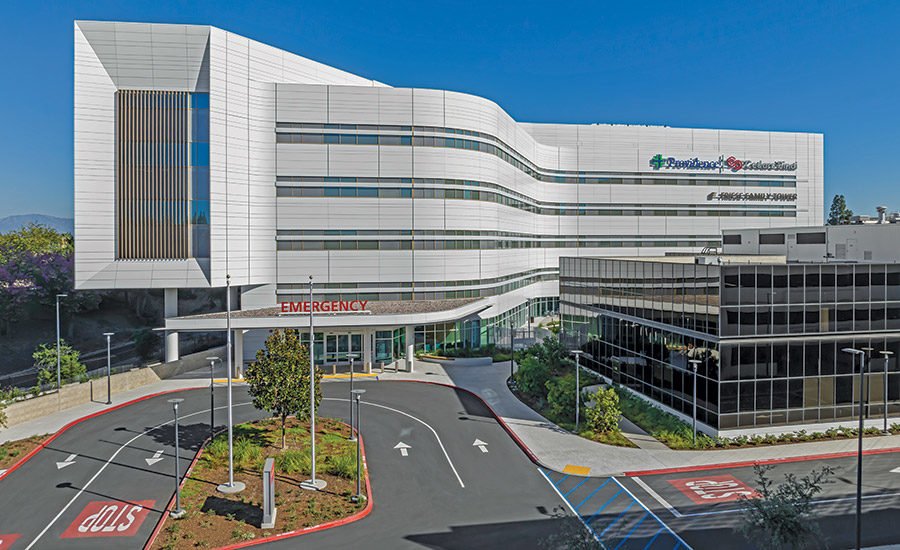
Tarzana reimagined
Tarzana, California
BEST PROJECT, HEALTH CARE
Sent by: McCarthy Building Cos.
Owner: Providence Cedar Sinai Medical Center
Main design company: Perkins and Will
General contractor: McCarthy Building Cos.
Civil/structural engineer: KPFF Consulting Engineers
MEP Engineer: Syska Hennessy Group
Associate Architect (Seismic Update): Taylor design
Registration Inspector: RF10 Inspection Inc.
At $448 million, Tarzana Reimagined is the largest healthcare project in the San Fernando Valley. Providence Cedars-Sinai Tarzana Medical Center has served the growing San Fernando Valley community since 1973. The scope of work in this expansive effort included the construction and renovation of 400,000 square feet of clinical space, with a new replacement tower, main entrance building and parking structure. . Crews also performed a seismic retrofit of the existing campus, as well as several campus improvements and renovations.
The team “overcame several challenges in the delivery [the project]including the limited area of the site for construction and the need to maintain full hospital operations throughout construction,” says Eric Brossy de Dios, associate director and senior project manager at Perkins&Will.
At the core of this expansion and modernization project is the Friese Family Tower, which features 150 private rooms, an expanded emergency department, a pharmacy, a pediatric unit, and specialized cardiovascular, critical and progressive units. Several new sustainability features that were new to the campus as a whole were incorporated into the tower, including energy-efficient lighting and controls and heat recovery chillers to use waste heat for HVAC.

Photo by RMA Architectural Photography
The Main Entrance Building revitalized the campus exterior and main public entrance with the addition of a covered entrance, lobby, gift shop, chapel, admissions center, nuclear medicine treatment room and gastrointestinal and preparation and recovery room.
A new central service plant modernizes campus infrastructure, and a 600-stall, 185,000-square-foot parking structure improves vehicle circulation by separating the emergency drop-off and main entrance from dedicated parking areas.
“Building health care is inherently challenging, especially when opening on an active campus,” says Erik Chessmore, vice president of McCarthy. “Delivering successful outcomes in such an environment requires an unwavering commitment to patient care, a collaborative spirit and innovative problem solving by a team. [that] is laser focused on a common goal.
A challenging master plan translated into complex and overlapping projects, milestones and upgrades to public services. The Tarzana team also had to ensure projects were completed before seismic compliance deadlines, accomplished by partnering with local and state officials to establish priorities that balanced patient care with needed campus upgrades throughout the six-year period.

Photo by RMA Architectural Photography
Work on the seismic project was due to start in March 2020, but would have temporarily affected the respiratory therapy department. With the pandemic in full swing, the team had to reprioritize the schedule to support the hospital’s immediate needs.
Ensuring worker safety was also critical, especially given the local area’s tendency to reach temperatures in excess of 100°F. Installing permanent shade structures, such as canopies between storage bins equipped with cooling fans and spray, helped keep things calm. In 2.3 million hours of work, the team recorded an OSHA recordable incident rate of 0.26, with zero lost time accidents.
Interim life safety measures also helped ensure the safety of patients and employees throughout construction.
The team combined these measures with two other planning tools: area disruption notices, which define the separation of construction activities from active areas, and procedural methods, which define the methods that to use in and around active public services. Despite the extended duration of the project, patient care was never affected by construction activities. Crews completed all work within budget in September 2023.
