

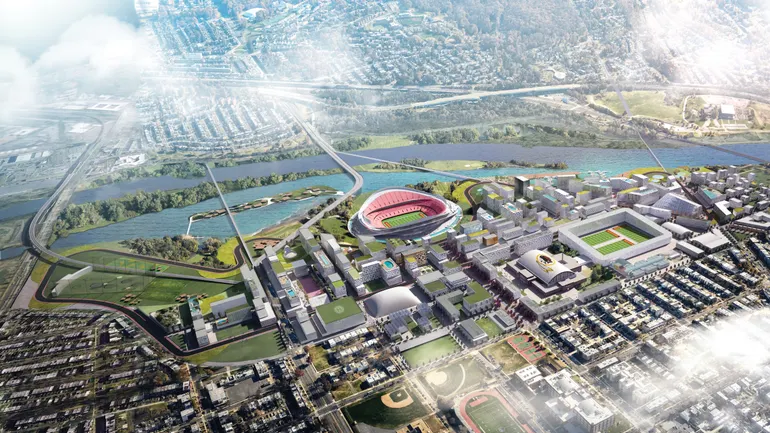
When the Denver Broncos ownership group announced its plans for a new football stadium in September, city and state leaders applauded its pledge to privately finance both the stadium and a new mixed-use district surrounding it.
But the Broncos’ announcement contained some notable fine print. The multibillion-dollar stadium complex will not be fully funded by the team’s owners, who include members of Walmart’s Walton family.
“The project will include city and state support for public improvements,” the announcement notes.
Sports economic experts say this kind of hybrid financing of mostly private but partly public sports stadiums is becoming more common as a new era of stadium construction begins.
Driving factors include research showing that taxpayer-funded stadiums don’t boost the local economy, voter reluctance to approve the skyrocketing costs of new stadiums and the growing use of less obvious public funding like tax increment financing and property tax forgiveness.
The transition from public to private
“During the great boom in stadium construction from 1992 to 2007, about two-thirds of those stadiums were funded by taxpayers,” said Victor Matheson, a professor of sports economics at the College of the Holy Cross in Massachusetts. “But then the Great Recession hit in 2008, and people found it quite distasteful to spend taxpayer dollars on sports stadiums.”
Today, when people vote to tax themselves to build a new stadium, the results are basically crap, according to a database compiled by Geoffrey Propheter, an associate professor at the University of Colorado Denver who specializes in property tax policy and the economics of sports facilities.
Since 1980, Propheter said, there have been 81 referendums on taxpayer funding for stadiums or arenas in the five major professional sports. Only 52% have succeeded.
The most recent failure is a 2024 vote in Missouri to continue a three-eighths-of-a-cent sales tax for 40 years to fund a new Kansas City Royals baseball stadium and improvements to the Kansas City Chiefs football stadium. Fifty-eight percent of voters rejected the tax, despite the Royals’ owners pledging to pay about half of the more than $2 billion stadium district.
“Taxpayer subsidies for stadiums are not popular,” Matheson said. “Not everyone likes a team. Even in places with rabid fandom, like Buffalo, taxpayer subsidies for their new [football] the stadium never topped 50% of the polls.”
The role of local government
Some cities avoid the taxpayer crackdown by avoiding stadium votes and instead approving public funding through city councils.
According to Propheter’s database, in the past 2.5 years, there have been 38 votes by representative democracies such as city councils on the financing of sports facilities in the five major sports leagues. All these votes passed.
That includes the Washington, DC council’s 11-2 vote in September to give the Commanders football team $1.15 billion in taxpayer funds to move its stadium from Maryland to DC.
The stadium would also anchor a residential and commercial district that D.C.’s budget director estimates could generate $4.2 billion in tax revenue over 30 years.
That sounds good on paper, Propheter said, but there’s a hidden price. The agreement exempts the commanders from paying property taxes for 30 years. It also gives team owners exclusive rights to develop 24 acres of land that DC controls around the new stadium site, in exchange for $1 a year in rent for 26 years.
“This is prime riverfront property that the district could develop without the commanders,” he said. “Council is essentially mortgaging the future of taxpayers, leaving billions of dollars in rent on the table that they could collect for this land.”
A poll found that for this and other reasons, 60% of DC residents oppose the stadium deal approved by the council.
Gaps in private financing
Many of the stadiums built in the 1990s and early 2000s had 30-year leases with the government entities that helped finance them. When those leases expire, Matheson said there is a new wave of stadium construction, but not a new wave of public funding. He estimated that about two-thirds of the stadiums currently under construction or in the planning stages are privately financed.
But as with the Broncos’ new stadium, that private funding may come with an asterisk.
“Look at the Carolina Panthers stadium,” Propheter said. The football stadium was built in 1996 with private funding and is still privately owned by the team. But last year, the city council of Charlotte, North Carolina, voted to fund $650 million in stadium renovations, with the team’s owner paying $150 million.
“So a stadium can start with private financing, but that doesn’t mean it stays privately financed,” Propheter says.
In the Broncos’ case, the owners plan to build a new stadium and mixed-use district at Burnham Yard, an abandoned railroad property near the existing stadium that the state bought in 2021. The Denver Post reported that discussions had taken place about declaring the property blighted and eligible for tax increment financing from the Denver Urban Renewal Authority.
DURA Executive Director Tracy Huggins said if the city adopts an urban renewal plan for Burnham Yard, it would be designated as its own urban renewal area with a dedicated TIF district. And by law, that TIF would be limited to public use improvements for the site.
“This includes infrastructure such as utilities, streets, sidewalks, environmental cleanup and site preparation, the elements that make redevelopment possible and accessible to the public,” he said. “For any stadium project, DURA could reimburse costs that provide a clear public purpose, such as life safety systems or ADA compliance in certain facilities.”
Minimal loss of taxpayer dollars
Sports teams get attention, but Matheson said it’s important for city leaders to remember they’re just one of many businesses that support the local economy.
“In the case of the Broncos, they are a business building a new establishment – they are no different than a shopping center developer or any other type of developer,” he said. “But when a sports team is involved, politicians lose their minds.”
Propheter said that for big cities, sports are a “really small fraction of the overall economic activity of any jurisdiction.” He is currently working on a book that examines what is happening in Oakland, California, after its professional basketball, football and baseball teams recently moved to other cities that offered more favorable financing for arenas and stadiums.
“The preliminary results show that we’re only talking about the city of Oakland losing a couple of million dollars in taxes a year,” he said. “With a city budget of over $2 billion a year, that’s less than a rounding error.”
