

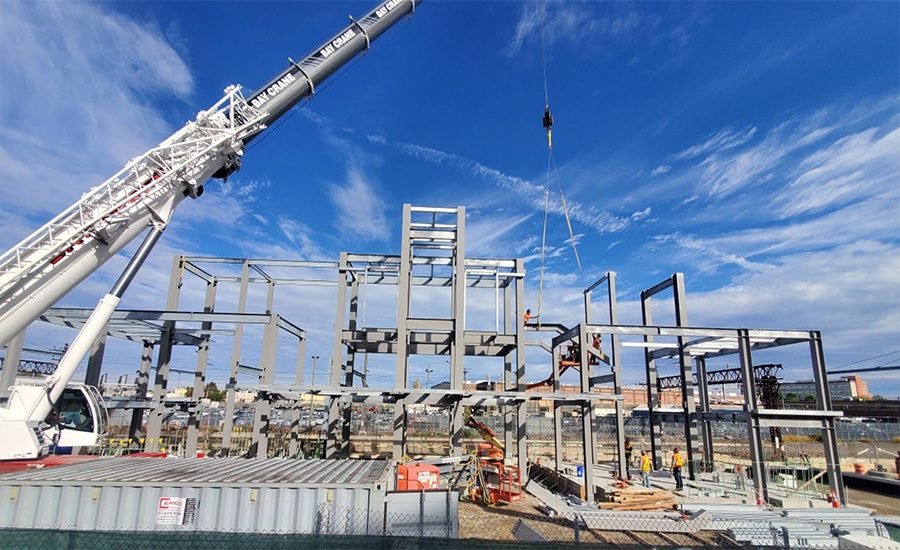
The Metropolitan Transportation Authority confirmed during its Oct. 27 joint Metro-North and Long Island Rail Road committee meeting that its long-planned Penn Station access project is facing a three-year delay, with substantial completion now expected in the second quarter of 2030.
While the delay was not discussed during the public session, MTA documents reviewed by ENR show the agency formally notified Amtrak in writing that its breach of contractual obligations has halted progress on the 19-mile commuter rail expansion. The project is part of the MTA’s effort to link the East Bronx and southern Connecticut more directly to the West Side of Manhattan via Penn Station.
Jamie Torres-Springer, president of MTA Construction & Development, accused Amtrak of “repeated breaches” of the Design and Construction Phase Agreement and the 2021 Cost Sharing Agreement, which governs the sharing of Amtrak’s Hell Gate Line project.
In a 10-page letter sent Oct. 27 to the rail carrier, he wrote that “the project is delayed by more than three years from the current mitigated schedule presented by HRJV,” referring to designer Halmar International/RailWorks JV.
MTA documents describe a pattern of missed access windows and absent equipment that the agency says has stalled construction. Only two of the 10 promised weekend track breaks were delivered in 2022 and five of the 38 in 2023.
RELATED
White House awards $16.4 million for 25 Northeast Corridor projects
During that period, Amtrak failed to provide required staffing for 98 days when track foremen were needed and for 77 days when electrical line technicians were required to de-energize catenary systems, violations of the 2021 agreement.
“As the right-of-way owner, Amtrak was contractually obligated to support the project,” the MTA report states. “Unfortunately, these commitments have not been met and the project has suffered significant delays as a result.”
The cost-sharing agreement requires Amtrak to provide track disruption windows and mandatory labor, with a clause allowing the MTA to recoup up to $50 million in delay-related costs if those commitments are not met. Torres-Springer said damages have already exceeded that amount and urged Amtrak to reopen negotiations.
“In the absence of significant corrective action and additional financial participation from Amtrak, MTA will consider all available remedies,” he wrote.
The agency’s filing puts the project at 39 percent complete, with the baseline budget of $2.867 billion unchanged, but “at risk” pending re-basing later this year. MTA has not yet quantified the impact of the delay on the total cost.
The delay highlights the breakdown in coordination and the impact of travel

Metropolitan Transportation Authority map showing a preliminary service plan for the 2027 interim phase of the $2.9 billion Penn Station Access Project. The plan calls for limited weekday Metro-North service to three new Bronx stations: Co-Op City, Morris Park and Parkchester/Van Nest, while full four-track operations are delayed until 2030.
Graphic courtesy of MTA Construction & Development
Under the design-build contract, Halmar-RailWorks is providing four ADA-accessible stations in the East Bronx, at Hunts Point, Parkchester/Van Nest, Morris Park and Co-Op City, along with bridge upgrades and modernized power, signal and communications systems. Ankura Consulting acts as an independent planner overseeing the work.
Agency officials are evaluating a temporary service plan that could open three of the new Bronx stations, excluding Hunts Point, as early as 2027 using existing two-track infrastructure, while delaying full four-track capacity until 2030.
During the meeting, MTA Chairman Janno Lieber said the authority is “pointing out what’s going on for the world to understand,” adding that transparency around interagency performance is essential to prevent a repeat of the coordination failures that dogged East Side Access.
Amtrak has not publicly disputed the MTA’s account. In a media statement, the railroad said it “remains committed to this critical project and to being good stewards of taxpayer investment,” noting that it has invested more than $140 million and deployed additional staff to support the work.
The delay has implications for both Bronx commuters and regional contractors. MTA projections show the extension could cut Manhattan commute times by up to 50 minutes and spur redevelopment near the new stations.
Lieber said the agency will present a new cost-risk assessment and new baseline schedule before the end of the year.
“This is not about guilt,” he said. “It’s about transparency and making sure the public understands what’s holding up one of the region’s most important transit links.”
