

dAta centers are often depicted as giant brains, but the miles of wires and cables radiating from them look more like the tentacles of a giant jellyfish… A single 500-acre hyperscale campus, like the one contractor Mortenson is building in Eagle Mountain City, Utah, has more than 40 miles of ductwork needed to safely house those lines.
Mortenson is among several companies that are rethinking every step involved and have achieved impressive safety improvements with reduced exposures to hazards.
Conduit bank sections are a series of conduits through which cables run. Traditionally, they are created by digging a trench, preparing the trench base, constructing forms and installing conduit cages before pouring concrete. Sections are often built in thick mud, and trenches often need to be dewatered in bad weather, extending the installation process to three to four weeks per 1,000 feet. The process is repeated over and over until the cables can be removed and the data center is powered up and connected.
As the labor-intensive work unfolds, workers are exposed to slippery conditions, trench collapses, and chemical burns from wet concrete.
Major electrical contractors such as Rosendin Electric i Bergelectric has analyzed the problems related to the duct bank. Excavation and utility contractors such as Muller and Contech Engineered Solutions and large general contractors and construction managers such as DPR and Turner Construction also have conduit bank programs or special methods.
Minneapolis-based Mortenson, through its manufacturing arm, BLUvera, took on the challenges in 2020, opting to embrace prefab and off-site prefab on a large scale.
Data center developer QTS had hired Mortenson for the large Utah project in Eagle Mountain City, west of Provo.
“The idea came from the Eagle Mountain hyperscale data center,” explains Nate Haack, vice president and general manager of BLUvera. “The project team was facing schedule challenges in a congested area, so they asked, ‘What if we prefab these elements off-site and install them like Lego blocks?’
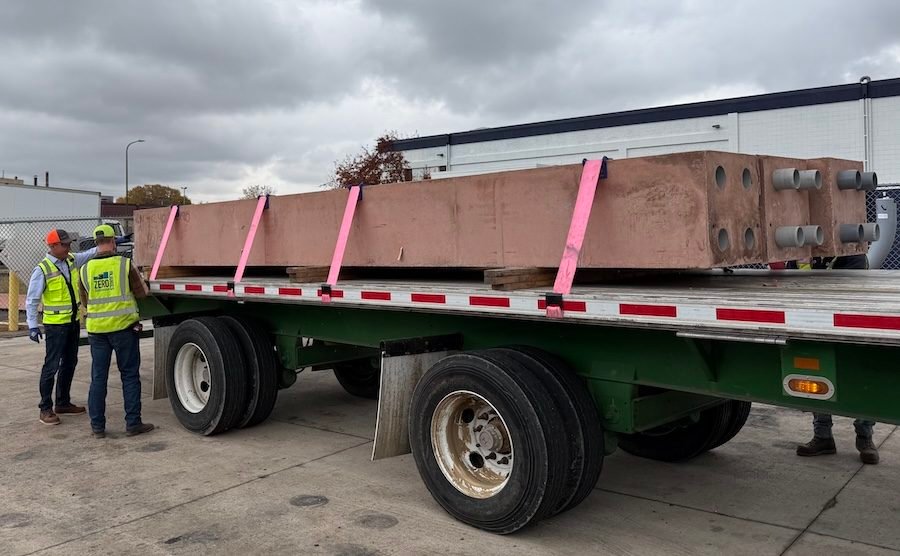
Over the past five years, BLUvera has scaled up its operations to produce 20-foot modular sections weighing 17,000 pounds in off-site fabrication shops, reducing on-site labor hours by 56 percent.
The risks to worker safety have also been reduced. Mortenson says he has seen an 87 percent reduction in safety incidents after switching to precast, based on BLUvera’s internal tracking data from 2024. The practice has reduced trench exposure by 60 to 70 percent, according to a company case study on the Eagle Mountain project. Teams go through the same tasks every day in manufacturing shops. The work carried out on site consists of placing duct bank beams and connecting ducts together.
Mortenson’s off-site precast has reduced wet concrete exposure, eliminating potential burns, slips or form collapses, and reduced excavator lift by 60%. Only one lift is needed for every 20 feet of duct bank versus 10 to 15 with a cast-in-place approach.

The data center duct bank construction process has been perfected by Mortenson and includes placing concrete in an interior fabrication shop. Photo: Courtesy of Mortenson.
“In the factory setup,” explains Haack, “we’re under a roof, in a controlled environment with forklift lanes and truck lanes. The way we pour our precast duct bank is cycled every day. So for our team members, it’s a rinse and repeat. Every day, they’re doing the same task, because they’re pulling every form every day.”
Defects have also dropped dramatically.
“We rarely have one,” says Haack. “We have seen an 83% reduction in quality defects with the most common defect resulting from damage due to truck loading and unloading.”
To minimize transportation and logistics costs, BLUvera took its prefab concept a step further and now deploys mobile factories near data center project sites. Installed near workplaces, they can be expanded very quickly.
“It’s very inefficient from a cost perspective to ship” sections of the conduit bank, Haack says. “We sign a lease, take possession, and within a month we’re producing … once we’re done producing the products for the job site, we’ll move on to the next one.”
Mortenson currently has a mobile duct bank factory in Louisiana. “We’ve been there since January and we’ll be there for another year,” says Haack. The company is working on leases for two more mobile factories.
Marty Corrado, a retired project manager, prefab advocate, and author of a prefab book, likes what he sees with data centers and compares it to projects he’s been involved with.
In 2017, working as JE Dunn’s general superintendent on the Sarah Cannon Hospital addition in Plano Texas, Corrado’s team included an electrical contractor’s prefabricated duct bank for a hospital, another type of structure hungry for electricity and data.
 Eliminating as much labor as possible in the trenches is one goal that Mortenson says has significantly improved safety performance during duct bank construction. Photo: Courtesy of Mortenson.
Electrical contractor Enterprise Solutions “dug the hole on a Monday and pretty much dug the entire hole in a week,” he explains. “In the next four weeks, [the team] poured the concrete for the [duct bank] pedestals, set up the bench, tie everything down and have it inspected. It was done in 30 days,” Corrado points out, adding that “it would normally take us four to five months.”
Of Mortenson’s innovation, Corrado says he’s “very happy to see the electrical side of the industry really start to work efficiently.”
Haack says Mortenson has more innovations in the works. He is preparing a new duct bank that he says will further reduce on-site labor by eliminating the need for someone to be in the trench to attach sections of PVC duct. The new system will reduce the project’s carbon footprint by “north of 30%,” he adds.
The developing data center construction boom will provide many opportunities to see what works best.
