

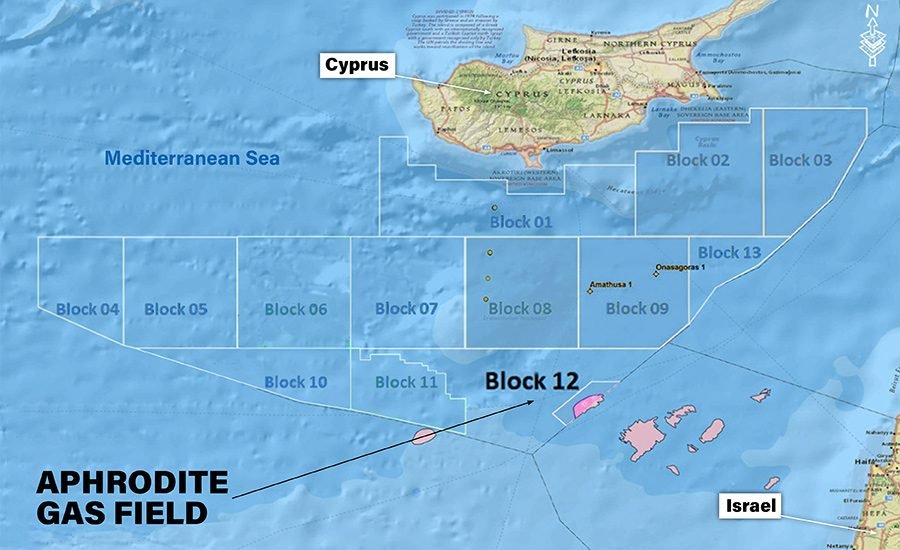

Global energy giant Chevron Corp. has awarded Australia-based engineering services firm Worley the front-end engineering design (FEED) contract to develop the Aphrodite gas field in the Mediterranean Sea off the coast of Cyprus, projected as a $4 billion development.
The FEED award is a reimbursable engineering and procurement contract, but without disclosing the value of the contract. Worley had previously done the preliminary engineering for the development.
The corporate unit Chevron Cyprus Ltd. operates the field, which contains 3.5 trillion to 4 trillion cubic feet of natural gas plus condensate after its discovery in 2011 by Noble Energy, now a unit of Chevron.
In awarding the FEED contract, Chevron, which has a 35% share of the development along with Shell and Israel NewMed Energy’s equal share of 30%, have indicated their intention to move on to the next phase. Initial work will be completed in December and a final investment decision on the project is expected by January 2027.
“We are happy that Chevron has finally decided to proceed with the development of the Aphrodite field,” a source at the Cyprus Energy Ministry told ENR.
The governments of Cyprus and Egypt have signed preliminary agreements for gas supplies, with an undersea pipeline intended to feed most of the volume into the Egyptian grid and the balance processed into LNG for re-export, likely to Europe.
In a statement, Worley said his work will cover “the entire development of the Aphrodite field, including part of the subsea systems, the floating production unit, the export pipeline and the onshore reception facilities,” as well as the procurement of equipment.
Looking for quick answers on construction and engineering topics?
Try Ask ENR, our new intelligent AI search tool.
Ask ENR →
A project favored by Cyprus since the discovery of the field appears to be progressing to supply gas for its own power generation and for the European market. The country is a member of the European Union. Investment in the development has faced obstacles including Aphrodite’s distance from the coast, the cost of the undersea pipeline to Cyprus and the island’s small gas market.
Chevron, which bought Noble Energy in 2020 for $5 billion, with then and later Aphrodite development plans unfulfilled. Noble had also discovered and was a developer of the Tamar and Leviathan gas fields off the coast of Israel, with an estimated combined 33 trillion cubic feet and production underway since 2013.
But earlier this month, in the wake of the war between Israel and the US and Iran, Chevron declared force majeure at the Leviathan field after the government ordered a temporary suspension of production for security reasons. Reuters said on February 28 that the country’s energy needs would be met through alternative sources.
The shutdown comes just weeks after Chevron announced in January a final investment decision for the Leviathan expansion, when the company said the plan “reflects our confidence in the future of energy in the region.” The expansion was expected to be completed by the end of this decade.
The Cyprus supply chain is developed
Meanwhile, two groups have submitted bids to supply the Cyprus floating production unit: Singapore-based Seatrium (formed by the merger of Sembcorp Marine and Keppel Offshore & Marine), and a South Korean group made up of Hanwha Ocean, Hyundai Heavy Industries and Samsung Heavy Industries. Subsea7 and Stena Drilling compete for subsea pipeline construction and installation contracts.
It is unclear whether the current timetables will be maintained, but construction work will begin in 2027 and end in 2031 with first gas production in 2032.
“Worley got the contract, but there is a long way to go before the FID,” Charles Ellinas, an expert in Eastern Mediterranean oil, gas and geopolitics as CEO of EC Cyprus Natural Hydrocarbons Company Ltd., told ENR. “Whatever happens, Chevron will not move to the next step until project returns meet their targets. So I expect delays.”
