

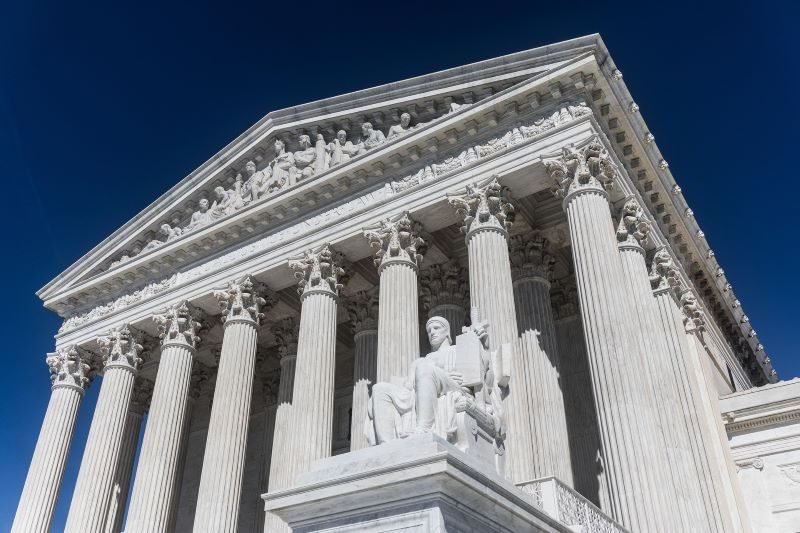

U.S. Supreme Court justices were skeptical of claims that President Donald Trump can impose broad and sweeping tariffs under the International Emergency Economic Powers Act and other laws, hearing oral arguments Nov. 5 in two consolidated cases brought by business groups and states challenging his authority.
Construction projects have already faced cost and other impacts from various tariffs on steel, aluminum and other materials, although most have only been in place for a few months at most, industry groups say.
“Constant changes in rates, effective dates and other provisions have made it difficult for contractors to price projects and likely led owners to postpone the future until they know their input costs and the demand or need for structures,” Ken Simonson, chief economist for the Associated General Contractors of America, said in an email.
Slowdowns are being seen in architectural billings, a key indicator of strength in downstream construction markets, while material prices have risen at a time when construction spending is shrinking, although growing data center and energy sector markets are softening the contraction to some extent, Anirban Basu, chief economist at Associated Builders and Contractors, said in an interview with ENR.
Related to cases before the high court:Learning Resources, Inc. against trump i Trump vs VOS selections— the justices did not seem inclined to agree with the Trump administration’s central argument, offered by U.S. Justice Department Attorney General John Sauer, that language in the International Emergency Economic Powers Act that gives the president authority to “regulate importation” can be interpreted as also granting authority to impose tariffs during a national emergency.
Sauer said Trump concluded earlier this year that “exploding trade deficits” and the trafficking of fentanyl and other opioids have created a national emergency because they are threats to national and economic security.
But several justices, including those in the conservative majority, were skeptical. Associate Justice Amy Coney Barrett asked Sauer, “Do you hold that all countries should be subject to tariffs because of threats to defense and the industrial base? I mean, Spain, France? I saw that with some countries, but tell me why so many countries should be subjected to the reciprocal tariff policy as they are.”
Sauer’s arguments were largely based on President Richard Nixon imposing blanket tariffs on all major trading partners in 1971 as a bargaining tool. Two years later, Congress enacted the International Emergency Economic Powers Act with the words “to regulate importation,” which Sauer said codified Nixon’s actions.
Chief Justice John Roberts said: “You have claimed a source [the act] which had never before been used to justify tariffs. No one has argued that it does until this particular case. Congress uses tariffs in other provisions, but not here.”
Associate Justice Brett Kavanaugh added that “One problem you have is that presidents since [the act was enacted] they haven’t done that. Your main answer, or one of your many answers to this, is the Nixon example.
Neal Katyal, a former Obama administration attorney general and now a partner at a law firm that argued on behalf of the private company plaintiffs, said the International Emergency Economic Powers Act is the wrong vehicle for imposing tariffs, because they are essentially taxes. “Although the presidents have used [it] impose economic sanctions thousands of times, without any president [its] For 50 years of his life he has tried to impose tariffs,” he said, adding that the president bypassed statutes that directly authorize tariffs that provide rails and caps.
ABC economist Basu notes that even if the Supreme Court rejects the administration’s arguments, it’s hard to know how the construction industry will be affected because it’s nearly impossible to predict how the president will respond.
“If, in fact, the Trump administration simply authorizes new tariffs based on new sections of the code, there really isn’t much economic change. [for contractors]” he says. But if the administration “decides that it can’t respond that way because the court has issued a ruling that makes it difficult [it] replace these tariffs through other mechanisms, this means future relief for contractors buying construction inputs.”
