

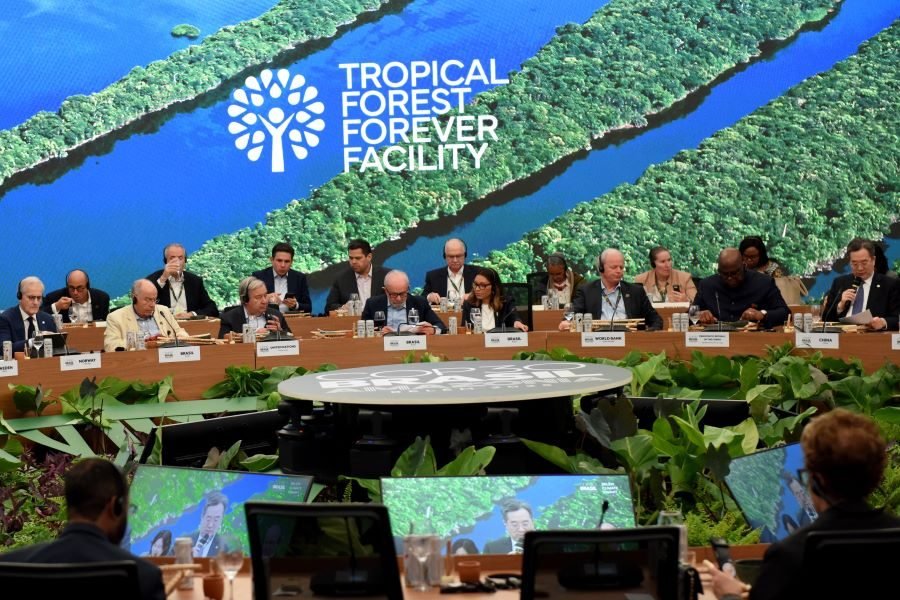

Nations walked out of international climate meetings in Brazil during the two weeks of the 30th United Nations Framework Convention on Climate Change (COP30) that ended last month, with little to show for their efforts. There was no representation from the Trump administration, which has embraced fossil fuels and denied that climate change is a crisis, and efforts to negotiate tangible plans to reduce fossil fuel emissions mostly collapsed.
“The talk at the COP has been to ’embrace the science and move away from negotiations to focus on implementation,'” Bill Hare, CEO of Climate Analytics, a Berlin-based global environmental non-profit, said in a statement. “However, there is a massive risk that the COP30 outcome will just leave countries to ‘implement’ policies that will warm the Earth to 2.6°C. There is no point in ’embracing the science’ if there is no action, just as there is no point in agreeing to global energy targets if they are not implemented.”
There were small gains. The meetings marked the official launch of the Tropical Forests Forever Facility initiative, which was established by the Brazilian government to provide annual funding to countries that preserve tropical forests. The $5.5 billion program received endorsements from 53 countries, those with tropical forests and others, and 19 of the endorsers were potential sovereign investors, according to the COP.
Marina Silva, Brazil’s Minister of Environment and Climate Change, said in a statement that the funds are not a donation, but “an initiative that works according to the logic of the market, leveraging private resources from public investments.”
He added that “for every dollar contributed by countries, around four dollars are expected to be mobilized from the private sector, creating a permanent trust fund. It is a new way of financing conservation, with shared responsibility and vision for the future.”
A total of 83 countries, more than ever before at a COP meeting, agreed to reduce fossil fuel emissions, and the final agreement calls for tripling funding to developing countries for climate adaptation projects. More than 14,000 local governments in cities around the world pledged to reduce emissions and protect communities from the deadly heat.
Some US lawmakers attended COP30 on their own, including US Senator Sheldon Whitehouse (DR.I.) and California Governor Gavin Newsom (D).
Whitehouse criticized the administration at a Nov. 14 news conference for being aligned with fossil fuel interests, adding that while officials deny climate change is a crisis, the financial community, including executives at Goldman Sachs, Freddie Mac and others, is well aware of it. “Many people who are not green by nature [are] looking for the next economic shocks,” he told the media.
Closing window to achieve the goal
Numerous studies suggest that the goal of the Paris Agreement adopted in 2015, which aimed to prevent average global temperatures from rising more than 1.5° Celsius above pre-industrial levels, is no longer achievable. In January, the World Meteorological Organization said 2024 was the first year in which average global temperatures exceeded a 1.5°C rise, reaching 1.55°C, the hottest years on record in the last decade.
A study published on October 27 in the journal nature suggested that the carbon footprint of the construction industry alone could more than double globally by 2050. The authors found that by 2022, the use and manufacture of materials such as cement, bricks and metals accounted for more than half of the industry’s carbon emissions, while glass, plastics, chemicals and biological materials contributed 6%. The remaining 37% comes from transport, services, machinery and on-site activities.
The authors concluded that under the business-as-usual scenario, “the carbon footprint of construction alone will exceed the annual carbon budget for the 1.5°C and 2°C targets over the next two decades.”
