

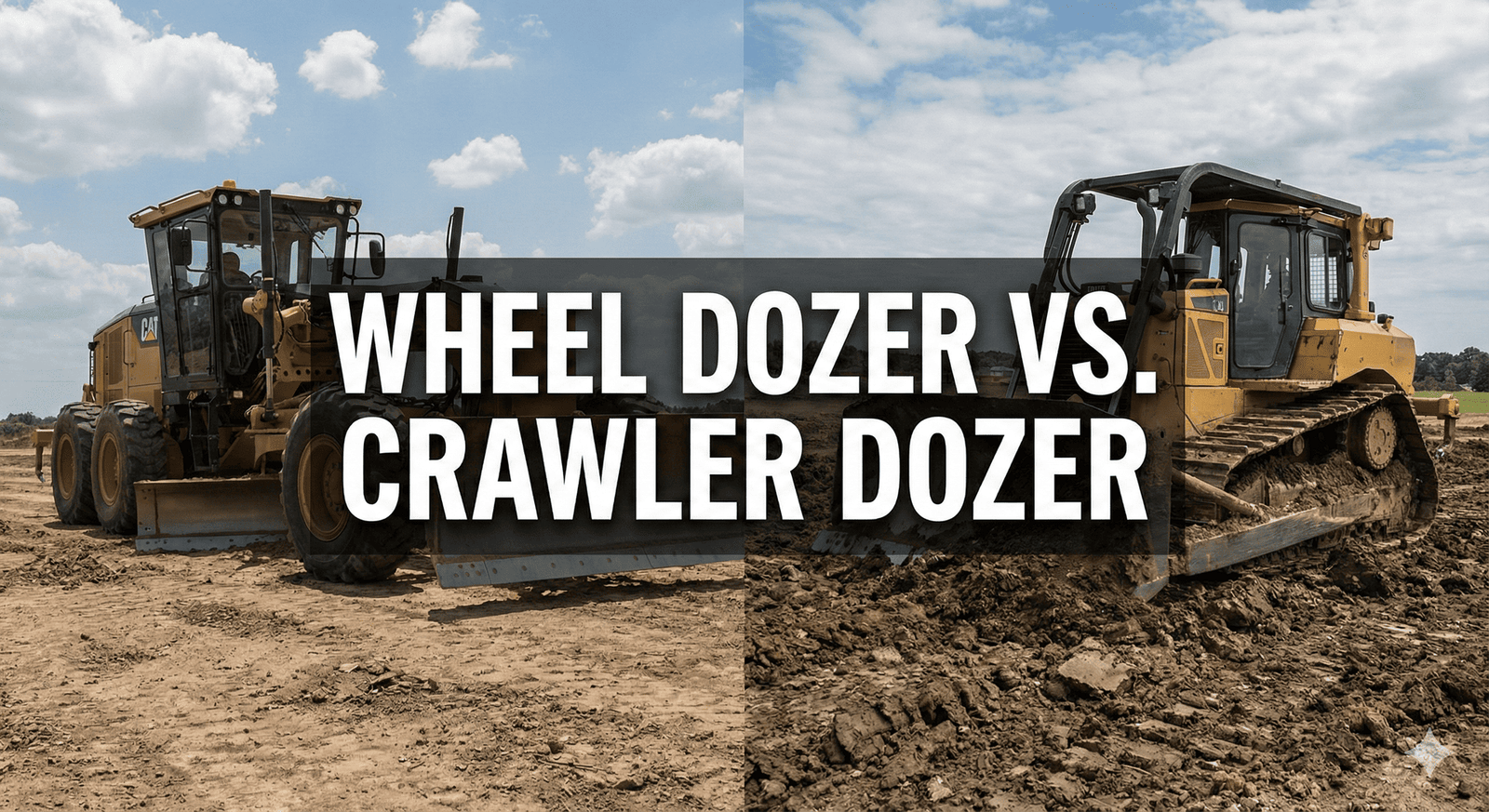
Deciding between a wheel dozer and a crawler dozer isn’t just a matter of “tires vs. tracks”—it’s a decision that directly impacts your project’s timeline, fuel budget, and long-term maintenance costs.
If you are stuck debating which machine deserves a spot in your fleet, you aren’t alone. It is the classic construction industry dilemma: do you need the raw, unshakeable gripping power of a tank (crawler), or the agile, high-speed versatility of a monster truck (wheel)?
Here is a comprehensive, human-written guide to help you make the right choice, stripping away the jargon and focusing on what actually matters on the job site.
Wheel Dozer vs. Crawler Dozer: Which Beast is Best for Your Needs?
In the heavy equipment world, the dozer is the undisputed king of pushing. But “dozer” is a broad term. While they share the same basic DNA—a massive front blade and a powerful engine—the difference in how they move changes everything.
Let’s break down the strengths, weaknesses, and ideal use cases for both, so you can stop guessing and start moving earth.
1. The Crawler Dozer: The “All-Terrain Tank”
When you close your eyes and picture a bulldozer, you are probably picturing a crawler. These are the tracked titans of the industry. They don’t just drive over terrain; they conquer it.
The Superpower: Traction
The crawler’s magic lies in its “footprint.” Because the weight of the machine is spread out over wide, continuous tracks, the ground pressure is incredibly low. This allows crawlers to “float” over soft mud, loose sand, and sticky clay where wheeled machines would instantly sink and spin.
Where It Wins:
-
Severe Terrain: If your job site looks like a swamp, a jagged mountainside, or a forest with loose loam, the crawler is your only option.
-
Heavy Pushing: Tracks provide superior friction. When you are pushing a massive load of wet soil, the tracks bite into the ground, converting almost all the engine’s horsepower into forward motion.
-
Grading and Slopes: Crawlers are inherently stable. Their low center of gravity makes them safer and more effective on steep inclines.
The “Human” Downside:
They are slow. Painfully slow. Moving a crawler from one side of a large site to the other feels like a road trip. Plus, the undercarriage (the tracks, rollers, and sprockets) is a wear-item nightmare. In abrasive soil (like sand or crushed rock), you are literally grinding money away with every mile you travel.
2. The Wheel Dozer: The “Agile Sprinter”
The wheel dozer is the misunderstood cousin. It looks like a wheel loader that hit the gym and swapped its bucket for a blade. It doesn’t have the brute-force reputation of the crawler, but it makes up for it with speed.
The Superpower: Mobility
A wheel dozer can hit speeds of 20 to 30 mph. That might not sound fast for a car, but for heavy equipment, it’s lightning. This mobility changes how you manage a site. You can clean up a loading area, zip over to maintain a haul road, and then drive back to the entrance to grade a ramp—all in the time it would take a crawler to turn around.
Where It Wins:
-
Large, Flat Sites: Open-pit mines, large commercial developments, and airports are wheel dozer territory.
-
Paved Surfaces: Need to cross a road? No problem. Rubber tires won’t chew up asphalt like steel tracks will.
-
Compaction: This is a hidden benefit. Because the weight is concentrated on four tires rather than spread out, wheel dozers provide excellent ground compaction as they work.
The “Human” Downside:
Traction is the enemy here. If it rains and the site turns to soup, a wheel dozer turns into a 50-ton ice skater. They simply cannot generate the push-power of a crawler in loose or slippery conditions. Also, tires are expensive; one sharp rock in the sidewall can ruin your day.
Head-to-Head: The Critical Comparison
Let’s look at the four specific factors that should drive your decision.
1. Terrain & Weather
This is the dealbreaker.
-
Choose Crawler if: The ground is unpredictable, soft, wet, or steep. If you are “pioneering” (clearing land for the first time), you need tracks.
-
Choose Wheel if: You are working on established surfaces, abrasive hard-pack, or concrete. If the ground is solid, wheels will be faster and cheaper to run.
2. Maintenance Costs (The Wallet Check)
This is where the debate gets heated.
-
Crawler: The undercarriage is expensive. It accounts for roughly 50% of the total repair costs over the machine’s life. If you run a crawler on abrasive ground (like silica sand), you will burn through tracks fast.
-
Wheel: Tires aren’t cheap, but generally, a set of tires lasts longer and costs less per hour to run than a track undercarriage—provided you aren’t spinning them in rock.
3. Speed & Cycle Times
Time is money.
-
Crawler: Great for short pushes (less than 300 feet). Beyond that, the slow reverse speed kills your efficiency.
-
Wheel: The king of “push-and-return.” If you have to push material 500 feet and then return for another pass, the wheel dozer gets back to the start line 3x faster than the crawler.
4. Versatility
-
Crawler: It’s a specialist. It pushes and grades. That’s it.
-
Wheel: It’s a multi-tool. It can tow equipment, act as a sprinkler truck (with attachments), and move between job sites without needing a low-boy trailer.
The Decision Matrix: Which one is for you?
To simplify this, let’s look at a few common scenarios.
Scenario A: The Land Developer
-
Job: Clearing trees, stripping topsoil, and cutting initial roads in a hilly, wooded area.
-
Winner: Crawler Dozer.
-
Why: You need the traction to push over trees and the stability to work on uneven, soft forest floors. A wheel dozer would get stuck in the first hour.
Scenario B: The Quarry/Mine Operator
-
Job: Cleaning up spill-over around a shovel, maintaining flat haul roads, and keeping the pit floor smooth.
-
Winner: Wheel Dozer.
-
Why: The ground is hard and abrasive (bad for tracks). You need to zip between different loading zones quickly. The wheel dozer can clean the floor in minutes and move on, keeping the haul trucks rolling.
Scenario C: The Road Builder
-
Job: Spreading base material for a new highway.
-
Winner: Wheel Dozer (mostly).
-
Why: You are working on a long, linear site. The speed of the wheel dozer allows it to spread gravel over miles much faster. However, if the base is super soft, you might still need a crawler for the initial rough grading.
Conclusion: It’s About the Underfoot
If you take one thing away from this guide, let it be this: Look at your feet.
If you are standing in mud, on a slope, or in loose dirt, buy the Crawler Dozer. It is the safe, reliable workhorse that ensures you can work 365 days a year, regardless of the weather.
If you are standing on hard-packed dirt, concrete, or abrasive rock, and you have a lot of ground to cover, buy the Wheel Dozer. It will save you fuel, time, and maintenance headaches.
The smartest fleets? They usually have both. But if you have to choose just one, let the terrain dictate the winner.
