


In late October, Ecocem, an Ireland-based supplier of low-carbon cement technologies, announced the completion of a Life Cycle Assessment (LCA) that validated that its Advanced Cement Technology (ACT) product is capable of reducing up to 60% of total CO.2 emissions associated with cement manufacturing, compared to Portland limestone cement.
ecocem ACT Low carbon cement technology reduces CO2 from the manufacture of cement replacing the creation of clinker for cement with the use of supplementary cementitious materials while providing the necessary strength, durability and workability required in any concrete that is used to manufacture. Certified ASTM C1157 means it can be used in concrete in high-rise construction, bridges and other uses in the US where high-strength concrete is needed.
“This certification is more than a technical achievement. It’s a signal to the US market that we are ready to deliver scalable decarbonization technology,” said Steve Bryan, CEO of Houston-based Ecocem Americas. “ASTM C1157 validates that our ACT technology performs to the highest standards, allowing it to easily integrate into existing supply chains and provide a powerful path for the United States to decarbonize the cement and concrete industrial sector.”
The ASTM C117 screening ACV for ACT was performed by Climate Eartha provider of digital environmental product declarations (EPDs) and business intelligence tools for the concrete industry, and in accordance with recognized industry methodologies and standards to support credibility and comparability of results. Specifically, the LCA screening found that Ecocem’s ACT technology achieved an embodied carbon of 345 kgCO2e/metric ton, which represents a reduction of up to 60% compared to the Portland Cement Association industry average of 844 kgCO2e/metric ton for Portland Limestone Cement.
ACT reduces cement emissions by reducing clinker content by up to 70% and replacing it with abundantly available materials such as locally sourced supplementary cementitious materials (SCM). Clinker is the key reactive component of cement, but is responsible for more than 90% of its carbon dioxide emissions. By optimizing the interaction and performance of SCMs and engineered mineral admixtures, ACT reduces clinker content and also enables more efficient use of SCMs.
Ecocem’s first production facility opened in Ireland in 2002 and focuses on using ground granulated blast furnace slag from electric arc furnace steel production as a replacement for clinker, but developed ACT in 2018 as an alternative to even this process. Investors in Ecocem’s technology include global steel maker ArcelorMittal and multinational concrete supplier Saint Gobain.
“The first few years were making GGBF, slag-based products, and it’s been the last seven years or so that we’ve expanded into more of a concrete technology company, but we’ve had field vendors and low-carbon cements for 25 years, so we’re very familiar with what commercial and industrial customers require,” Bryan said.
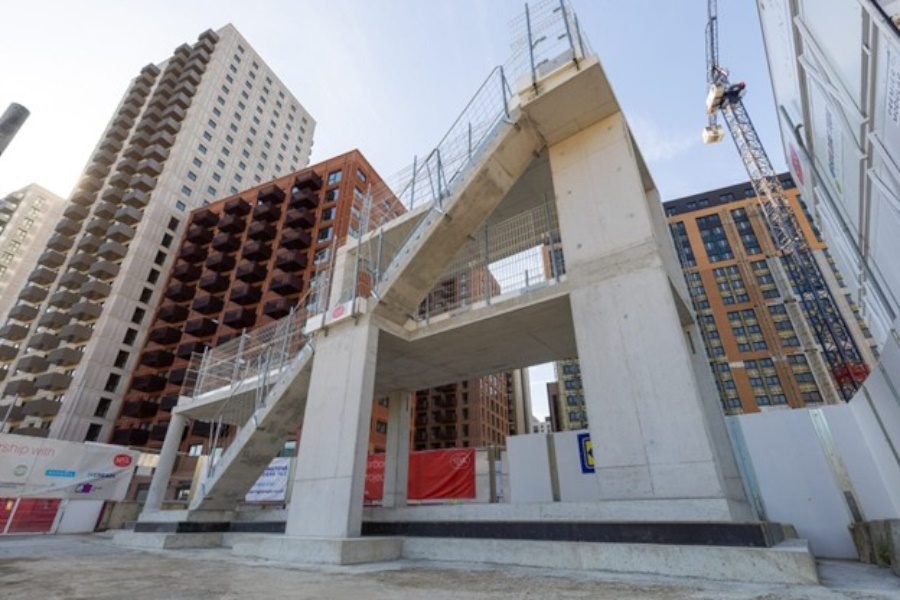
ACT was recently used in a building project at Wembley Park in London, reducing the carbon incorporated by 70% of the overall project. Ecocem has also moved forward with its first US project, a proposed terminal and milling operation at the Port of Los Angeles. It is still in the early stages of planning and review.
