

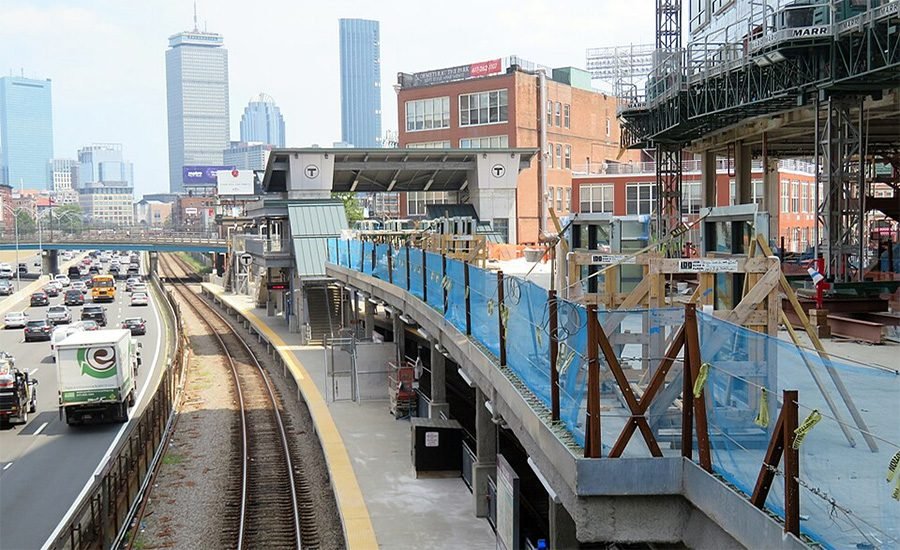
Boston finds itself with a near-completed two-acre deck built over the Massachusetts Turnpike with no vertical construction erected, an unusual and consequential stop for one of the city’s most complex air rights ventures.
The platform, designed to carry twin life sciences towers above I-90 and the MBTA-Massachusetts Bay Transportation Authority’s Framingham/Worcester Line at Lansdowne Station, is nearing completion even as developer IQHQ has put the project’s next phase on hold indefinitely.
The unusual circumstances put new scrutiny on the 99-year air rights lease that governs the site, including public realm improvements tied to the towers and the financial exposures created when a platform is finished long before revenue-generating buildings take shape.
IQHQ told MassLive on Dec. 4 that the company “remains committed to the project” but is reevaluating the phase “given current market conditions,” adding that timing will depend on “when the market improves.”
Fenway Center has undergone multiple iterations since ENR first reported on the project more than a decade ago. The current version, led by IQHQ and original developer Meredith Management, has become one of the largest and most technically complex constructions attempted along the Turnpike corridor in recent years.
RELATED
Fenway Center Eyes Boston Air-Rights
move forward
The air rights pad is the first major phase of the Fenway Center, a 960,000-square-foot development whose roof is supported by drilled micropiles and driven H-piles installed between active freeway lanes and commuter rail operations.
How air rights over I-90 work

Click on the image for an explanation of the engineering, sequencing and financial structure behind the construction of large developments on the Massachusetts Turnpike.
Image by Pi.1415926535 (CC BY-SA 4.0)
Crews have worked in tight windows overnight to install foundations and erect steel assemblies capable of supporting the tower’s full loads while maintaining uninterrupted rail service below.
The deck closes one of the last major gaps along the urban Turnpike corridor and establishes the structural foundation for two life sciences towers, new public streets and improved pedestrian links between Fenway and Kenmore Square.
With the deck moving toward completion in early 2026, the extended pause in vertical construction has created an unusual condition for an air rights megaproject: a fully designed platform with no active development above it.
The delay raises questions about maintenance responsibilities, long-term transportation costs and how long the structure can sit idle before review by the Massachusetts Department of Transportation or the Boston Planning and Development Agency. Air rights agreements typically include cure periods or modification provisions before any enforcement action, and neither MassDOT nor the planning agency has indicated that those mechanisms are in play.
Financial pressure
The financial strain on the project emerged publicly when JF White Contracting Corp. filed a lawsuit in Suffolk Superior Court on Nov. 12, alleging more than $27 million in unpaid balances on the $138 million roofing and foundation contract.
The complaint, which also names MassDOT because of its ownership of the Turnpike corridor, asserts lien rights over the air rights parcel and seeks to avoid certain administrative actions related to the lease.
In his filing, JF White wrote that late payments and change order disputes have created “significant financial pressure” as crews worked within tight access windows dictated by highway and commuter rail schedules.
IQHQ has not publicly responded to the allegations beyond reiterating to MassLive that the company is “evaluating its development schedule” in response to changing demand. ENR reached out to IQHQ for comment, but the San Diego-based developer did not respond.
The developer has also not announced any construction financing for the planned towers, and industry watchers note that lenders are increasingly requiring high pre-lease thresholds for speculative lab projects, especially those with expensive initial infrastructure phases such as air rights roofs.
The market decline is heavy
The pause comes as Boston’s life sciences sector experiences one of its sharpest contractions in more than a decade.
Regional lab vacancy reached 38% in Boston and 22% in Cambridge, according to Colliers’ Q2 2025 Greater Boston Life Sciences report, also climbing along the Route 128 corridor as millions of square feet of new space was delivered with minimal pre-leasing.
Real estate firm CBRE reported in its Q3 2025 MarketView that overall Greater Boston lab vacancy rose to nearly 29%, and asking rents softened to $80 per square foot, about 16% from the 2022 peak.
Template gauges have also been cooled. MassBio’s 2025 Industry Snapshot found that biopharmaceutical companies in Massachusetts announced more than 4,900 layoffs in 2024, with additional reductions reported in early 2025.
According to PitchBook/MassBio data, funding for early-stage companies was down 17% year-over-year, and MassBioEd has reported an increase in R&D job seekers amid hiring freezes.
Turbulence in federal research funding has added to the uncertainty. The National Institutes of Health’s fiscal year 2024 funding report shows that while Massachusetts institutions remained the nation’s top recipients at nearly $2.5 billion, the state also received more than $1.3 billion in canceled or rescinded awards during the fiscal cycle, prompting several hospitals and research centers to slow expansion plans.
Market analysts cited by CBRE and Colliers say sustained absorption may take several quarters. For air rights projects that require significant pre-leasing to unlock financing, the path to vertical construction can be longer than at conventional sites.
RELATED
Not one, but two air rights projects are rising over the Massachusetts tollway in Boston
Outlook
MassDOT’s air rights lease for the Fenway Center parcel includes milestones for tower development and delivery of public realm improvements. The agency has not responded to detailed questions from the media, including ENR, but has acknowledged in planning agency documents that coordination with the developer is ongoing.
Agency officials have publicly stated that the Boston Life Sciences Pipeline is undergoing a “major recalibration” and developers are expected to adjust the phase as conditions evolve. The agency has not indicated that the Fenway Center hiatus has triggered any formal review action.
With the deck nearing completion, a contractor lawsuit pending and Boston’s life sciences market still absorbing a deep correction, the Fenway Center is among the most closely watched air rights projects in the region.
Analysts say its next steps will depend on a recovery in tenant demand, improved capital availability and resolution of structural and contractual issues created when a major platform is built before towers seek to finance it.
