


From artificial intelligence to asphalt mixes, stakeholders around the world continue to look for ways to build, maintain and operate roads and highways that are safer, more resilient and more equitable.
For example, the European Union recently implemented environmental information requirements on construction products, which require reporting on life-cycle impacts such as global warming potential, recyclability and resource efficiency, noted Michael Gruber, a researcher at the Institute of Transport Sciences at TU Wien, a university in Vienna. Speaking to attendees at the International Road Federation conference in Long Beach, Calif., Dec. 8-11, he noted that his institution is working on software to create reports for asphalt mixtures.
Thierry Goger, Secretary General of the European National Highway Research Laboratories, also highlighted the European Union’s Circularity Circuit, a broad push for a closed-loop system economy of reuse, repair and recycling, with key initiatives such as circular construction in regenerative cities. His agency is working to use digitization to help determine new asphalt mixes, recycle cementitious materials for bridge slabs, and reuse existing bridge elements in new structures. Other goals include adaptive lighting for bridge traffic flows, 3D printing for bridge elements, and identifying “where circularity can be embedded” in a project’s lifecycle.
Eliot Wall, CEO of GAF, which provides asphalt coatings and sealants intended to create “cool pavements,” said the company has several projects in the U.S. where its epoxy-coated acrylic coating with a solar-reflective additive keeps pavement 10 to 12 degrees cooler than uncoated surfaces.
Other speakers described projects that use technology to optimize signals and traffic flows. The city of Arcadia, Calif., is testing a cloud platform that allows traffic engineers to proactively optimize traffic signals for buses, ambulances and other priority vehicles, especially during major events, said Ravindra Kondagunta, CEO of Connected Signals, the technology provider.
The pilot program has saved 26 percent of time to respond to incidents and up to 35 percent to get to a hospital, he said.
Masoud Hamedi, director of data science at Iteris, described its ClearGuide software that was used to manage traffic during an 11-mile, $650 million freeway reconstruction project in Arizona. On-demand camera images of road and traffic conditions, aided by AI, helped make decisions such as giving the contractor a larger work zone in one location and moving construction closures to better times, such as school breaks.
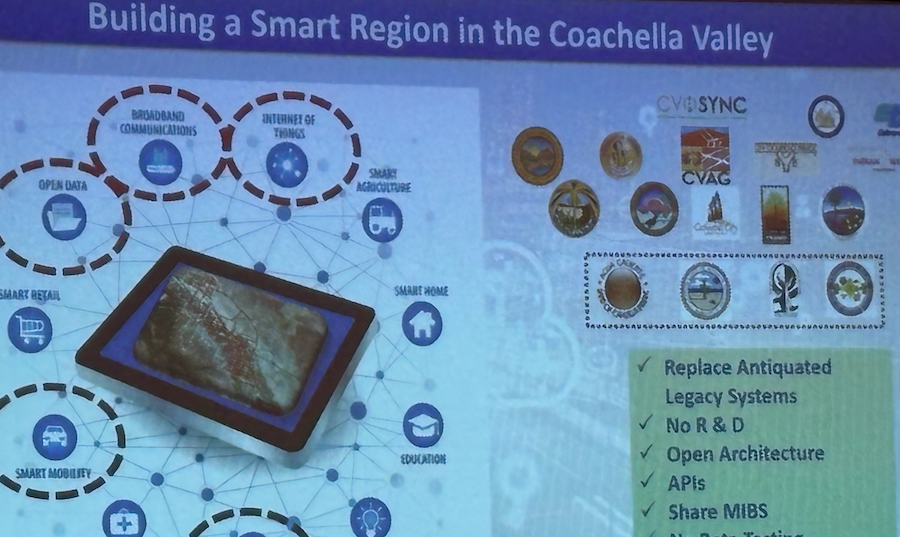
Carlos Ortiz, CEO of ADVANTEC Consulting Engineers, described a pilot program to create a connected and digitized road network in the Coachella Valley, working with 12 agencies and implementing 12,000 smart transportation elements in 12 corridors.
Elements include intelligent CCTV systems with analytics, mobile vehicle-to-everything (v2x) units, changeable message signs and secure fiber optic Ethernet communications.
